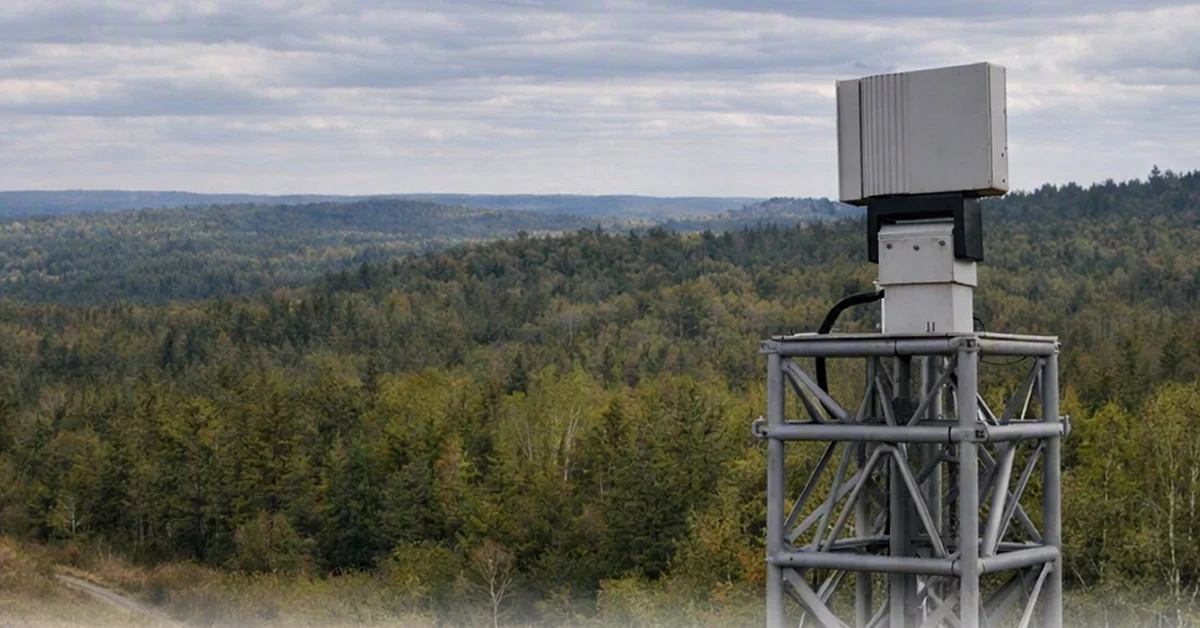
Teledyne FLIR Defense unveiled the Ranger R10-3DX, a compact mid-range counter-unmanned aircraft system (C-UAS) radar, at the Association of the United States Army (AUSA) Annual Meeting and Exposition in Washington on October 13, 2026. The company says the panel radar detects micro-UAS at ranges beyond 3 kilometers and will be available in the first quarter of 2027.
The launch comes as small drones remain one of the most persistent force protection problems for military installations, airports and critical infrastructure, and as defense customers look to field detection layers at scale rather than in a handful of high-cost configurations. Teledyne FLIR, a unit of Teledyne Technologies, is pitching the R10-3DX across counter-drone, force protection, airport security, border security and coastal surveillance missions.
Ranger R10-3DX Coverage, Detection Ranges and AI Classification
The R10-3DX uses digital beam-forming to provide continuous wide-area coverage within a low size, weight and power (SWaP) envelope. Teledyne FLIR rates its detection performance at more than 3 kilometers against micro-UAS, more than 6 kilometers against pedestrians and more than 12 kilometers against light vehicles. That spread matters operationally: a single sensor can feed both the air picture and the ground perimeter picture at a base or border site, reducing the number of radars an operator must site, power and maintain.
Coverage is modular. One panel covers 90 degrees in azimuth and up to 60 degrees in elevation, and four panels combine for full 360-degree surveillance. The elevation figure matters most for counter-drone work: steep vertical coverage shrinks the cone above the sensor where a quadcopter or loitering munition can approach undetected.
AI-based classification algorithms sort tracks into drones, aircraft, birds, pedestrians and vehicles. Bird rejection is the chronic false-alarm problem for micro-UAS radars. The radar tracks multiple targets simultaneously, which Teledyne FLIR presents as relevant to swarm-type incursions. The company has not published a maximum track count, operating frequency band, refresh rate, panel weight or power draw, and those figures will determine how the system performs against competitors.
How the R10-3DX Fits Teledyne FLIR’s Layered C-UAS Portfolio
The R10-3DX is qualified to MIL-STD-810H for environmental durability and MIL-STD-461G for electromagnetic compatibility, and it can be installed at fixed sites or on mobile platforms. Teledyne FLIR says it integrates with electro-optical/infrared (EO/IR) sensors and mitigation systems, the standard slew-to-cue architecture in which the radar detects a target and hands the track to a camera for visual identification before an effector is assigned.
It joins a Ranger line that includes the man-portable R8-3DX panel radar, which the company markets as able to track more than 500 drone targets simultaneously while filtering birds, and the R20SS, an X-band ground and coastal surveillance radar rated to 20 kilometers against personnel and vehicles. Teledyne FLIR also offers the Cerberus XL C-UAS, a mobile multi-sensor detect-to-defeat platform unveiled at AUSA 2024. The company has not said how the R10-3DX relates to the R8-3DX or whether it will be offered inside Cerberus XL.
“Small unmanned aircraft continue to present growing security challenges across military installations, airports, and other key infrastructure sites worldwide,” said Rob Tarantino, senior vice president of surveillance at Teledyne FLIR Defense, who described the radar as “affordable, compact, and highly capable.”
Analysis: The R10-3DX is a cueing sensor, not an air defense radar, and should be judged that way. A 3-kilometer micro-UAS detection range gives an EO/IR turret or short-range effector a usable warning window against Group 1 quadcopters, but limited time against faster one-way attack drones. Its value lies in coverage geometry and cost, which matter most to commanders protecting dozens of sites rather than one high-value asset. If pricing matches the affordability pitch, the radar targets the volume tier of the C-UAS market, where the US Army and allied forces are trying to extend baseline detection across installations instead of concentrating it at a few critical nodes.
Teledyne FLIR expects the R10-3DX to be available in the first quarter of 2027. Unit price and certified command-and-control integrations remain undisclosed. No launch customer has been announced. The next indicators to watch are integration agreements with C2 and effector vendors and any US Army or allied evaluation ahead of first deliveries.