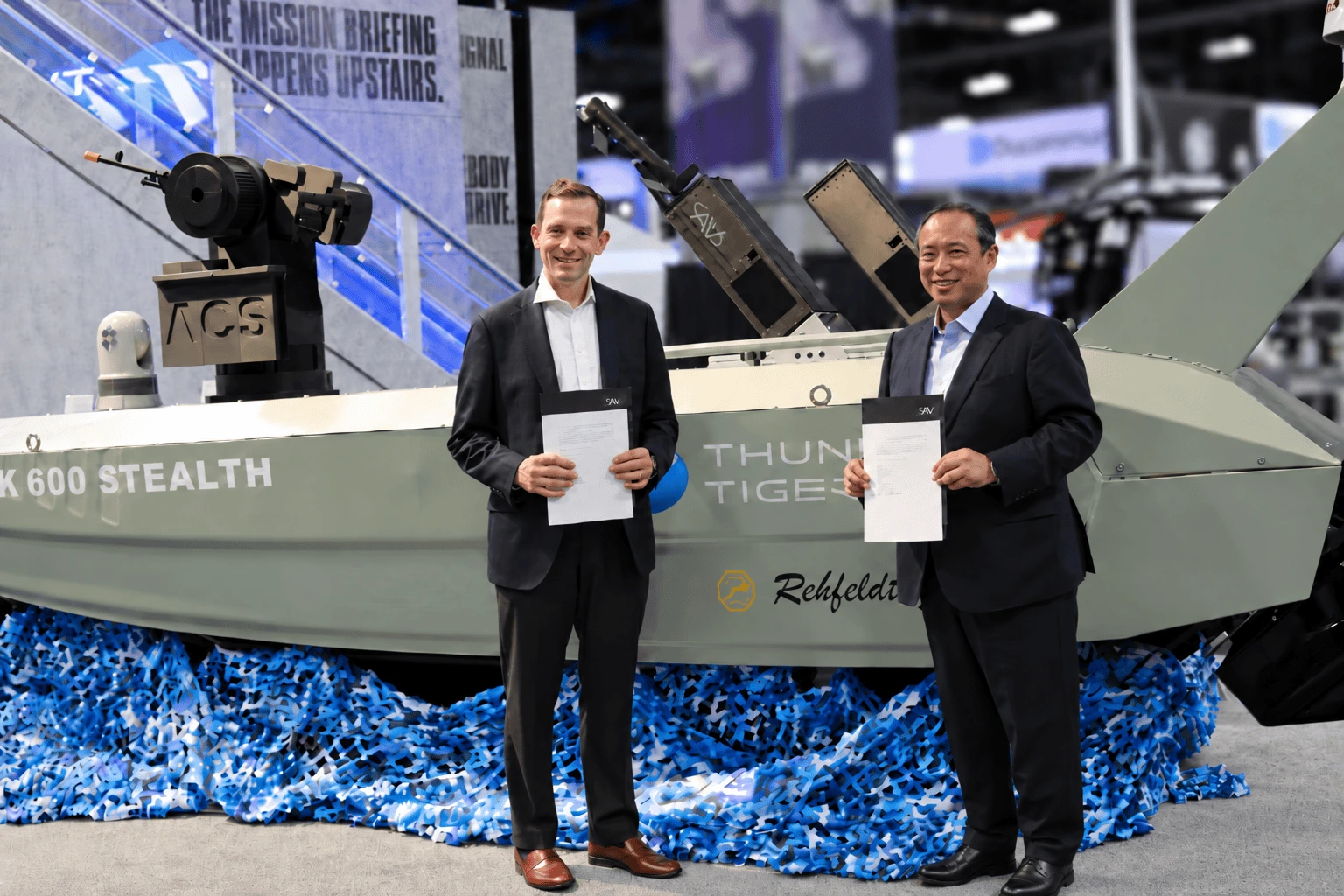
AeroVironment (AV) and Taiwan’s Thunder Tiger Corp. have signed a memorandum of understanding (MOU) to explore integrating Switchblade loitering munitions on Thunder Tiger’s unmanned surface and ground platforms and to assess co-production of unmanned aircraft systems (UAS) in Taiwan, the Arlington, Virginia-based company announced on October 14, 2026. The two firms signed the agreement at the Association of the United States Army (AUSA) Annual Meeting & Exposition in Washington, D.C.
The deal lands as Taipei shifts from demonstrations to volume buys of unmanned systems. Taiwan’s Ministry of National Defense (MND) has planned roughly NT$30 billion (about $1 billion) to acquire 1,350 attack and reconnaissance unmanned surface vessels (USVs) through 2027, while an Executive Yuan special-budget proposal would authorize about $6.5 billion from 2026 to 2031 for reconnaissance drones, attack UAVs and one-way attack USVs aimed at amphibious and logistics shipping. Switchblade is already on Taiwan’s order book: in June 2024 the State Department approved a $60.2 million Foreign Military Sale covering 720 Switchblade 300 all-up rounds (AURs) and 101 fire control systems.
Switchblade on SeaShark: Scope of the AeroVironment Thunder Tiger Agreement
The MOU is a framework, not a contract. It sets out three lines of effort: integration of select Switchblade Family of Systems configurations onto Thunder Tiger’s unmanned surface and ground platforms, potential localization and co-production of UAS in Taiwan, and future capability co-development. The most concrete task is a technical feasibility study of a launcher carrying multiple Switchblade AURs aboard a Thunder Tiger USV, intended to advance interoperability and support future demonstrations. Neither company has disclosed which Switchblade variant the launcher would carry, the number of tubes, a demonstration date or any financial terms.
“Modern defense demands the ability to rapidly integrate proven capabilities and produce them at scale,” said Church Hutton, AV’s senior vice president and chief growth officer.
The candidate munitions differ sharply in weight and effect. According to AV specifications, the Switchblade 300 Block 20 weighs 1.68 kg as a munition and 3.27 kg as an AUR including its launch tube, offers more than 20 minutes of endurance and a 30 km range with an extended-range antenna, and accepts fragmentation or explosively formed penetrator warheads. The Switchblade 600 munition weighs 15 kg, or 29.5 kg as an AUR, carries an anti-armor warhead, loiters at 113 km/h and sprints at 185 km/h. It offers more than 40 minutes of endurance and a demonstrated standoff of at least 40 km, extendable past 90 km through a datalink forward pass between operators. Both rounds share a tablet-based fire control unit.
On the platform side, Thunder Tiger’s SeaShark 600 is a six-meter aluminum-hull USV that the company rates for a 300 to 600 kg payload, switchable between reconnaissance and one-way attack roles. The eight-meter SeaShark 800 is an attack USV with a stealth-coated aluminum hull and a top speed the company gives as 92.6 km/h, or 50 knots. On paper, four Switchblade 600 AURs would weigh about 118 kg before launcher structure, well inside the SeaShark 600’s rated envelope. Thunder Tiger’s Tiger Road unmanned ground vehicle, rated for a 400 kg load, is the natural candidate for the ground side of the agreement, although the companies did not name it.
From Hull Stamping to Co-Production: Taiwan’s Drone Industrial Base
The co-production track matters as much as the launcher. Thunder Tiger, founded in Taichung in 1979 as a radio-controlled model maker, has pivoted toward military unmanned systems. It stamps SeaShark hulls from aluminum sheet at its Luzhu facility in Taoyuan, reported a pace of about one USV per week earlier this year, and is building a production, assembly and test center at Chiayi’s Dapumei Industrial Park for both drones and boats. The company has also said it would bid on Armaments Bureau tenders covering nearly 50,000 small drones.
Thunder Tiger has assembled a portfolio of US partners. Shield AI signed an MOU with the company on May 13, 2026, to run its Hivemind autonomy software on the SeaShark line, and the two firms later demonstrated SeaShark 600 and 800 hulls executing a coordinated search and escort mission off Pingtung. Auterion supplies AI navigation and targeting for Thunder Tiger aerial and ground systems. Adding AV would pair US-built autonomy with a US-built strike payload on a Taiwanese hull.
For AV, localization in Taiwan addresses a structural constraint: wartime resupply across the Taiwan Strait. The MND expects unmanned systems to suffer high attrition in a conflict, and a blockade would complicate any munitions delivery from the continental United States. Local final assembly or co-production would shorten that chain. Any transfer of Switchblade production data would still require US export licensing, which the announcement does not address. AV has already absorbed the political cost of Taiwan sales: China’s Ministry of Commerce placed the company on its export control list on March 4, 2025.
Analysis: The agreement could turn the SeaShark from a single-use weapon into a recoverable launch platform. A one-way attack USV trades its hull for one hit on one target. A USV carrying Switchblade 600 rounds could hold offshore, launch munitions that themselves loiter for 40 minutes, and withdraw. That adds tens of kilometers to Taiwan’s engagement envelope against an amphibious force and restores positive identification before commit, which an explosive boat lacks. It also shows how US firms are entering Taiwan’s unmanned market: by plugging payloads into locally built hulls rather than selling finished platforms.
The next markers are a feasibility finding, a launcher design and a first live demonstration, none of which have been dated. The MND’s USV awards under the 2026 to 2027 program and the progress of the special-budget proposal will determine whether a Switchblade-armed SeaShark configuration has a funded customer. Export licensing for any co-production remains the principal unknown.