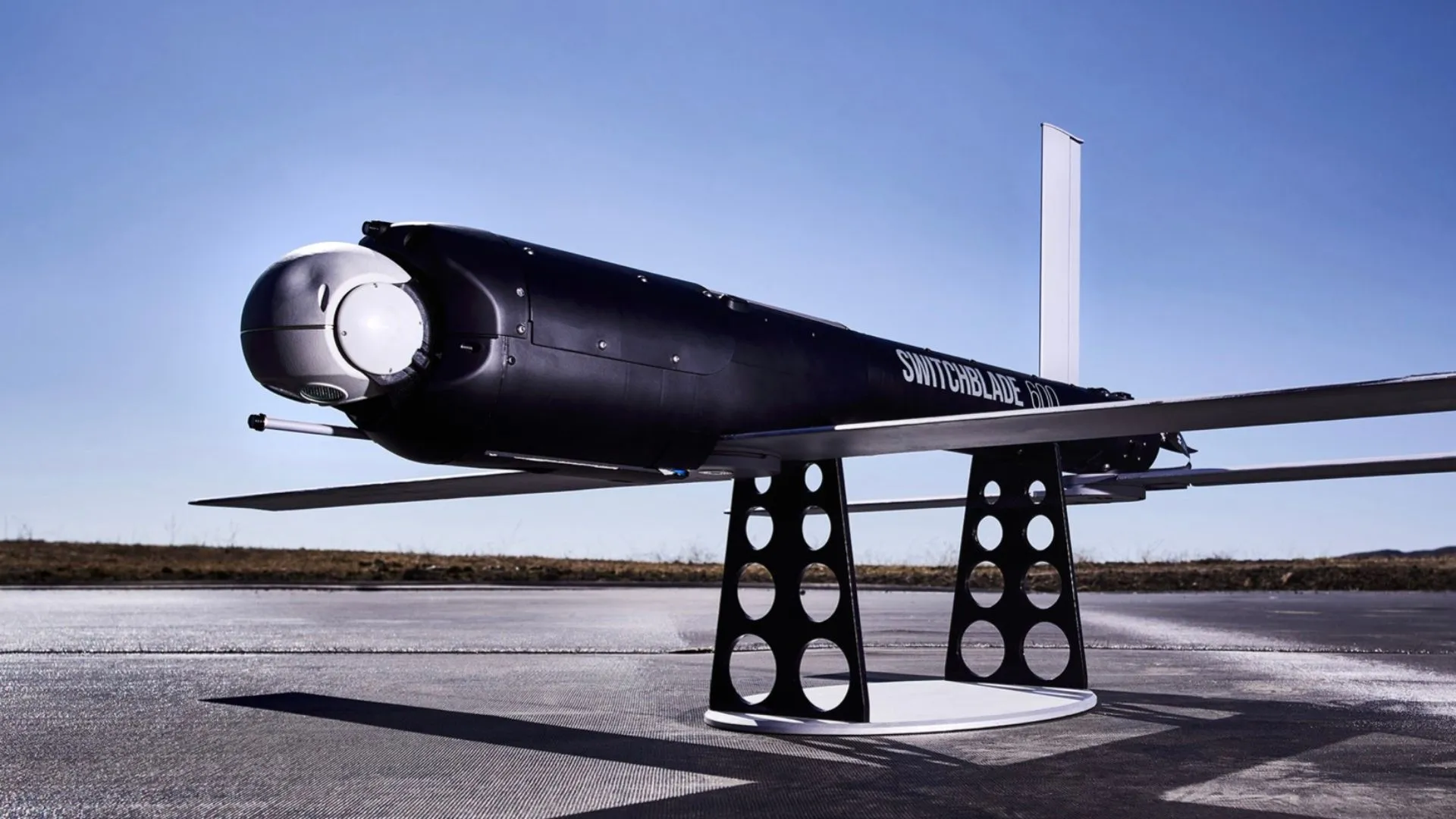
AeroVironment (AV) can now pursue Direct Commercial Sales (DCS) of its one-way attack systems to Australian customers, the company said on October 14, 2026. The route adds to the non-binding memorandum of understanding (MOU) AV signed with Australian munitions group NIOA at the LAND FORCES 2026 exhibition in Perth, held October 6 to 8, to explore local production, integration and sustainment of those systems in Australia.
The deal tracks the Australian Army’s reorientation toward littoral maneuver and long-range strike under the National Defence Strategy. In August 2026, Head Land Capability Major General Kurt Brown told industry that Army is normalizing autonomous systems and moving to employ them at greater scale across the littoral and maritime domains. Canberra’s only announced AV loitering munition purchase remains the Switchblade 300, revealed on July 8, 2024. In an essay published October 14, Sean Colvin, AV’s director of business development for Asia Pacific, argued that Australian sovereignty should be judged by control over how fast a capability is fielded, adapted, sustained and scaled, a standard he calls operational sovereignty.
What Could Move Onshore: Warheads, Sustainment and NIOA’s Energetics Base
Under the MOU, AV and NIOA will assess pairing AV’s autonomous strike systems with NIOA’s weapons and munitions expertise. Cooperation areas include local manufacturing and integration, in-country support and sustainment, and Australian variants carrying NIOA-developed payloads, warheads and mission effects where technically, commercially and legally feasible. NIOA could also become the Australian distributor and authorized support partner, covering customer engagement, training, logistics, maintenance coordination and inventory management.
The parties share a non-binding ambition to make Australia a regional center of excellence for advanced launched effects and loitering munitions serving Australian and allied customers. Every element is conditional on U.S. and Australian government approvals and on separate definitive agreements. No contract value, production volume, timeline or specific variant has been disclosed.
NIOA brings existing energetics capacity. The privately owned Queensland group, founded in 1973, is a major tenant at the government-owned munitions facility at Benalla, Victoria, and a joint venture partner with Rheinmetall in the artillery shell forging plant at Maryborough, Queensland. Payload and warhead integration, where NIOA’s industrial base is strongest, would localize the components that matter most for wartime resupply.
Switchblade Range and Australia’s Littoral Manoeuvre Group
AV’s one-way attack line centers on the tube-launched Switchblade family. The man-portable Switchblade 300 Block 20 weighs about 3.3 kg as an all-up round, reaches up to 30 km with its extended-range antenna and sprints at 161 km/h, according to AV. Canberra did not say which configuration it ordered in 2024, but Defence footage released at the time showed the munition striking a towed maritime target.
The baseline Switchblade 600, which AV still markets alongside a newer Block 2 version, is the anti-armor tier. Manufacturer data lists a 15 kg air vehicle in a 29.5 kg all-up round, endurance above 40 minutes, a 113 km/h loiter speed and a 185 km/h sprint speed. Baseline range exceeds 40 km and stretches past 90 km when control is passed to a forward operator. The munition carries a stabilized electro-optical/infrared (EO/IR) sensor, encrypted datalinks and an anti-armor warhead, and deploys from its launch tube in under 10 minutes. Australia has not announced a Switchblade 600 purchase.
For a littoral force, that range step matters. A 30 km munition serves the platoon fight. A 40 to 90 km anti-armor effector begins to cover the coastal approaches and inter-island gaps where units of the Littoral Manoeuvre Group, formally established in Brisbane on March 30, 2026, are expected to operate.
Direct Commercial Sales, Allied Platforms and the Competing MBDA Deal
Australia’s 2024 Switchblade order reportedly moved through Foreign Military Sales (FMS), the government-to-government channel run by the Defense Security Cooperation Agency. DCS lets AV contract directly with Australian buyers under a U.S. export license, which can shorten timelines and give the customer more control over configuration and support. AV has not disclosed when the authorization was granted or which systems it covers. Colvin summed up the logic: “A sovereign requirement without a responsive acquisition pathway is still a dependency.”
AV is also promoting the reverse flow. In September 2025, it integrated the Hyperspectral Optical Radar (HSOR) from Australian firm ARKEUS, since branded Warden, onto its JUMP 20, a Group 3 vertical takeoff and landing drone with more than 13 hours of endurance, a 30-pound (13.6 kg) payload bay and beyond-line-of-sight range above 500 nautical miles. AV says the HSOR-equipped JUMP 20 offers more than eight times the range of traditional EO/IR sensors in degraded visual environments. Colvin presents the pairing as evidence that Australian sensors can ride proven allied airframes instead of requiring new ones.
AV is not NIOA’s only partner. At the same exhibition, NIOA signed a separate MOU with MBDA to explore Australian production of the Deluge one-way attack munition, which NIOA says enters production in France in 2027.
Operational Sovereignty and the Limits of Onshore Production
With parallel MOUs covering a U.S. and a European system, NIOA is positioning itself as Australia’s integration hub for one-way attack munitions rather than a single-vendor licensee. That gives Canberra leverage, but it also marks the limit of operational sovereignty: warheads, assembly and sustainment can move onshore, while flight software, guidance and datalinks stay under U.S. export control. The AUKUS export-control exemption in force since September 2024 eases many transfers among the three partners, yet it confers no design authority. The real test is whether Australian variants can be modified without returning to Washington for every change.
Next milestones are definitive AV and NIOA agreements, U.S. approvals for any technology transfer and a funded Defence requirement to anchor production volumes. Defence has not announced a follow-on loitering munition buy linked to the MOU. Until a contract fixes quantities, variants and in-country work share, the framework remains an option on future capability, not a production commitment.