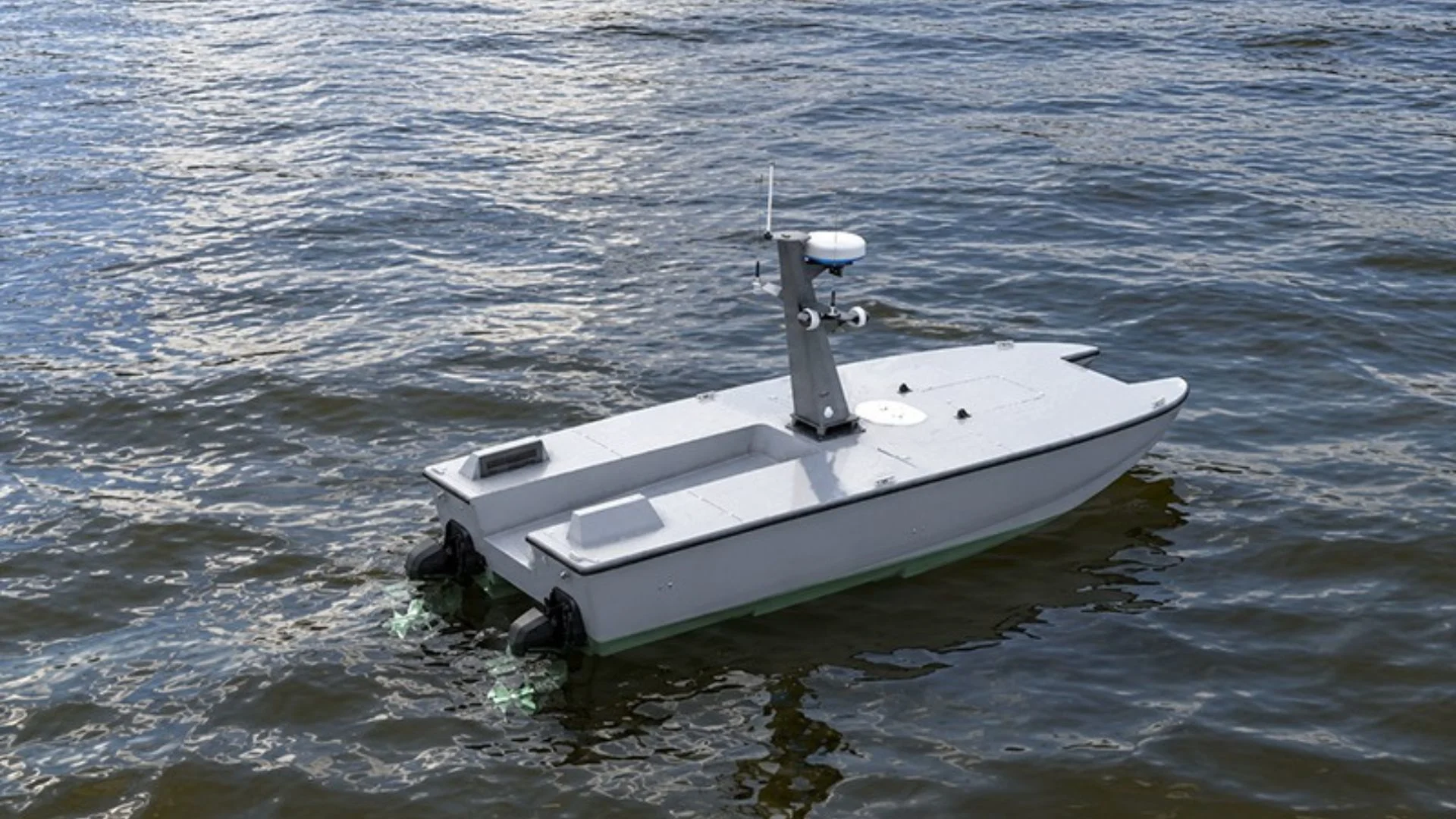
Taiwan’s Coast Guard Administration (CGA) has signed an agreement to acquire Devil Ray T24 unmanned surface vessels (USVs) from Maritime Tactical Systems, Inc. (MARTAC), the Melbourne, Florida-based manufacturer announced on October 13, 2026. Vessel numbers and contract value were not disclosed. Under a co-production arrangement, part of the fleet will be built at a MARTAC partner facility in Edgewater, Florida, while Taiwanese firm Confucian Co., Ltd. will manufacture the remainder in Taiwan.
The purchase turns a framework into a procurement. MARTAC, Taiwan’s state-owned National Chung-Shan Institute of Science and Technology (NCSIST) and Confucian signed a tripartite memorandum of understanding (MOU) on September 18, 2025, at the Taipei Aerospace and Defense Technology Exhibition (TADTE), covering research, co-manufacturing and technology sharing. According to Confucian Chief Executive Officer James Lee, the T24 buy is the CGA’s first USV program. It arrives as the agency absorbs sustained pressure from China Coast Guard patrols around Taiwan’s outlying islands and recurring People’s Liberation Army (PLA) drills around the main island.
Devil Ray T24 Specifications: Speed, Payload and Mothership Role
The Devil Ray T24 is a 27.5-foot (8.4-meter) autonomous vessel built on a patented catamaran hull with a 10-foot (3.0-meter) beam and a craft weight of 7,500 pounds (3,400 kilograms), according to manufacturer data. An inboard diesel powertrain, with a gasoline option, delivers burst speeds above 50 knots. MARTAC rates open-ocean cruising range at up to 600 nautical miles and maximum payload at 1,800 pounds (816 kilograms).
Those figures fit the CGA’s operating area. The Taiwan Strait is roughly 70 to 100 nautical miles wide, so a 600-nautical-mile range supports extended patrols between the main island and the Penghu, Kinmen and Matsu island groups without a return to port. The 50-knot sprint lets operators close on a suspect contact to identify and record it before committing a crewed cutter.
The defining feature is the T24’s marsupial mothership role. The vessel can host and launch MARTAC’s smaller MANTAS T12 USV as well as third-party unmanned aerial vehicles (UAVs) and unmanned underwater vehicles (UUVs), turning one hull into a forward node for over-the-horizon sensing. Control spans fully autonomous, semi-autonomous and manual modes under MARTAC’s MantaFleet autonomy, with collision avoidance compliant with international collision regulations (COLREGS). Datalinks include line-of-sight radio, satellite communications, mesh networking and low probability of intercept and detection (LPI/LPD) radios, a relevant feature in waters where jamming is a planning assumption. Listed missions include intelligence, surveillance and reconnaissance (ISR), coastal patrol, electronic warfare and logistics.
The CGA has already shown how it intends to employ the platform. On October 7, 2026, at its Taipei Harbor base, the agency demonstrated a T24 operating alongside a Shield AI V-BAT vertical takeoff UAV for senior officials including National Security Council Secretary-General Joseph Wu, ahead of the October 10 National Day parade.
How the Co-Production Deal Builds Taiwan’s Unmanned Maritime Base
Industrial terms weighed heavily in the selection. “[O]ne of the most important reasons the Taiwan government selected MARTAC was the company’s willingness, from the very beginning, to establish co-production in Taiwan,” Lee said. MARTAC described the sale as one of the largest international purchases of US-manufactured USVs to date.
The production split between Florida and Taiwan has not been published. A senior Taiwanese official cited in regional press reports in July 2026 described a CGA plan to procure 25 USVs and two UUVs through NCSIST working with MARTAC, with at least one prototype entering testing in the first half of 2027, while cautioning that the plan was at an early stage. MARTAC has not confirmed those figures, and it remains unclear whether the T24 agreement covers all or part of that requirement.
US-side capacity is also growing. In September 2026, MARTAC announced a partnership with SŌLACE Boats intended to add production capacity of 100 Devil Ray vessels per year in Florida. At a CGA rehearsal for the October 10 National Day parade, a MARTAC M18 unmanned surface vessel appeared alongside an AeroVironment Jump 20 drone; local press reported the M18 will enter service once training concludes.
Analysis: The production model matters more than the hull count. A coast guard facing a gray-zone competitor every day needs persistent maritime domain awareness more than additional crewed hulls, and USVs that launch their own aerial and subsurface sensors stretch a limited cutter fleet across a wider patrol area. Local assembly by Confucian also gives Taiwan repair and sustainment capacity that does not depend on transpacific shipping, a direct hedge against a quarantine or blockade in which resupply from Florida could not be assumed. For MARTAC, the deal turns the 2025 framework into a Taiwan-based production line that later project-specific agreements under the same MOU could draw on.
Key details remain undisclosed: vessel count, contract value, delivery schedule and payload configuration. The next markers are the first Taiwan-assembled hull, initial CGA testing in 2027 and any follow-on order under the same tripartite framework.