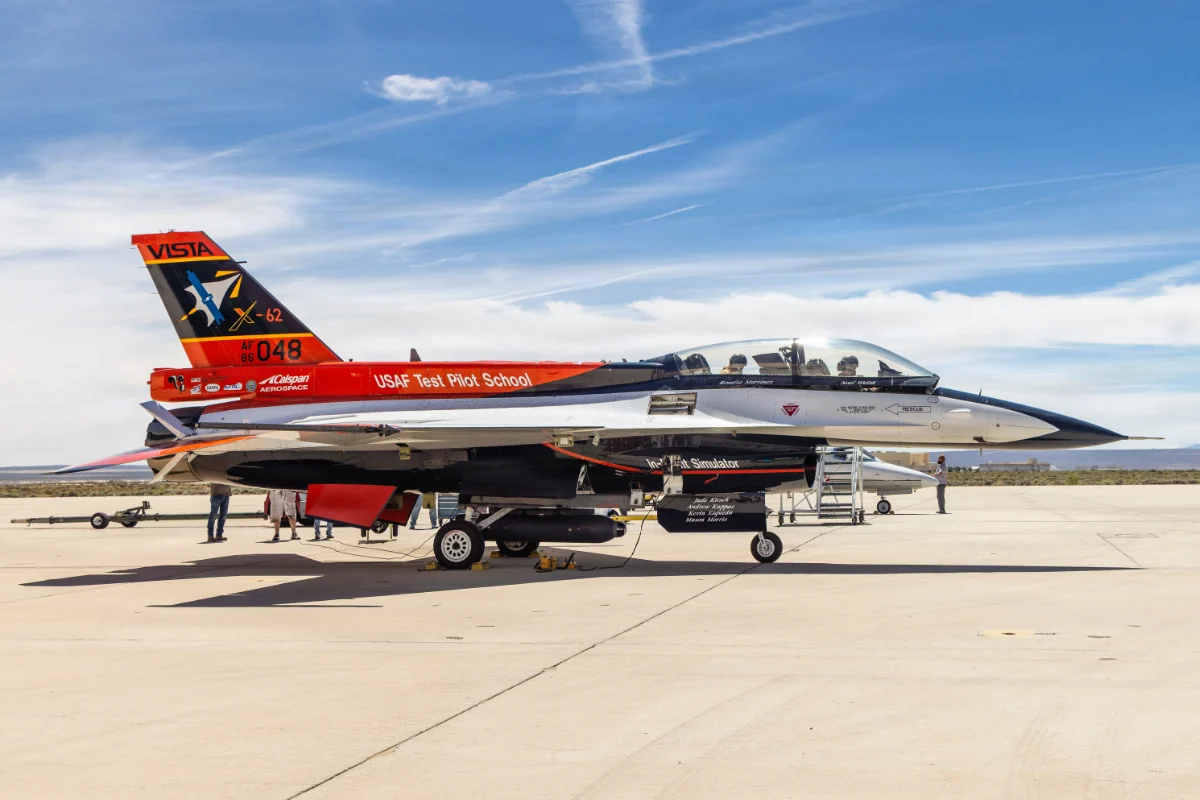
The U.S. Air Force Test Pilot School set out to define three new flight-test concepts for its X-62 VISTA (Variable In-flight Simulator Test Aircraft) and instead received a final proposal of more than 30, after the aircraft’s inaugural research symposium drew more than 80 participants from industry, academia and the joint force to Edwards Air Force Base, California, in August 2026. The concepts target fiscal years 2027 and 2028, according to the Air Force, which detailed the outcome on October 13, 2026.
The symposium, co-hosted with the Test Resource Management Center (TRMC), comes during a Mission Systems Upgrade (MSU) designed to turn the aircraft from a flight-controls research platform into a modular combat-autonomy testbed. Built on a modified F-16D Block 30 airframe with Block 40 avionics and redesignated X-62A in 2021, VISTA became the centerpiece of the Defense Advanced Research Projects Agency (DARPA) Air Combat Evolution (ACE) program, which flew AI agents in within-visual-range engagements against a crewed F-16 in 2023. The service now describes it as America’s first AI X-plane.
Inside the X-62 VISTA Symposium: 30-Plus Test Concepts for FY2027-28
Briefings came from DARPA, the Air Force Research Laboratory (AFRL), MIT Lincoln Laboratory and the Air Force Institute of Technology, among others. Aircrew from an Air Combat Command fighter squadron also shared recent operational experience on building pilot trust in machine-learning systems.
“The X-62 Summit was the first time we convened stakeholders across the spectrum of capability development of autonomy tools for combat aviation,” said Col. Maryann Karlen, commandant of the Air Force Test Pilot School. “This demonstrates, without a doubt, the demand for testbeds like the X-62.”
The proposals will feed a shared research roadmap for the post-upgrade aircraft, according to the Air Force, with Test Pilot School students remaining the jet’s primary innovators. The service has not disclosed which concepts were retained, how many it can fund, or how sorties will be allocated between government and industry users.
The demand follows a dense spring test cycle. During HAVE HEAT in April 2026, a Lockheed Martin Skunk Works AI agent ingested live data from a Legion Pod infrared search-and-track (IRST) sensor and flew the X-62 into tactical intercept positions against a T-38 target, completing 27 AI-controlled intercepts across eight flights. The parallel HAVE HOLIDAYS series loaded third-party software into the aircraft’s Enterprise Open Mission Systems Architecture computer. HAVE BALLDROP integrated an autonomous agent derived from AFRL’s xFACTOR program, HAVE THANKS flew BirdBox, an open-architecture assisted target recognition framework, and HAVE DREIDEL evaluated runtime assurance software developed with 3Laws Robotics to keep autonomous behavior inside operator-defined limits.
Mission Systems Upgrade Adds Radar, Compute and Edge AI Hardware
The MSU, funded by TRMC through the Air Force Test Center, adds an advanced radar, additional computing power and capacity for more sensors. Lockheed Martin Skunk Works, Calspan Corporation, AFRL and RTX are working on the upgrade. RTX’s Raytheon received a contract in December 2025 to fit the aircraft with its PhantomStrike radar, a compact, air-cooled gallium nitride (GaN) fire-control radar that the company says is smaller, lighter and less power-hungry than modern active electronically scanned array (AESA) sets.
An onboard fire-control radar would let AI agents work with radar tracks alongside IRST data rather than a single passive sensor, the configuration flown in HAVE HEAT. Integration is already fast: both spring campaigns completed integration and ground testing within about three months, according to the Air Force.
HAVE SANTA addressed the processing side. IBM’s NorthPole neuromorphic chip was installed in VISTA’s computers to assess its performance under flight conditions, and the low-power processor accelerated Skunk Works’ Supermassive simulation to run parallel trajectory simulations in flight. Onboard trajectory prediction is directly relevant to autonomous aircraft expected to operate where datalinks are degraded. Once the upgrade concludes, the X-62 is intended to complement VENOM, the Air Force’s Eglin-based F-16 autonomy testbed effort, and to test emerging applications for priority defense programs.
Analysis: A more than tenfold gap between planned slots and proposals is less a measure of enthusiasm than a symptom of scarcity. The Air Force autonomy enterprise, including Collaborative Combat Aircraft (CCA) mission software, is producing AI agents faster than it can fly them on instrumented, crewed airframes where a safety pilot can take back control. That makes test capacity, not algorithms, the near-term constraint. Turning 30-plus concepts into fielded capability will require either more VISTA-class sorties or disciplined triage that ties X-62 time to program-of-record requirements.
Next milestones include completion of the MSU, first flights with the new radar, and publication of the shared roadmap that will determine which proposals fly in fiscal 2027 and 2028. The Air Force has not released a completion date or cost figure for the upgrade, nor a schedule for a second symposium.