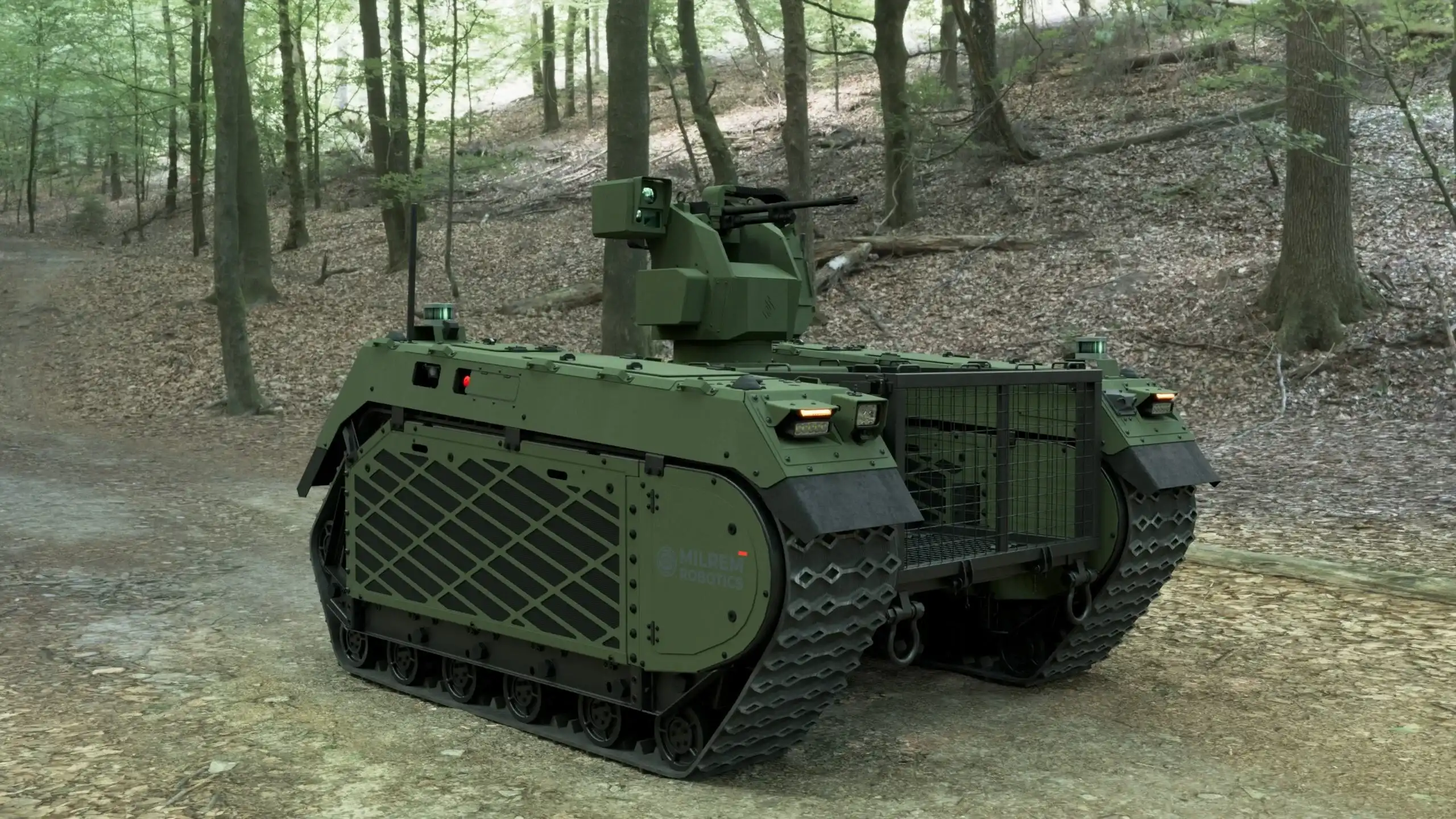
Milrem Robotics and Chugach Alaska Corporation have signed a Memorandum of Cooperation to explore producing and sustaining the Estonian company’s unmanned ground vehicles (UGVs) in the United States. Signed at the Association of the United States Army (AUSA) 2026 Annual Meeting in Washington and announced on October 14, 2026, the agreement could make Chugach Milrem’s preferred U.S. partner for production, integration and lifecycle support, serving U.S. customers and Foreign Military Sales (FMS) cases.
The Army’s ground robotics market is in flux. The service terminated its Robotic Combat Vehicle (RCV) program in 2025, with Army Secretary Daniel Driscoll later telling senators that requirements growth had made it too expensive. The main remaining volume opportunity, the Small Multipurpose Equipment Transport (S-MET) Increment II, is a two-way prototype competition between American Rheinmetall Vehicles and HDT Expeditionary Systems, with a production award planned for late fiscal year 2027 covering up to 2,195 vehicles. Milrem, which lost the original SMET competition in 2017, has reached the Army mainly through experimentation and a cold-weather research purchase in March 2025.
What the Milrem Robotics Chugach Agreement Covers
The memorandum covers Milrem’s current and future portfolio of UGVs and autonomous systems, aimed at potential requirements from the Department of Defense, other federal agencies and the U.S. commercial dual-use market. Beyond final assembly, the companies expect the work to include configuring Milrem platforms to U.S. specifications, operator and maintainer training, and long-term sustainment, the elements U.S. program offices weigh in supportability reviews.
The second objective is export. The partners intend to jointly pursue FMS cases in which U.S.-built Milrem systems would reach allied and partner nations through established U.S. acquisition channels. Stefan Behre, Milrem’s chief sales officer, described the aim as building the means to “produce, integrate and sustain” the systems inside the United States rather than simply selling into it.
Anchorage-based Chugach is one of the regional Alaska Native Corporations created under the Alaska Native Claims Settlement Act of 1971. It reports roughly 5,000 employees at 110 locations across 28 states and 10 countries, and more than 3,000 shareholders. Chief Executive Officer Jonathan Dalrymple cited the group’s defense work in shipbuilding, aviation, facilities, logistics, information warfare and technical services, and said Milrem systems are in operational use or part of robotics programs in 21 countries. Chugach also markets access to Small Business Administration 8(a) pathways, which let Alaska Native Corporation subsidiaries receive sole-source federal awards under rules more permissive than those applied to most other 8(a) participants.
Neither company disclosed a financial value, production site, planned volumes or schedule. The memorandum commits the partners to define a relationship, not to open a production line.
THeMIS Specifications and the U.S. Army UGV Market After RCV
THeMIS (Tracked Hybrid Modular Infantry System) is the logical first candidate for any U.S. line, backed by combat employment in Ukraine since 2022. Publicly available specifications indicate a curb weight of about 1,650 kg, a rated payload of 750 kg, a maximum payload of 1,200 kg, a top speed of 20 km/h and up to 15 hours of diesel-electric hybrid run time, or up to 1.5 hours on batteries alone. Line-of-sight control extends to 1.5 km with AES256 encryption, and the Milrem Intelligent Function Integration Kit (MIFIK) adds autonomous navigation.
Those figures straddle the S-MET Increment II requirement of 2,000 lb (907 kg): THeMIS falls short on rated payload but exceeds it at maximum load, a distinction that matters for sustained resupply, where rated figures govern loading. Industrial capacity is less of a constraint. Milrem expects to deliver more than 150 THeMIS to Ukraine by the end of 2026, with VDL Defentec setting up a final assembly line in Born, the Netherlands, while the Tallinn plant Milrem expanded in 2024 can build more than 500 a year, according to the company.
Higher up the portfolio sits HAVOC, an 8×8 hybrid-electric robotic combat vehicle unveiled at IDEX 2025. Milrem lists a weight of about 15 tonnes without payload, a 5-tonne mission payload, 110 km/h on roads and 50 km/h off-road, weapons up to 30 mm, and STANAG 4569 Level 3 ballistic and artillery protection. At launch, the company said the hull could take a main gun of up to 57 mm. With RCV terminated, HAVOC’s U.S. prospects depend on whether the Army reopens a combat-class robotics competition.
Analysis: The agreement is less a production decision than a market-access instrument. Selling from Tallinn to the Pentagon and FMS customers faces three barriers: U.S. domestic-content preferences, security cooperation rules that generally require Foreign Military Financing (FMF) grants to be spent on U.S.-origin defense articles, and scrutiny of a supplier majority-owned since February 2023 by the UAE’s state-owned EDGE Group. A U.S. production node run by an Alaska Native Corporation, which cannot be bought or sold, addresses the first two and brings a contracting vehicle federal buyers know. It extends a partnering pattern already visible with VDL Defentec in the Netherlands, Poland’s PGZ and, since October 7, 2026, Hanwha Aerospace, which may build THeMIS in Australia and New Zealand. THeMIS is becoming a multi-site product, and FMF-funded allied buyers stand to gain most.
The next markers are a definitive agreement naming a site, volumes and work share, and a first order or FMS case for a U.S.-assembled THeMIS. The late fiscal 2027 S-MET Increment II award will set the logistics UGV baseline a U.S.-built THeMIS must beat. Still unknown is how much engineering, software and data rights EDGE and Milrem will transfer.