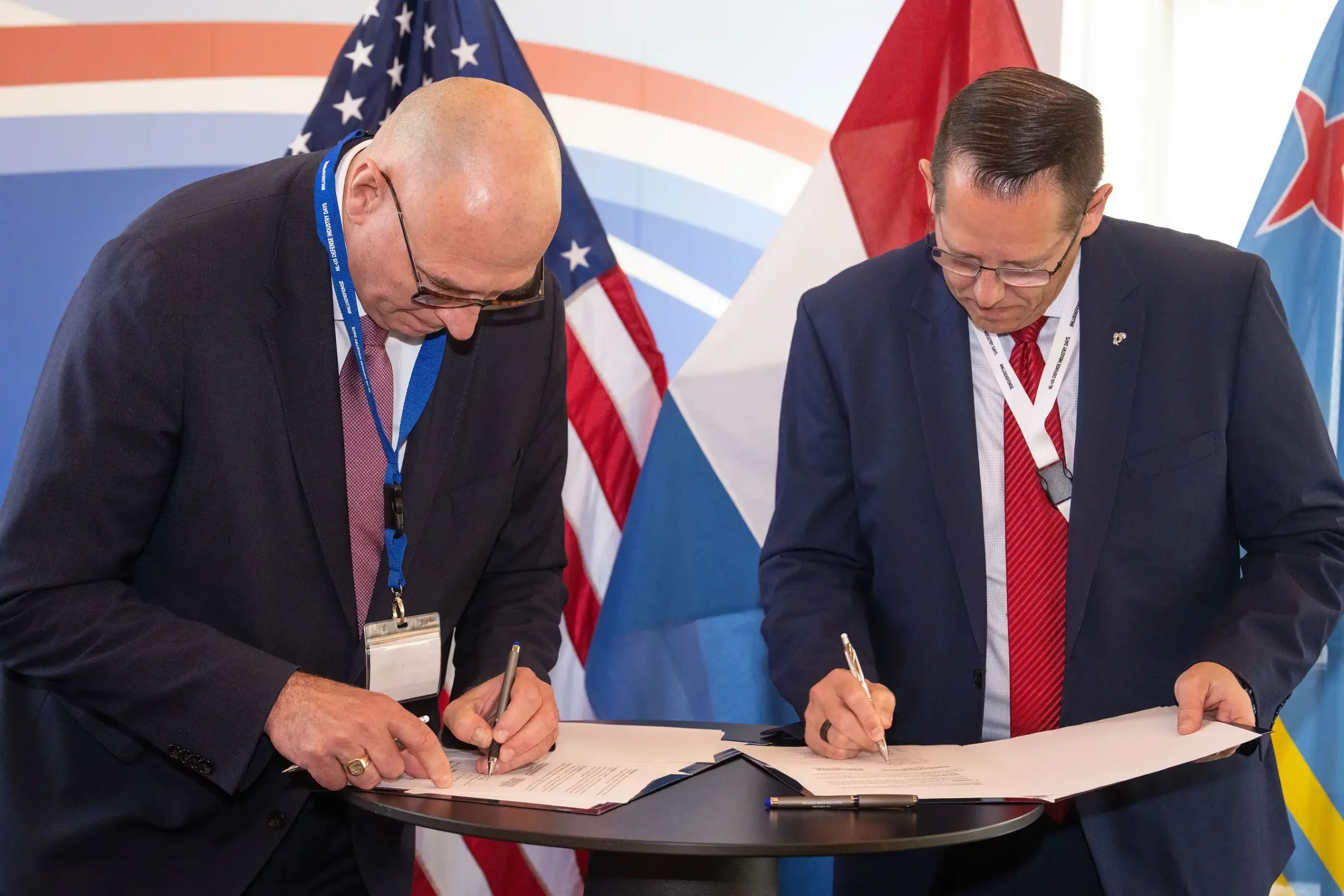
Lockheed Martin’s Skunk Works advanced development organization and the Royal Netherlands Aerospace Centre (NLR) expanded their strategic partnership on October 15, 2026, adding collaboration on unmanned aerial systems (UAS) to a research framework first signed two years ago. NLR Chief Executive Officer Tineke van der Veen and Ron Fehlen, vice president and general manager of Skunk Works, signed the renewed memorandum of understanding (MOU) at the NL-US Defense Industry Days in Washington.
The original MOU, signed on October 17, 2024, at the same bilateral industry forum, set out an exploratory agenda covering European strategic autonomy, military operational analysis, technology roadmaps and connectivity to the Dutch industrial base. According to Lockheed Martin, that framework has since matured into projects moving advanced technologies from the laboratory toward operational solutions that support the readiness of the Dutch air arm, which formally became the Royal Netherlands Air and Space Force on July 1, 2025. The expansion also follows the June 29, 2026, publication of the Dutch Defence White Paper 2026, which ties defense spending to 3.5% of gross domestic product by 2035 and makes unmanned systems a central feature of the future force.
Four Pillars Define the Next Phase of the Skunk Works NLR Partnership
The renewed agreement organizes cooperation around four pillars: connectivity to the Dutch industrial base, coordination on military operational analysis, alignment on technology roadmaps, and collaboration on UAS. The partners say the work aims to position Dutch defense suppliers within the international supply chain, bridge the gap between mission needs and formal capability requirements, and develop enabling technologies jointly.
UAS collaboration is the only new pillar. European strategic autonomy, listed as a focus area in the original MOU, does not appear among the pillars announced for this phase.
Van der Veen tied the expansion directly to the white paper, which she said identifies NATO as “the cornerstone of our defense” and the United States as the Netherlands’ most important ally. She argued that modern aerospace development depends on cross-border integration to field systems that no single nation can build alone, and said NLR intends to work with Skunk Works on the air force’s highest priorities. Fehlen said the two organizations have already matured specific projects, citing thermoplastics, and that the next phase will target new solutions to pressing aerospace and defense challenges.
Neither organization disclosed the value, duration or funding of the agreement, the specific UAS projects it will cover, or which thermoplastics projects were completed under the first MOU.
Thermoplastic Composites and Drone Testing: What NLR Brings to Skunk Works
Thermoplastics is the only technology area either partner named. NLR has built a substantial body of work in thermoplastic composites, including an 8-by-4-meter single-piece lower fuselage skin for the Airbus-led Multi-Functional Fuselage Demonstrator, produced under the European Clean Sky 2 STUNNING project, which NLR describes as the largest known single thermoplastic piece ever made.
Unlike thermoset composites, which cure irreversibly, thermoplastic matrices can be reheated and fusion-welded. That allows large assemblies to be joined with far fewer mechanical fasteners and supports automated, out-of-autoclave production. For an organization such as Skunk Works, those properties bear directly on build speed and unit cost, the two variables that dominate the economics of uncrewed combat aircraft and attritable airframes.
NLR also brings test infrastructure. The center operates wind tunnels spanning low-speed to supersonic regimes, along with dedicated facilities for research, development, test and evaluation of remotely piloted aircraft and counter-drone systems, and it has contributed to programs including the F-35 and the AH-64 Apache. Its long-standing role supporting the Dutch Ministry of Defence gives the operational analysis pillar a direct channel into requirement setting.
The UAS pillar matches the direction set in The Hague. The Defence White Paper 2026 states that unmanned systems should generate more than half of operational effects within five years, under a principle of uncrewed where possible and crewed where necessary. Days after its release, the ministry committed €30 million to Intelic, a Dutch developer of software that connects uncrewed air and ground systems within a single operational network.
Analysis: The expansion gives Skunk Works an established channel into a Dutch defense establishment that is shifting money toward uncrewed systems and affordable mass, at a time when European governments are pressing to keep more procurement spending on the continent. By embedding with NLR, which sits between the ministry, the air force and Dutch industry, Lockheed Martin positions itself upstream of requirements rather than responding to them, while offering Dutch suppliers a route into US supply chains. The absence of European strategic autonomy from the stated pillars, alongside van der Veen’s emphasis on the United States as the primary ally, frames the partnership squarely within NATO and the transatlantic industrial relationship rather than as a hedge toward European self-sufficiency. For the Royal Netherlands Air and Space Force, which now flies the F-35A as its sole fighter, closer alignment between national research and the aircraft’s prime contractor could ease the integration of future uncrewed systems with its fifth-generation fleet.
Neither partner has published a timeline, a budget or a first UAS deliverable under the expanded MOU, and it is unclear whether jointly developed technology will compete in upcoming Dutch acquisitions of uncrewed systems. The next markers are project announcements under the four pillars, Dutch supplier entry into Skunk Works supply chains, and any results presented at the 2027 NL-US Defense Industry Days.