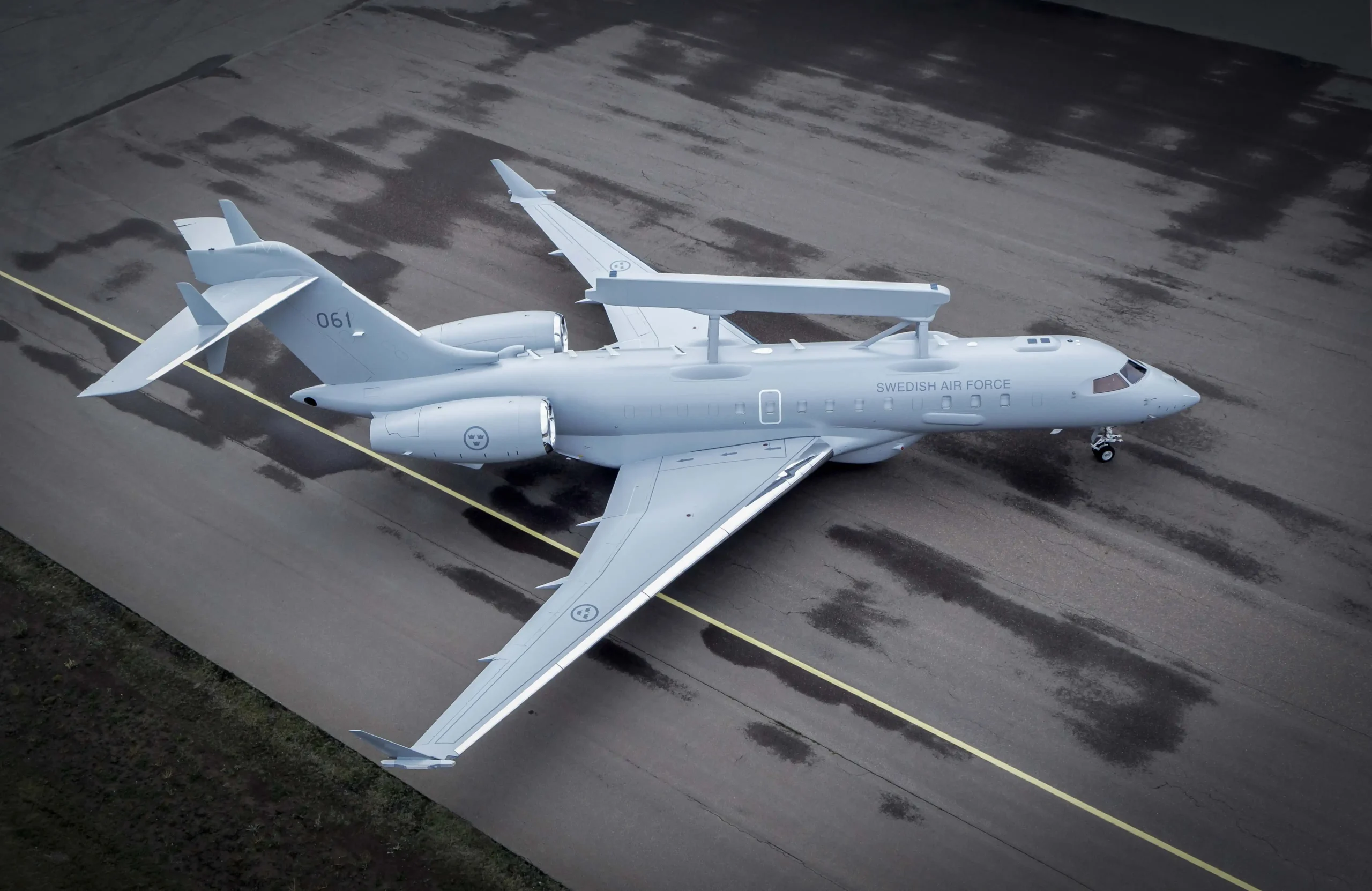
Saab presented the first GlobalEye airborne early warning and control (AEW&C) aircraft built for Sweden on October 15, 2026. The jet is the lead of three ordered by the Swedish Defence Materiel Administration (FMV) for the Swedish Air Force, which designates the type S 106, and now enters a testing and verification phase ahead of its first flight and delivery.
The rollout is the first visible step toward closing a capability gap Sweden accepted deliberately. In May 2024, Stockholm pledged its ASC 890 airborne surveillance aircraft, the Saab 340-based Erieye platform known in Swedish service as the S 100D Argus, to Ukraine as part of a SEK 13.3 billion aid package. The government said it would offset the resulting shortfall by buying an additional GlobalEye and accelerating the two already on order.
Saab GlobalEye S 106 Timeline From 2022 Contract to Delivery
FMV contracted the first two aircraft on June 30, 2022, in a deal valued at approximately SEK 7.3 billion, with deliveries planned during 2027 and options for two more airframes. FMV exercised one option on June 27, 2024, ordering a third aircraft for approximately SEK 2.6 billion with a delivery period running from 2024 to 2029. One option remains open, and the three S 106 jets represent roughly SEK 9.9 billion in contracted value.
The aircraft presented today began as a Bombardier Global 6000 business jet, handed to Saab in July 2023 and flown to Sweden in January 2024 for conversion at Linköping, where Saab integrates the mission system. The Erieye ER radar is built in Gothenburg. Saab CEO Micael Johansson called the presentation an important milestone for both Saab and the Swedish Armed Forces.
Neither Saab nor FMV has released a date for first flight or handover. Swedish officials indicated in June 2025 that the lead aircraft would enter service in an interim configuration, with delivery split into two steps and full capability following later; which mission functions are deferred has not been disclosed. The Swedish Air Force has identified Uppsala as the S 106 rear base, with plans to disperse the aircraft across several bases.
Erieye ER, Seaspray, and ESM: Inside the S 106 Sensor Suite
The S 106 is built around the Erieye ER (Extended Range), an S-band active electronically scanned array (AESA) radar housed in a dorsal beam roughly 10 meters long. Saab credits the ER with a 70% detection range increase over earlier Erieye generations and cites a range beyond 550 kilometers. Publicly available specifications indicate an instrumented range of 650 kilometers, with fighter-size targets detected at around 450 kilometers from 30,000 feet and 550 kilometers from 35,000 feet, depending on aspect, clutter and jamming. Saab says the radar is designed to track cruise missiles, small unmanned aircraft and hovering helicopters.
Below the fuselage, a Leonardo Seaspray 7500E X-band AESA adds synthetic aperture radar (SAR), inverse SAR, maritime moving target indication and ground moving target indication (GMTI). A FLIR Star Safire 380HD electro-optical/infrared turret, electronic support measures and electronic intelligence (ESM/ELINT), the Automatic Identification System (AIS) and IFF/ADS-B complete the suite. The mission system fuses these inputs into common tracks distributed over Link 16 and satellite communications. The Swedish configuration normally carries two pilots and five mission operators, with up to seven command-and-control workstations available.
Two Rolls-Royce BR710A2-20 turbofans rated at 65.6 kN each give the S 106 more than 11 hours of endurance and a typical surveillance altitude of roughly 30,000 to 36,000 feet. That marks the main operational break from the turboprop ASC 890: higher orbits extend the radar horizon against low-altitude threats over the Baltic, while the maritime radar and EO/IR turret give commanders a single platform for air, surface and littoral surveillance. Self-protection includes radar and laser warning receivers and countermeasure dispensers.
NATO E-3 Replacement and Export Orders Drive GlobalEye Production
Sweden’s first jet arrives as GlobalEye moves from niche export product to NATO’s chosen airborne surveillance platform. The United Arab Emirates, the launch customer, operates five aircraft. France finalized a SEK 12.3 billion order for two in December 2025, and an undisclosed Middle Eastern customer ordered two more for SEK 10.1 billion on July 27, 2026, for delivery in 2030.
In July 2026, a group of allies including Germany, Norway, the Netherlands and Sweden announced the joint procurement of up to 10 GlobalEyes to replace part of NATO’s E-3A Sentry fleet, after abandoning a plan to buy six Boeing E-7A Wedgetails.
Canada named Saab preferred supplier for its AEW&C requirement on May 27, 2026, and signed a non-binding term sheet with its Defence Investment Agency on September 25, 2026, covering six aircraft. On September 10, 2026, the Netherlands signed a letter of intent for one aircraft, due in 2031, that would join Sweden’s three S 106s in a shared four-aircraft pool, with Dutch crews training on Swedish jets from 2028.
That pipeline is pressuring the line. Johansson said during Saab’s second-quarter 2026 earnings call that GlobalEye output would rise from about two aircraft per year to six around 2030, above a previous target of four, and Saab is expanding its Linköping conversion facilities.
Analysis: The S 106 is no longer just a national recapitalization program. As the first GlobalEye in a NATO air force, Sweden’s aircraft becomes the reference configuration and, through the Dutch pooling arrangement, a training base for European users ahead of NATO’s 2031 target for an E-3 successor. That raises the cost of any slippage: a delay in Swedish test and verification would ripple into Dutch crew conversion, alliance integration planning and Saab’s production ramp. Initially, Sweden will also field only the interim configuration.
The next public milestone is first flight, for which no date has been released, followed by delivery in interim configuration and a later upgrade to full capability. FMV still holds an option for a fourth aircraft. A Dutch purchase contract, a NATO procurement contract and a definitive Canadian agreement remain unsigned, and each depends on Saab holding Swedish schedules while scaling production.