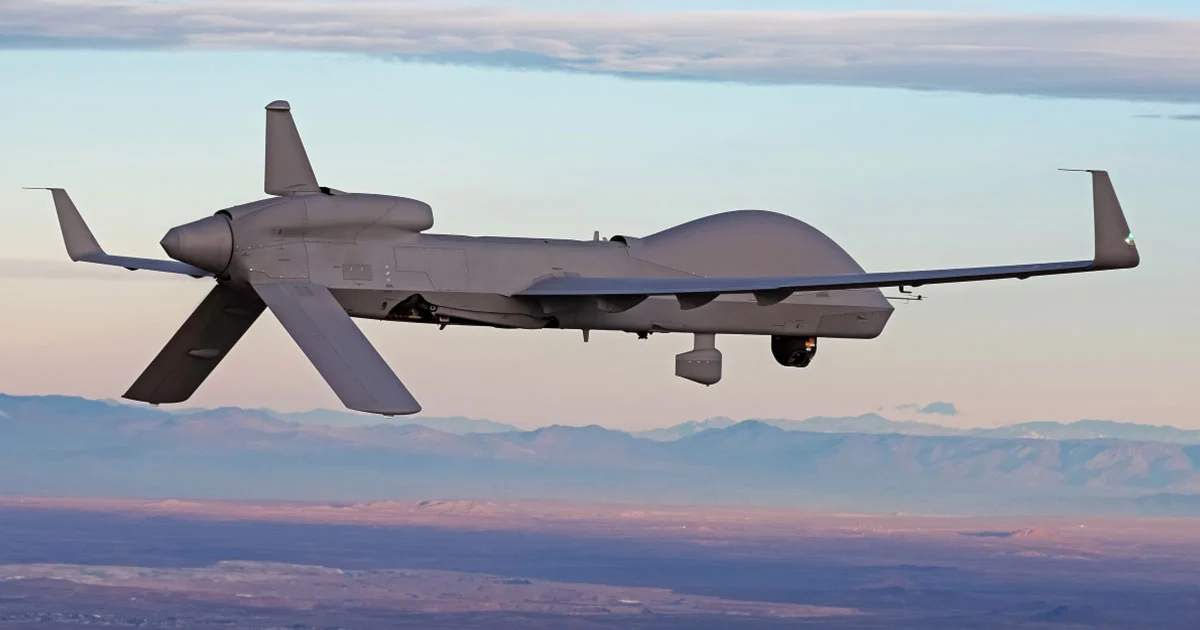
General Atomics Aeronautical Systems, Inc. (GA-ASI) has completed flight testing of a Sierra Nevada Company (SNC) Electronic Support Measures (ESM) system on the U.S. Army’s MQ-1C Gray Eagle Extended Range (ER) uncrewed aircraft system, the company announced on October 15, 2026. The Gray Eagle ESM is a passive sensor designed to let the aircraft detect and target hostile Integrated Air Defense Systems (IADS) while remaining outside their Weapon Engagement Zones (WEZ). GA-ASI did not disclose test dates, location, or results.
The test follows an April 15, 2026 contract under which the Army tasked GA-ASI with adding enhanced electronic intelligence (ELINT) to the Gray Eagle ER, with SNC and the Army’s Capability Program Executive Intelligence and Spectrum Warfare as integration partners.
Its timing is awkward: on May 1, 2025, Army Secretary Dan Driscoll and Chief of Staff Gen. Randy George canceled further Gray Eagle procurement under the Army Transformation Initiative (ATI), labeling the drone obsolete. The service now plans a runway-independent Group 4+ Vertical/Short Takeoff and Landing (VSTOL) successor, with a request for proposals expected soon, while the Fiscal Year 2026 National Defense Authorization Act bars retiring Gray Eagle without a capability of equal or greater effectiveness.
Gray Eagle ESM Integration: What SNC’s Passive Sensor Adds
GA-ASI describes the SNC payload as a small form-factor detection and collection system. Neither company has publicly identified the specific model. The description matches SNC’s AE-4500 Auto ESM family, but that link remains unconfirmed.
Publicly available specifications for the AE-4500 indicate precision geolocation and targeting up to 40 GHz, 240-degree instantaneous azimuth coverage, and on-board processing of pulsed, continuous-wave (CW), and frequency-modulated continuous-wave (FMCW) emitters. The architecture pairs a 3U OpenVPX receiver processor with antenna panels covering 0.5 to 18 GHz, extendable to 40 GHz. SNC rates the system at Technology Readiness Level (TRL) 9, already flying on UAVs and business jets.
That coverage spans UHF through Ka band, including the S, C, X, and Ku bands where most surface-to-air missile (SAM) acquisition and fire control radars operate. VHF early warning radars sit below the 0.5 GHz floor, although SNC offers a low-band extension for that class of emitter. The AE-4500 produces single-ship emitter fixes and supports multi-ship geolocation by triangulation or time difference of arrival (TDOA). Two Gray Eagles flying coordinated orbits could, in principle, tighten location accuracy on a SAM engagement radar beyond what one aircraft achieves alone, and the sensor adds no emissions of its own.
The test does not establish targeting-grade accuracy: ESM fixes arrive as error ellipses, and turning them into strike coordinates usually requires cross-cueing with radar or electro-optical sensors.
Gray Eagle ER Airframe: Endurance, Altitude, and Open Architecture
GA-ASI lists the Gray Eagle ER at a 4,200-pound maximum gross takeoff weight, up from 3,600 pounds on the baseline MQ-1C, powered by a 180-horsepower heavy fuel engine in place of the original 160-horsepower unit. The airframe carries roughly 900 pounds of internal fuel, and a 500-pound centerline hardpoint can carry an external pod with another 450 pounds. The company quotes a 42-hour maximum endurance and a 29,000-foot ceiling.
For an ESM mission, altitude and dwell time are the operative figures. Line-of-sight geometry puts the horizon from 29,000 feet at roughly 385 kilometers (about 240 miles) for a ground-level emitter. That is a theoretical ceiling; real detection range depends on emitter power, terrain, and receiver sensitivity. Endurance approaching two days lets a single orbit build an electronic order of battle that tracks radar activity, relocations, and emission control discipline over time.
GA-ASI credits Gray Eagle’s open systems architecture, built around the C5ISR/EW Modular Open Suite of Standards (CMOSS), for keeping integration time and cost down. At the Army’s Vanguard demonstrations at Fort Huachuca, Arizona, in September 2024, a Gray Eagle ER flew communications intelligence (COMINT) and mobile ad hoc network (MANET) radio payloads. During Project Convergence Capstone 5 (PC-C5) in 2025, it flew Detect, Identify, Locate, and Report (DILR) missions in an electronically contested environment, cross-cueing ELINT, COMINT, and synthetic aperture radar (SAR) payloads. GA-ASI also cites U.S. European Command (EUCOM) exercises.
Standoff ESM and Crewed-Uncrewed Teaming for Army Aviation
GA-ASI frames the upgrade around two missions. The first is deep sensing for ground commanders: locating IADS nodes and passing them into the targeting cycle. Emitter fixes of sufficient quality could cue Army long-range fires such as the Precision Strike Missile (PrSM), although GA-ASI has not described any fires integration.
The second is Crewed-Uncrewed Teaming, which GA-ASI says will increase survivability for crewed Army aircraft. The claim carries weight as ATI shrinks the attack helicopter force and retires the AH-64D. AH-64E Apache crews working under a Gray Eagle would get warning of active SAM radars before entering their envelopes, instead of relying on radar warning receivers that react only once the helicopter is illuminated.
“Combining long-range detection with the range and persistence of the Gray Eagle ensures that commanders always know when an adversary’s IADS is operating,” said GA-ASI President David R. Alexander.
Analysis: The Army is buying new sensing for an aircraft it formally declared obsolete, and the logic holds. The Group 4+ VSTOL successor targets fielding around Fiscal Year 2028, budget permitting; until then, the Gray Eagle ER remains the division’s organic long-endurance sensor. Army aviation leaders frame the replacement as an architecture more than an airframe, so an ESM qualified on a CMOSS-compliant Gray Eagle becomes a portable capability, not a sunk cost. It also strengthens GA-ASI’s case for Mojave, the STOL Gray Eagle derivative it is expected to offer. The constraint is survivability; a propeller-driven, medium-altitude drone has little margin inside modern IADS coverage, and passive standoff sensing is the profile that keeps it relevant.
Still undisclosed: geolocation accuracy, contract value, the number of aircraft to be modified, an initial operational capability date, and whether the ESM will migrate to the Gray Eagle 25M ordered by the Army National Guard. The next markers are the Army’s Group 4+ VSTOL request for proposals and Fiscal Year 2027 budget decisions, which will show whether the service funds a fleet-wide retrofit.