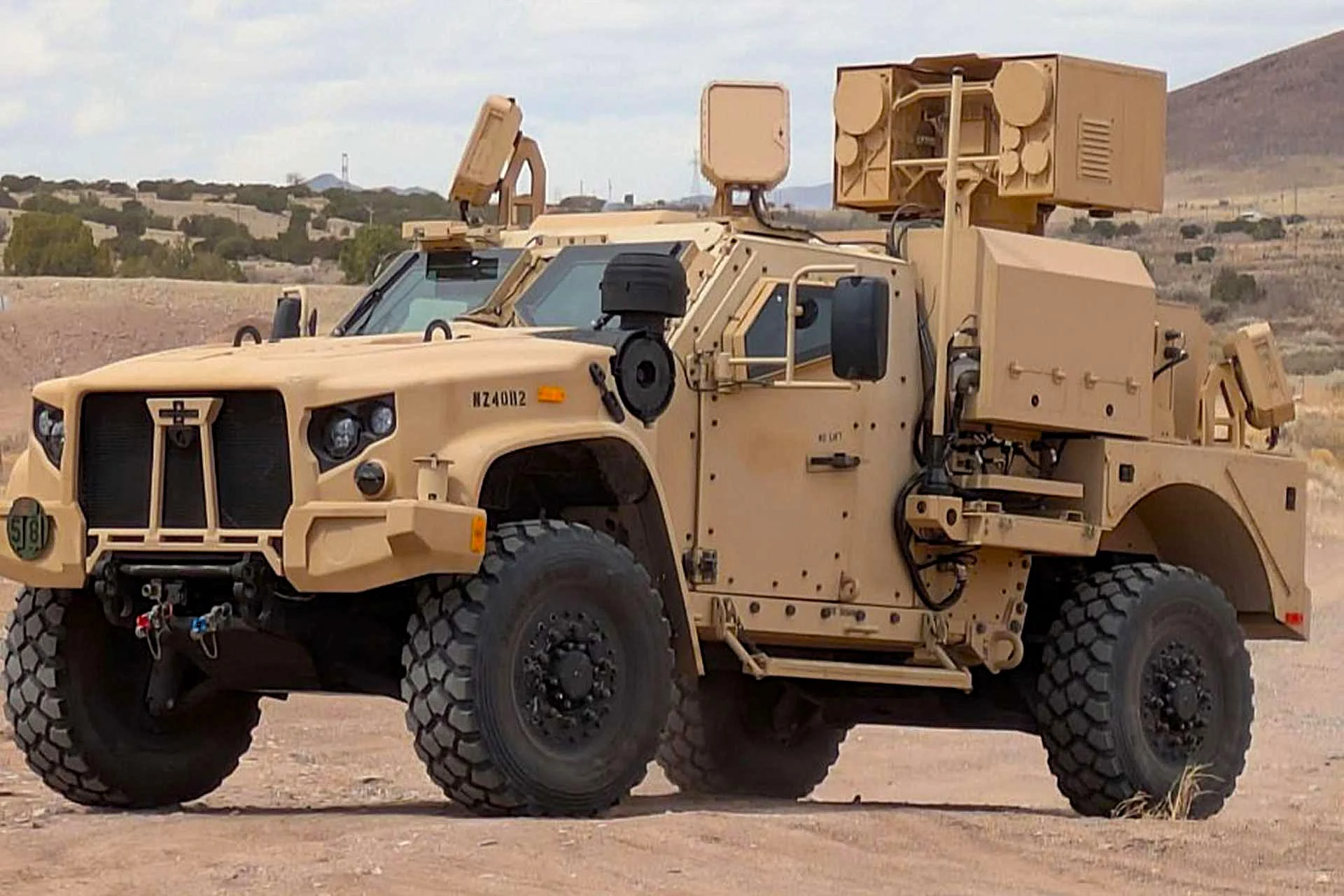
The US Army wants its Enduring-High Energy Laser (E-HEL) counter-drone weapon mountable on “any vehicle in the motorpool” and operable by soldiers outside dedicated air defense units, program officials said on October 12, 2026, at the Association of the US Army (AUSA) annual meeting in Washington, D.C. The War Zone, which attended the panel, reported the remarks.
The vehicle-agnostic push follows the Army’s September 2, 2026, award of a $464.8 million Other Transaction Agreement to AeroVironment for E-HEL production, the service’s first production contract for a high-energy laser weapon, covering dozens of the company’s 30-kilowatt-class LOCUST X3 systems. It also follows a difficult stretch: the 50-kilowatt Directed Energy Maneuver-Short Range Air Defense (DE M-SHORAD) Stryker prototypes, built for the 4th Battalion, 60th Air Defense Artillery Regiment at Fort Sill, Oklahoma, suffered reliability problems that pushed the Army toward a different model.
E-HEL on a Sled: Army Laser Weapons Built for Any Vehicle
Brig. Gen. Guy Yelverton, Capability Program Executive for Defensive Fires within the Portfolio Acquisition Executive for Fires, framed E-HEL as a kit, not a vehicle. “We’re focused on any vehicle in the motorpool,” he said, according to The War Zone. “And, so, our E-HEL is on a sled. With that, I can look at integrating it onto multiple different vehicles.”
Yelverton linked vehicle agnosticism to a second goal: a system easy enough to train on and operate that it is no longer tied to an air defense military occupational specialty. “I can now look at any formation type to be able to put a high-energy laser capability into it for the counter-UAS fight,” he said, referring to counter-unmanned aircraft systems (UAS).
The underlying design is a modular open systems approach with 11 major interfaces, according to the Army, allowing deployment from fixed bases, semi-fixed tactical sites, and mobile combat vehicles. Kirk Williams, Chief Engineer at the Army’s Directed Energy Project Office, explained the lesson behind it: “you can have a really cool integrated system, and then when that truck needs an oil change, well, then your laser weapon system is down for the count.” Modularity also eases technology insertion and, Williams hopes, vendor pricing.
Inside LOCUST X3: 30 kW Beam, Sensor Cueing, and Battery Magazine
At the core of LOCUST X3 is a turret housing the beam director and electro-optical and infrared cameras for acquisition and tracking, cued by small-form-factor radars and passive radio frequency detectors on the host vehicle or by off-board sensors. AeroVironment says the X3 adds AV_Halo AI-driven targeting and is designed to defeat Group 1 to Group 3 UAS. The Army has not disclosed an effective engagement range.
The Joint Light Tactical Vehicle (JLTV) is the initial host, with palletized configurations also planned. Integration on the lighter Infantry Squad Vehicle (ISV) remains under study, with size, weight, and power as the constraint. “JLTV has a lot better payload capacity than ISV,” Williams said. “So we really need to be able to get something smaller if we want to have the same effectiveness on an ISV.” Earlier LOCUST variants already ride on both vehicles along the US-Mexico border.
Yelverton said battery capacity provides “around 80 seconds, 120 seconds” of lasing depending on the system. “The quicker I get on the target, kill it, and off the target, I start rebuilding, regenerating that magazine depth,” he said. Dwell time is therefore the critical metric: a laser engages one target at a time, and its beam degrades through atmosphere, smoke, and dust. At 30 kilowatts, LOCUST X3 sits at the low end of the power spectrum, below DE M-SHORAD’s 50 kilowatts and the 150-kilowatt-class containerized weapon sought by the separate Joint Laser Weapon System (JLWS) program.
From Reliability Gaps to Fielding: E-HEL Timeline Through 2028
“Lasers are real. We can do it. We can go out. We can shoot things,” Williams said. “But what we got to do now is make these systems reliable enough so that the soldiers have the faith in them when they need them.” Field-level maintainability and repairability are the next bar, because, as he put it, “things are going to break.”
The Army plans to receive the first JLTV-mounted LOCUST X3 in the fourth quarter of fiscal 2027, with early 2028 as the operational target and spring 2028 as the latest acceptable date. No receiving unit has been named, though the 7th Infantry Division at Joint Base Lewis-McChord, Washington, has been floated as a potential partner. Col. Charles Kean, the division’s Deputy Commanding Officer for Support, said soldiers need the systems early to test them “in the mud, the dirt, the humidity of the Pacific” and iterate, “because the adversaries continue to iterate in reverse against us.”
Analysis: The decisive shift in E-HEL is organizational rather than optical. By decoupling the laser from a specific chassis and a specific specialty, the Army is treating short-range drone defense as a function every formation owns, not a service supplied only by the air defense branch. The constraint is scale. Dozens of 30-kilowatt systems, each engaging one target at a time on a battery magazine of roughly 80 to 120 seconds, buy point defense for selected convoys and sites, not division-wide coverage. As Kean stressed, lasers remain one layer of a broader air and missile defense architecture; their weight in it will depend on how quickly the Army moves to volume buys once reliability is proven. China, meanwhile, has paraded its LY-1 laser, and Chinese firms already sell laser systems abroad.
Next come first delivery in the fourth quarter of fiscal 2027, operational status in early 2028, and a decision on ISV integration. Unit cost, effective range, and the first fielding unit remain undisclosed. In parallel, JLWS targets a containerized 150-kilowatt-class weapon on a similar timeline before moving toward 300- and 500-kilowatt-class designs, and Scott Keeney, chief executive of LOCUST laser partner nLIGHT, told the panel he sees one-megawatt-class lasers on the horizon.