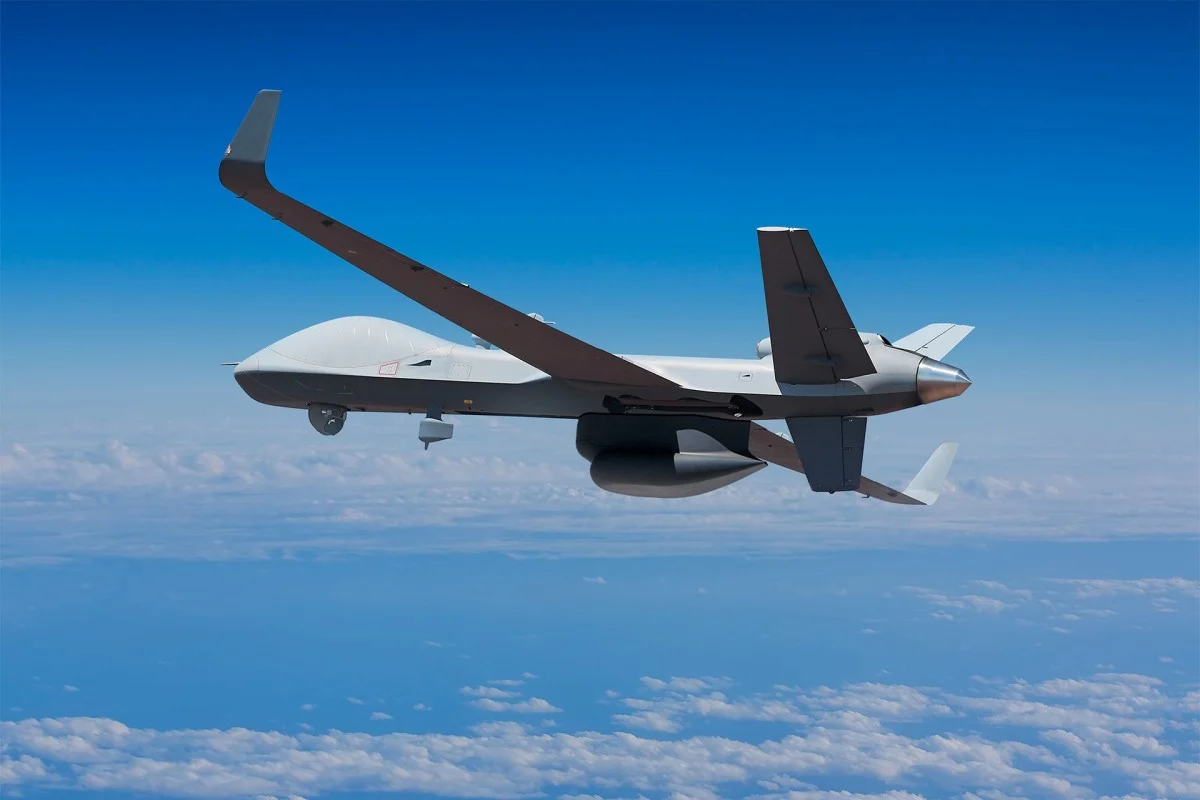
The US Air Force has awarded General Atomics Aeronautical Systems Inc. (GA-ASI) a $38,766,471 sole-source contract for contractor logistics support and sustainment of Taiwan’s MQ-9B SkyGuardian uncrewed aircraft, fitted in the maritime configuration GA-ASI markets as SeaGuardian, through August 31, 2029. The Foreign Military Sales (FMS) contract, awarded October 1, 2026, and announced by the Pentagon on October 15, comes 17 days after Taiwan’s first two MQ-9Bs made their initial flights from Hualien Air Base on September 14, 2026.
The award moves the program from acquisition into sustainment after a delayed delivery cycle. The State Department approved the sale of four weapons-ready MQ-9Bs on November 3, 2020, in a package the Defense Security Cooperation Agency (DSCA) valued at $600 million. GA-ASI received a not-to-exceed $217.6 million undefinitized contract action on May 1, 2023, for four aircraft, two Certifiable Ground Control Stations, spares and support equipment, with work then due by May 2025. That schedule slipped. Taiwanese officials attended a handover ceremony for the first two aircraft in the United States on March 17, 2026; the pair arrived by sea at Kaohsiung in June and spent about three months in assembly and testing in Hualien County with GA-ASI support. The remaining two are due in 2027.
Taiwan MQ-9B Sustainment Contract Covers Fleet Through August 2029
The Air Force Life Cycle Management Center (AFLCMC) at Wright-Patterson Air Force Base, Ohio, is the contracting activity under contract FA8689-26-C-B006. Work will be performed in Poway, California, and the full $38,766,471 in FMS funds was obligated at award, so the effort is fully funded from the outset.
Across a 35-month period of performance, the contract averages about $1.1 million per month. The Pentagon describes its scope only as sustainment services and contractor logistics support (CLS). It does not state the contract type, whether coverage extends to the second pair due in 2027, or how many contractor personnel will work in Taiwan. The 2020 notification already listed spare and repair parts, support and test equipment, and contractor logistics and engineering support among the package elements, but the terms of this follow-on award have not been disclosed.
The sole-source designation is consistent with GA-ASI’s role as original equipment manufacturer of both the aircraft and the Certifiable Ground Control Stations delivered under the 2023 contract. The 2029 end date also aligns with Taiwan’s own funding line: the Republic of China Air Force (ROCAF) budgeted NT$21.7 billion, about $687 million, for the four-aircraft program between 2022 and 2029.
MQ-9B Airframe Specifications and the 2020 Maritime Sensor Package
The manufacturer’s current data sheet gives the MQ-9B a 24-meter (79-foot) wingspan, an 11.6-meter (38-foot) length and a maximum takeoff weight of 5,670 kilograms (12,500 pounds). It lists up to 1,814 kilograms (4,000 pounds) of external payload on nine hardpoints, eight under the wings and one on the centerline, plus 363 kilograms (800 pounds) internally. A Honeywell TPE331-10GD turboprop, the engine listed in the 2020 notification, gives a maximum speed of 210 knots true airspeed, a ceiling of 40,000 feet and endurance of up to 40 hours. The design is built to the NATO STANAG 4671 airworthiness standard and integrates a detect-and-avoid system for controlled airspace, a practical requirement at Hualien, where military and civil traffic share the airfield.
The 2020 package listed a mission suite built for the maritime role: the L3Harris WESCAM MX-20 electro-optical/infrared (EO/IR) turret, the Raytheon SeaVue maritime multirole patrol radar and the Leonardo SAGE 750 electronic support measures (ESM) system, along with C-band line-of-sight ground data terminals and Ku-band satellite communications (SATCOM) GA-ASI Transportable Earth Stations. The SeaVue radar has been reported to detect and track surface vessels at 150 to 300 kilometers. Whether every item on the 2020 list was retained in the delivered configuration has not been officially confirmed.
Hualien Operations and the Limits of a Four-Aircraft Fleet
Ku-band SATCOM is what turns the airframe into a strategic sensor. Operating from Hualien on the east coast, the MQ-9B can hold orbits over the Philippine Sea beyond line-of-sight range and stay on station far longer than the ROCAF P-3C Orion patrol aircraft that have carried much of the burden of tracking People’s Liberation Army (PLA) Navy deployments. DSCA framed the capability as intelligence, surveillance and reconnaissance (ISR), target acquisition, and counter-land, counter-sea and anti-submarine strike. Taiwan describes the aircraft as a long-range reconnaissance platform for monitoring PLA and gray-zone activity in surrounding waters, and INDSR research fellow Su Tzu-yun has said the MQ-9Bs are meant to strengthen reconnaissance and surveillance rather than serve as a primary offensive weapon. The radar and SATCOM link could also contribute over-the-horizon targeting data to shore-based anti-ship systems such as the Harpoon Coastal Defense System approved in October 2020. Taiwan’s order has so far been publicly described as surveillance-focused.
Fleet size is the binding constraint. Su Tzu-yun, who heads the strategy and resources division at Taiwan’s defense ministry-funded Institute for National Defense and Security Research (INDSR), estimates a peacetime rotation of one aircraft on duty, one on standby, one in training and one in maintenance, with up to three on duty during major exercises or periods of gray-zone pressure. That model holds only if spares and repairs arrive on schedule, which is precisely what this contract buys.
Analysis: The contract is small, but it determines how much of Taiwan’s new long-endurance ISR capability is actually usable. With four airframes, persistent maritime coverage depends on sortie generation rather than fleet size, and this award places that availability in the hands of a single US manufacturer through 2029. In peacetime, that is an advantage: Taiwan inherits a mature supply chain and operates the same aircraft family as the Japan Coast Guard, which has flown the SeaGuardian variant since 2022, and the Japan Maritime Self-Defense Force, which plans to field 23. In a blockade, however, spares shipped from California become a contested logistics problem, and the contract announcement says nothing about in-country depot capacity.
The next milestones are the completion of flight evaluation at Hualien, an initial operational capability date that Taipei has not announced, and delivery of the second pair in 2027. Contract modifications could follow as the fleet doubles. Beyond that, two questions remain open: whether Taiwan funds additional MQ-9Bs as it expands its drone inventory, and whether it ever arms the weapons-ready airframes it bought.