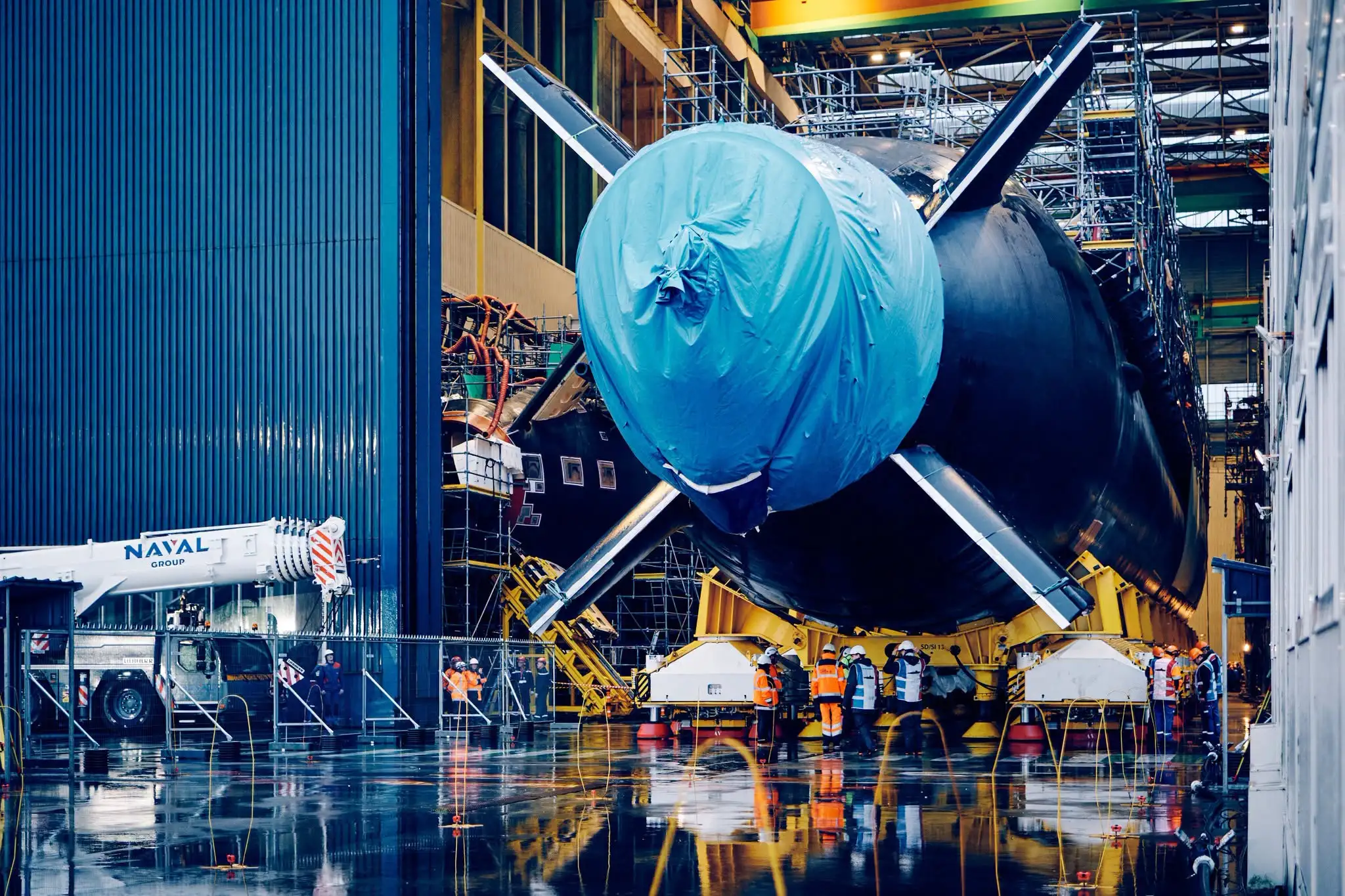
Naval Group on October 16, 2026, began moving the nuclear-powered attack submarine Rubis (S639), the fifth of six Suffren-class boats built under France’s Barracuda program, from its construction hall in Cherbourg to the floating launch platform in the Cachin basin. Catherine Vautrin, France’s Minister for the Armed Forces and Veterans, presided over the ceremony alongside Patrick Pailloux, the delegate general for armament.
The Barracuda program, run by the Direction générale de l’armement (DGA) with the French Alternative Energies and Atomic Energy Commission (CEA) responsible for the reactors, replaces the six Rubis-class nuclear attack submarines (SSNs) commissioned from the early 1980s. Three Suffren-class boats are in active service: Suffren since June 2022, Duguay-Trouin since April 2024 and Tourville since July 2025. De Grasse was delivered on June 24, 2026, with admission to active service pending. With Perle decommissioned on June 23, 2026, Améthyste is the last first-generation SSN still in the order of battle.
Rubis Submarine Follows the De Grasse Production Cadence
The move onto the shiplift, known in French as the dispositif de mise à l’eau (DME), is not the launch itself. Completion work continues on the platform until the boat’s first float, followed by dockside tests and sea trials before delivery to the French Navy.
Pierre Éric Pommellet, chairman and chief executive of Naval Group, said the milestone came “just 17 months after that of the nuclear attack submarine De Grasse.” That boat provides the clearest template for what follows. De Grasse rolled out in May 2025, reached first reactor criticality in December 2025, began sea trials on February 24, 2026 and was delivered four months later, roughly 13 months after its transfer to the DME.
Open-source reporting indicates Rubis is scheduled to start alpha sea trials by summer 2027, with delivery expected by the end of 2027. The DGA has not published a firm date. The sixth and final boat, Casabianca (S640), remains under construction, with delivery due by 2030 under the 2024-2030 Military Programming Law (LPM).
According to the DGA, more than 10,000 people and 800 companies have taken part in the program, with 3,000 direct jobs, including 800 at subcontractors, mobilized daily. Naval Group builds the boats and their nuclear boiler components with TechnicAtome.
Hybrid Propulsion, Pump-Jet and MdCN: Inside the Suffren-Class Design
Publicly available specifications put the Suffren class at 99 meters in length and 8.8 meters in diameter, with a surfaced displacement of 4,700 tonnes and a submerged displacement between 5,100 and 5,300 tonnes depending on the official release. That is roughly twice the displacement of the Rubis class it replaces.
Propulsion centers on a pressurized water reactor derived from the K15 units of the Triomphant-class ballistic missile submarines and the aircraft carrier Charles de Gaulle, rated at about 150 MW thermal. The hybrid plant combines two propulsion turbines, two turbo-generators and two electric motors, and drives a pump-jet propulsor in place of a conventional propeller. Combined with an X-form stern rudder arrangement, the design delivers a submerged speed above 25 knots and a test depth beyond 350 meters. The operational payoff is a higher quiet speed when sanitizing the exit routes of ballistic missile submarines leaving Île Longue or screening a carrier strike group.
Endurance reaches 70 days, against 45 for the Rubis class, and planned availability exceeds 270 days per year. In a six-boat force, that availability figure weighs more than any single performance parameter.
The weapons suite, fired from four 533 mm tubes according to open-source data, combines F21 heavyweight wire-guided torpedoes, SM39 Exocet anti-ship missiles, FG29 mines and the MBDA Naval Cruise Missile (MdCN), credited with a range beyond 1,000 km. MdCN gives French SSNs a deep land-attack capability for the first time. An optronic mast replaces the hull-penetrating periscope, and each boat carries a crew of about 65 plus up to 15 special forces operators, deployable through a diver lock-out hatch or an optional dry deck shelter.
How Rubis and Casabianca Close Out the Barracuda Program
Rubis inherits the traditions of the Free French minelaying submarine of the Second World War, which the DGA credits with 28 combat missions and 683 mines laid, and which General Charles de Gaulle made a Companion of the Liberation on October 14, 1941. Its first-generation predecessor, Rubis (S601), left active service in 2022.
Vautrin framed the rollout in industrial terms. “The Rubis is a French success. It carries the work of the Cotentin, the excellence of our industry and the ambition of an entire nation,” she said, in remarks translated from French.
Imagery released by Naval Group shows the stern section of Casabianca alongside Rubis in the construction hall. With the last hull approaching completion, attention is shifting to Evol SNA, a reported evolution roadmap intended to keep the class current over the next 30 years. Preliminary work on a third-generation SSN, referred to as SNA3G, has not yet become a formal program.
Analysis: The Rubis rollout confirms that the Barracuda line, whose lead boat was delivered in November 2020, more than three years behind the original contract schedule, has delivered a hull every 16 to 19 months since 2023. The constraint has moved from production to force structure. France asks six SSNs to protect ballistic missile submarine patrols, escort the carrier strike group and collect intelligence. Until Rubis is delivered, the force relies on Améthyste, the last first-generation boat in service, to cover the gap left by Perle. Any slip on Rubis or Casabianca extends that dependence and narrows the margin for concurrent tasking.
Next on the schedule are Rubis’s first float in the Cachin basin, dockside trials and first reactor criticality, none of which has an officially announced date. Alpha trials are expected by summer 2027. De Grasse’s admission to active service would bring the Suffren-class active fleet to four. The open questions are whether Naval Group can match the 13-month DME-to-delivery pace set by De Grasse, and what scope and funding the Evol SNA roadmap receives.