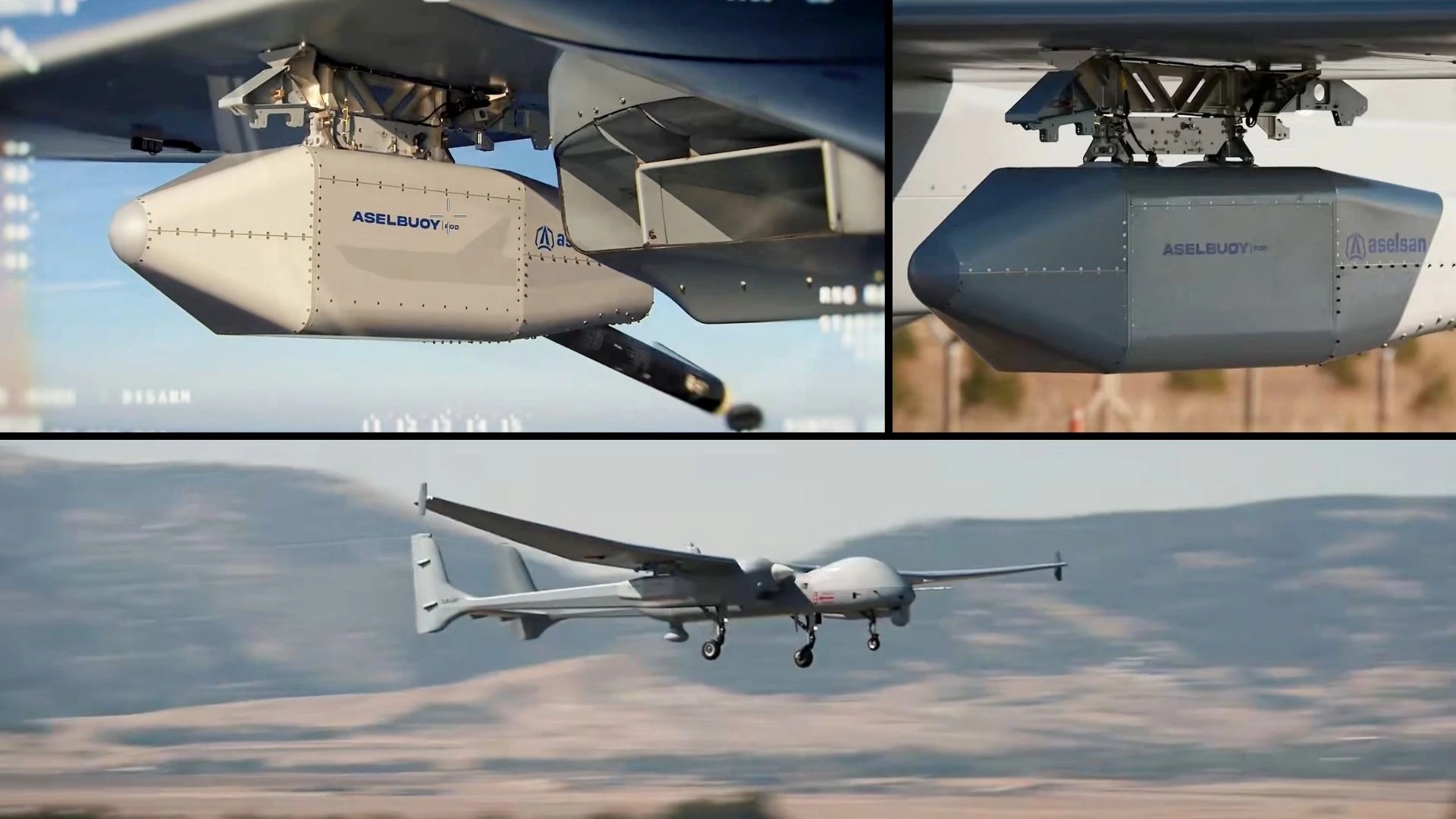
Turkish Aerospace’s (TUSAŞ) AKSUNGUR medium-altitude long-endurance (MALE) unmanned aerial vehicle released three ASELSAN aselBUOY 100P passive sonobuoys off Antalya during the Turkish Naval Forces’ TURNAs-2026 exercise and relayed their acoustic data to a ground station in Ankara, where underwater targets were detected, TUSAŞ announced on October 24, 2026. It was the first aselBUOY drop from an unmanned aircraft.
TURNAs-2026, the Turkish Naval Forces Command’s unmanned maritime systems exercise, runs in the Gulf of Antalya and the Eastern Mediterranean through October 27, according to Türkiye’s Ministry of National Defense. It gathers 18 ships, 11 aircraft, 9 UAVs, 7 unmanned underwater vehicles and 9 unmanned surface vessels, including a submarine and SH-70 helicopters. The sortie brings into a live exercise an anti-submarine warfare (ASW) role TUSAŞ first displayed on AKSUNGUR at the 2019 International Defence Industry Fair (IDEF).
AKSUNGUR Sonobuoy Mission Profile Over the Gulf of Antalya
AKSUNGUR launched from Ankara and reached the exercise area under satellite control, a beyond-line-of-sight transit flown from its home ground control station. Powered by its TUSAŞ Engine Industries (TEI) PD170 engines, the aircraft descended to 1,000 ft to release the three aselBUOY 100P units and a fourth sonobuoy of undisclosed type, then climbed to 6,000 ft for the listening phase and stayed on station for roughly four hours.
The profile follows sonobuoy physics: a low release altitude limits parachute drift and tightens pattern accuracy, while the subsequent climb extends the aircraft’s radio horizon and keeps every buoy within reliable VHF reception.
Acoustic data flowed to an integrated acoustic data transfer center at the Ankara ground control station, where operators processed it and detected underwater targets. The relay likely used the satellite link; neither company has described the data path. The architecture matches the phased plan TUSAŞ outlined in 2023: AKSUNGUR first relays raw sonobuoy data, with onboard processing to follow. It keeps acoustic analysts ashore and the airframe light, but ties detection performance to satellite bandwidth and latency.
Gaps remain. Neither TUSAŞ nor ASELSAN has identified the targets, released detection ranges or confirmed whether ASELSAN’s ASELBUOY POD, its modular UAV launcher, was used. A four-buoy load suggests a test of the release-and-relay chain, not a full search pattern.
aselBUOY 100P DIFAR Sensor, Depth Modes, and VHF Link
The aselBUOY 100P is a NATO A-size passive sonobuoy of the Directional Frequency Analysis and Recording (DIFAR) type, the most widely used sonobuoy category in Western ASW. ASELSAN lists a length of 915 mm, a diameter of 120 mm and a weight of 10 kg. The DIFAR sensor delivers directional bearings across a 5 to 2,400 Hz band, with hydrophone depths of 30 m or 150 m and operating lives of 0.5, 1, 2, 4 or 8 hours.
Each buoy transmits on one of 96 VHF channels between 136 and 173.5 MHz, at ranges up to 20 km. A UHF command link lets operators change channel and operating time after launch, and the buoy scuttles itself when its programmed life ends. The two depth settings allow placement above or below the thermal layer, a decisive variable in Mediterranean waters where seasonal thermoclines can mask a submerged contact from a shallow sensor.
ASELSAN launched the program in late 2015 as a self-financed effort, building on underwater acoustics work begun in 2006. Air-launch trials from a Cessna turboprop in 2018 exposed a since-corrected parachute fault. A first production contract with the Turkish Naval Forces Command moved the buoy into serial production in early 2026. An active variant aimed at quieter submarines remains in development without a disclosed timeline.
The A-size format is the operational point: it fits NATO-standard launch tubes and processors, giving Türkiye a domestic source for an expendable consumed in large numbers during any sustained submarine hunt.
AKSUNGUR Airframe, PD170 Engines, and the 1,250 kg Upgrade Path
AKSUNGUR is a twin-engine, twin-boom derivative of the ANKA, developed in 18 months and first flown on March 20, 2019. TUSAŞ lists a 24 m wingspan, an 11.6 m length, a 3,300 kg maximum takeoff weight and a payload above 750 kg across six hardpoints, three per wing, rated at 500 kg, 300 kg and 150 kg. The two PD170 twin-turbocharged diesels, each rated at a claimed 172 hp, support a 40,000 ft ceiling and up to 50 hours of endurance; the type logged 49 hours at 20,000 ft on September 1, 2020. Mission payloads include electro-optical/infrared, synthetic aperture radar and signals intelligence packages.
The maritime figure is tighter: in full-payload maritime patrol configuration, TUSAŞ has cited 12 hours at 25,000 ft. In August 2026, General Manager Mehmet Demiroğlu said TUSAŞ aims to raise payload to 1,250 kg next year and endurance to about 60 hours while integrating torpedoes, sonobuoys and new radar systems, primarily for Navy requirements.
AKSUNGUR is not Türkiye’s only sonobuoy-capable drone. During the Denizkurdu-I/2026 exercise in September, a Baykar Bayraktar TB3 flying from TCG Anadolu released two sonobuoys from Baykar’s SAS POD and processed buoy data onboard, including data from buoys laid by a crewed maritime patrol aircraft. The contrast is architectural: TB3 offers shipborne reach and onboard processing, while AKSUNGUR brings heavier payload, land-based endurance and shore-side processing.
Analysis: TURNAs-2026 demonstrated the front half of an unmanned ASW kill chain. Detection now happens in Ankara, but prosecution still depends on a crewed patrol aircraft, an SH-70 helicopter or a surface combatant until AKSUNGUR carries a lightweight torpedo. The near-term value is persistence: a MALE UAV seeding and monitoring buoys for hours frees crewed patrol aircraft for localization and attack. With a domestic A-size DIFAR buoy and two national UAV sonobuoy programs, Türkiye now fields an ASW sensor chain largely insulated from foreign export decisions.
Next markers include onboard acoustic processing, larger buoy loads through a qualified UAV launcher, the 1,250 kg AKSUNGUR variant targeted for 2027 and lightweight torpedo integration. ASELSAN’s active aselBUOY remains the open question against quieter diesel-electric and air-independent propulsion submarines. Neither company has said whether the TURNAs-2026 results will feed a Navy order for ASW-configured aircraft.