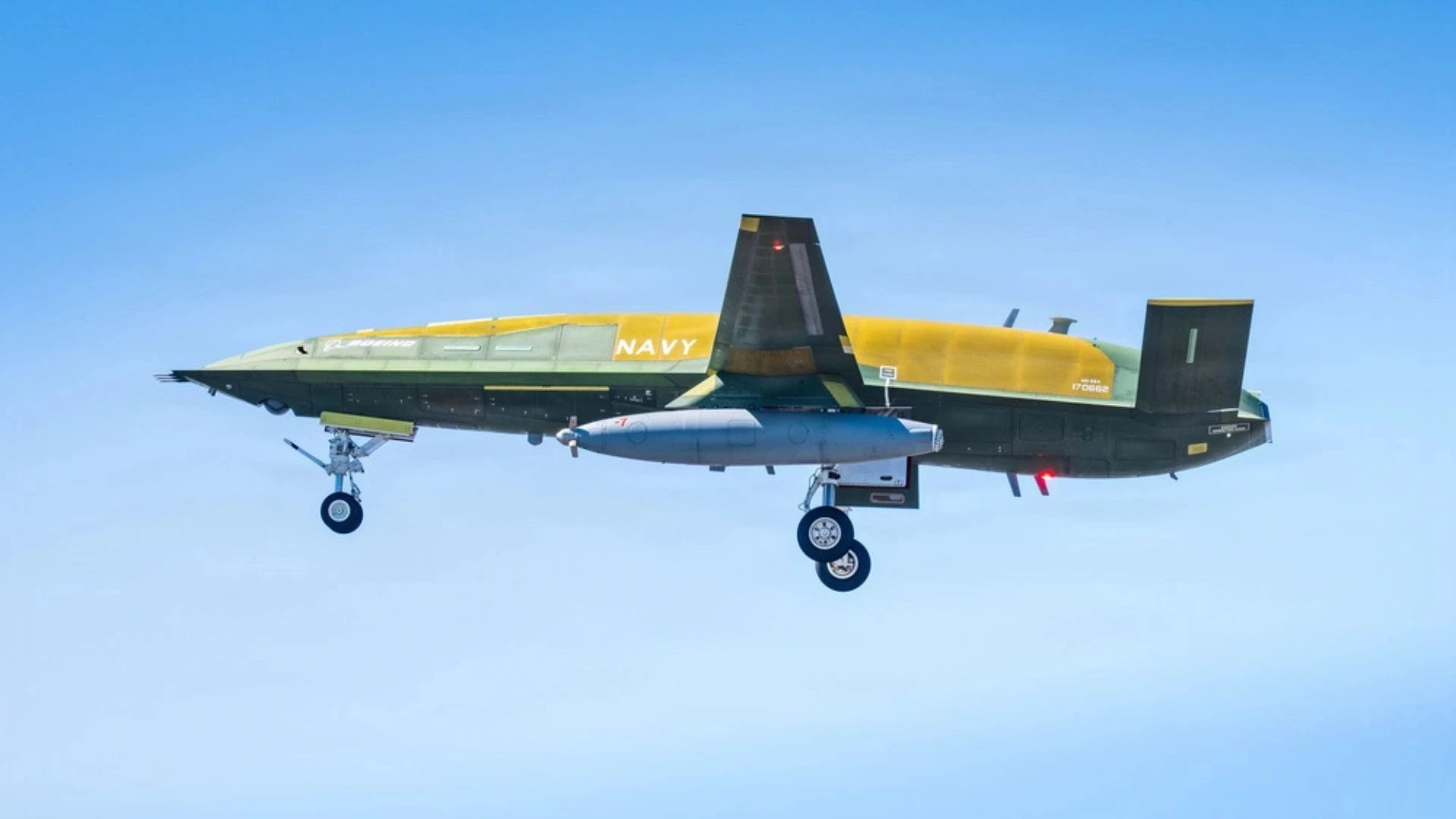
The U.S. Navy awarded The Boeing Co. of St. Louis, Missouri, a not-to-exceed $80 million indefinite-delivery/indefinite-quantity (IDIQ) contract on October 16, 2026, to fund system improvements, configuration development, integration, production readiness, and sustainment for the MQ-25A Stingray unmanned aircraft system. Naval Air Systems Command (NAVAIR), Patuxent River, Maryland, placed the sole-source award under contract N0001927D1006, with work in St. Louis scheduled to run through October 2031.
The award follows the program’s first production contract by barely a month. On September 14, 2026, the Navy awarded Boeing a $562 million fixed-price incentive contract for three Low-Rate Initial Production (LRIP) Lot 1 aircraft and long-lead components for three Lot 2 aircraft, with first Lot 1 deliveries expected in 2029. That deal followed Milestone C approval, announced May 19, 2026, and the April 25, 2026, first flight of a production-representative MQ-25A from Boeing’s facility at MidAmerica St. Louis Airport in Mascoutah, Illinois. The new IDIQ gives NAVAIR a standing engineering vehicle to keep maturing the design while production begins.
Inside the $80 Million MQ-25A Stingray Contract Structure
No funds were obligated at award. The Navy will obligate money on individual task orders as requirements emerge, so the $80 million figure is a ceiling, not a commitment. The contract combines cost-plus-fixed-fee and cost-no-fee pricing: Boeing recovers allowable costs on every order but earns a fixed fee only on the cost-plus-fixed-fee portions. The announcement does not specify which tasks fall under each pricing type, nor which configuration changes are planned.
The contract number carries its own information. Under standard Department of Defense numbering, the 27 segment denotes fiscal 2027 and the letter D designates an IDIQ instrument. The Pentagon states the award was not competitively procured.
The pricing also shifts how risk is shared. Boeing won the engineering and manufacturing development (EMD) contract in August 2018 at $805 million for four aircraft on a fixed-price basis. An $85 million modification in 2020 added three System Demonstration Test Articles, and a $657 million modification awarded in March 2024 added two more. Boeing has repeatedly booked reach-forward losses on the fixed-price EMD effort, including $147 million in the second quarter of 2022 and $68 million in the second quarter of 2023, the latter attributed to schedule delays on the EMD contract. Follow-on engineering under the new IDIQ will be reimbursed at cost, moving that exposure toward the government.
From First Flight to Fleet: MQ-25A Integration Milestones Through 2031
The orders will touch an aircraft still early in its flight test campaign. Publicly available specifications indicate the MQ-25A is powered by a single Rolls-Royce AE 3007N turbofan, carries roughly 15,000 lb of transferable fuel to a radius of about 500 nautical miles from the carrier, and delivers it through a wing-mounted hose-and-drogue aerial refueling store. Its wingspan is approximately 75 feet. The Navy lists intelligence, surveillance, and reconnaissance (ISR) as a secondary mission.
The aircraft flies autonomously, with air vehicle pilots supervising from the Unmanned Carrier Aviation Mission Control System (UMCS) MD-5 ground control station. Lockheed Martin’s Multi-Domain Combat eXchange (MDCX) software forms the backbone of that station, and on September 30, 2026, Lockheed received a contract capped at $57.71 million to develop, qualify, and test MDCX for the Stingray fleet through September 2027. The same day, Lockheed Martin announced that USS Ronald Reagan (CVN 76) had become the second carrier ready to operate the MQ-25A, after its Unmanned Air Warfare Center received an MD-5C in August 2026, following USS Theodore Roosevelt (CVN 71) in March.
Test progress remains incremental. After its two-hour first flight in April, the production-representative MQ-25A completed a second flight, its first with airborne landing gear cycles, by early July. The aircraft is slated to move to Naval Air Station Patuxent River, Maryland, by the end of 2026 to prepare for carrier qualification. Navy budget documents released in April 2026 placed initial operational capability (IOC), defined as three MQ-25As with trained personnel and equipment ready to deploy aboard an MQ-25A-capable carrier, in the second quarter of fiscal 2029, against an original 2024 target. The program of record stands at 76 air vehicles, including four EDM aircraft and five System Demonstration Test Articles, at an estimated $16.6 billion, or about $218 million per aircraft, according to the Government Accountability Office’s 2026 weapon systems assessment.
Analysis: The dollar value is marginal against a $16.6 billion program, but the scope is revealing. Configuration development, integration, and production readiness are now funded in parallel with envelope expansion, carrier integration, and LRIP, a concurrency profile that typically generates engineering changes after aircraft are already on contract. A five-year cost-reimbursable vehicle lets NAVAIR fold flight test findings into the production baseline without reopening fixed-price lots, at the price of carrying cost growth on that engineering. Operationally, every slip keeps F/A-18E/F Super Hornets in the organic tanking role, consuming airframe hours and strike sorties the carrier air wing needs to operate beyond the reach of long-range anti-ship missiles in the Indo-Pacific.
The first task orders, and the funds obligated against them, will show where NAVAIR expects configuration work to concentrate. Near-term milestones include the ferry to Patuxent River, the LRIP Lot 2 award planned for 2027, and first Lot 1 deliveries in 2029, which will lift the fleet beyond the 14 aircraft now on contract. The Navy has not disclosed which system improvements the IDIQ will fund first.