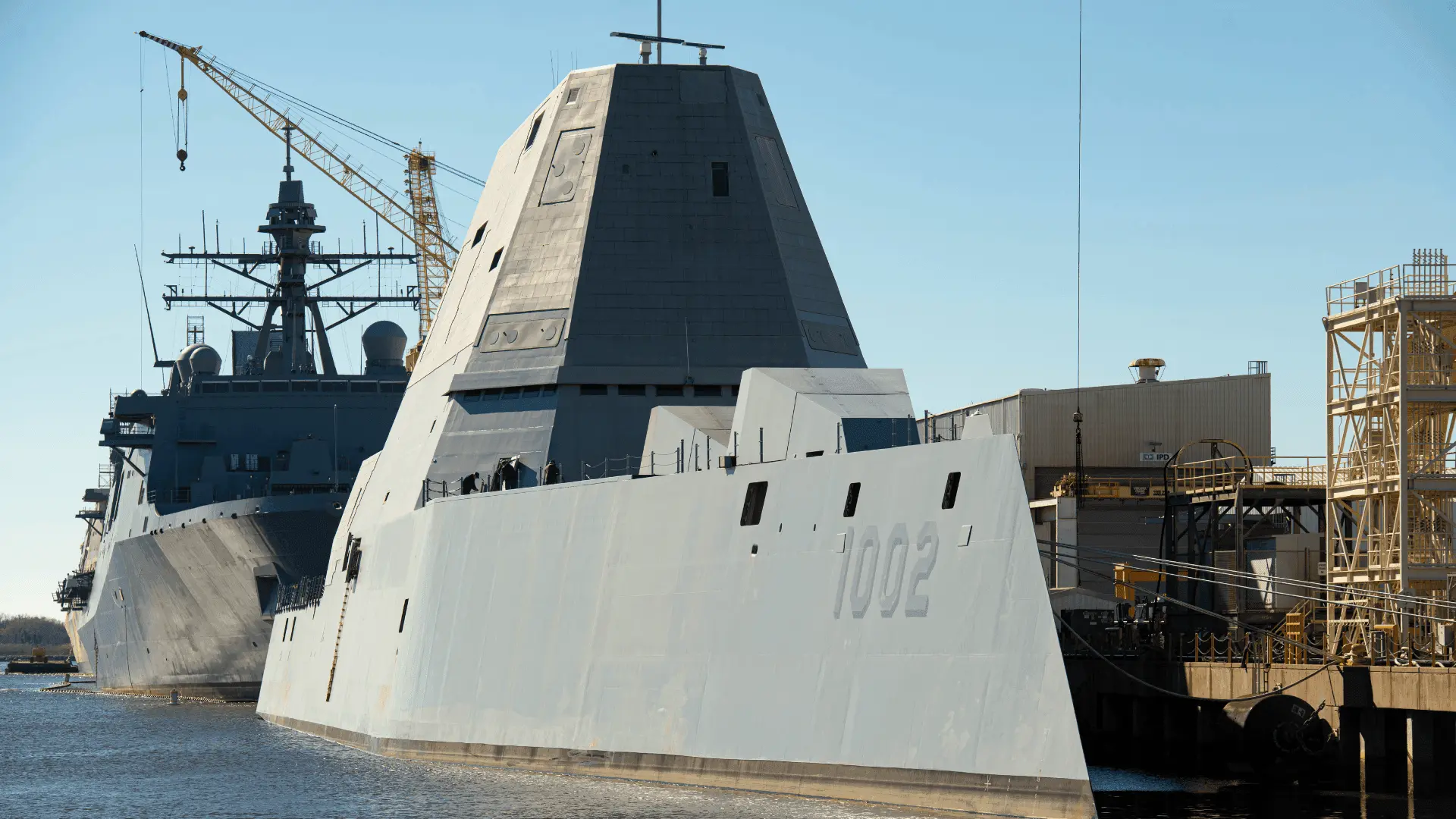
The U.S. Navy has awarded HII’s Ingalls Shipbuilding division a $99.1 million contract modification to take Lyndon B. Johnson (DDG 1002), the third and final Zumwalt-class destroyer, through sea trials at Pascagoula, Mississippi, the shipbuilder announced on October 19, 2026. The ship is also being modernized to become the Navy’s second Conventional Prompt Strike (CPS) hypersonic weapon platform, after lead ship USS Zumwalt (DDG 1000).
The award follows a Government Accountability Office (GAO) report, released July 17, 2026, that found the Navy’s effort to equip all three Zumwalt-class ships for CPS running 24 months behind schedule, with the upgrade estimate rising from $1.8 billion to at least $2 billion. Cut from a planned 32 ships to three, the class was reoriented from littoral land attack to offensive surface strike in 2017 and designated the initial CPS host in 2022. Zumwalt completed builder’s sea trials in January 2026.
DDG 1002 Sea Trials Contract Scope, Funding, and Delivery Timeline
According to the Pentagon’s contract announcement, the $99.1 million modification adds the DDG 1002 sea trials scope to an existing Ingalls contract. About 95 percent of the work will be performed in Pascagoula, with completion expected in October 2028. The Navy obligated approximately $59.3 million at award from fiscal 2025 and fiscal 2026 shipbuilding funds. The announcement did not specify the number of underway periods, the split between builder’s and acceptance trials, or a date for the first trial.
Built by General Dynamics Bath Iron Works in Maine, Lyndon B. Johnson arrived at Ingalls in January 2022 for installation, activation, and testing of its combat systems under the Navy’s phased delivery approach. Ingalls received a $41.6 million cost-incentive-fee contract for that combat systems availability in August 2022. The fiscal 2024 budget then moved delivery from fiscal 2024 to fiscal 2027 so the ship could receive CPS at the yard; the Navy extended the activation period by two years, placed the CPS work on contract in August 2024, and dry-docked the hull in January 2025 for land-level production. The GAO now expects delivery in 2028.
Two factors have slowed the work, according to the GAO. The Navy funded DDG 1002’s combat system activation incrementally and sequenced it behind Zumwalt’s refit. It has also cannibalized parts from DDG 1002 to keep DDG 1000 and USS Michael Monsoor (DDG 1001) operating; those parts must be returned or replaced before the ship can deploy. Ingalls Shipbuilding President Brian Blanchette said the award reflects “the Navy’s continued confidence in the Ingalls team” to execute the test and trials work.
Conventional Prompt Strike Integration on the Second Zumwalt Hull
The CPS conversion removes the two Mk 51 155mm Advanced Gun Systems (AGS), left without an affordable munition after the Long Range Land Attack Projectile was cancelled, and installs a Large Missile Vertical Launch System of four 87-inch-diameter tubes forward. Each tube holds three missiles, for 12 CPS rounds per ship. The launcher uses a cold-gas system, common with the Virginia Payload Module planned for Block V Virginia-class submarines, that ejects the missile from its canister before first-stage ignition at a safe distance above the ship.
Lockheed Martin is prime integrator for the missile, which pairs a two-stage solid rocket motor with the Common Hypersonic Glide Body built by Dynetics. It is the same all-up round the Army fields as the Long-Range Hypersonic Weapon (LRHW), known as Dark Eagle. The missile stands nearly four stories tall, which drove the choice of the 610-foot DDG 1000 hull as the first surface host. Official range figures are classified; publicly reported estimates exceed 1,725 miles (2,775 kilometers). As of April 2026, the Navy estimated unit cost at $63 million to $71 million, averaging about $67 million.
Publicly available specifications indicate the class displaces 15,656 long tons and carries about 78 megawatts of installed power in an Integrated Power System built around two Rolls-Royce MT30 main turbine generators rated at 35.4 MW each and two RR4500 auxiliary turbine generators. That shared electrical plant feeds propulsion and combat systems and remains the class’s chief reliability risk: the GAO cited numerous category 3 and 4 casualty reports on the power system since 2020. The ships retain their 80-cell Mk 57 Peripheral Vertical Launch System, AN/SPY-3 radar, and Total Ship Computing Environment, systems the GAO flagged as costly to sustain.
Analysis: The award buys at-sea validation of a hull, not a fielded capability, and the missile line, not the shipyard, sets the gap between the two. With DDG 1001 converted, the class will hold 36 CPS rounds. The GAO found Lockheed Martin’s facility able to build six to seven missiles a year against the 12 needed to stabilize production, on a line that also supplies the Army’s planned 48 LRHW rounds. At that rate, filling the class once would absorb more than five years of output. A pending decision on replacing the class’s unique combat and network systems, estimated at $1 billion to $2 billion, will shape what that capacity costs to sustain.
The Navy plans the first at-sea CPS flight test from USS Zumwalt in the third quarter of fiscal 2027, when missile procurement is slated to begin. Michael Monsoor is scheduled to enter its modernization period at Ingalls in February 2027. No date has been announced for DDG 1002’s first underway trial, and whether the ship deploys with full spares and missiles aboard remains unresolved.