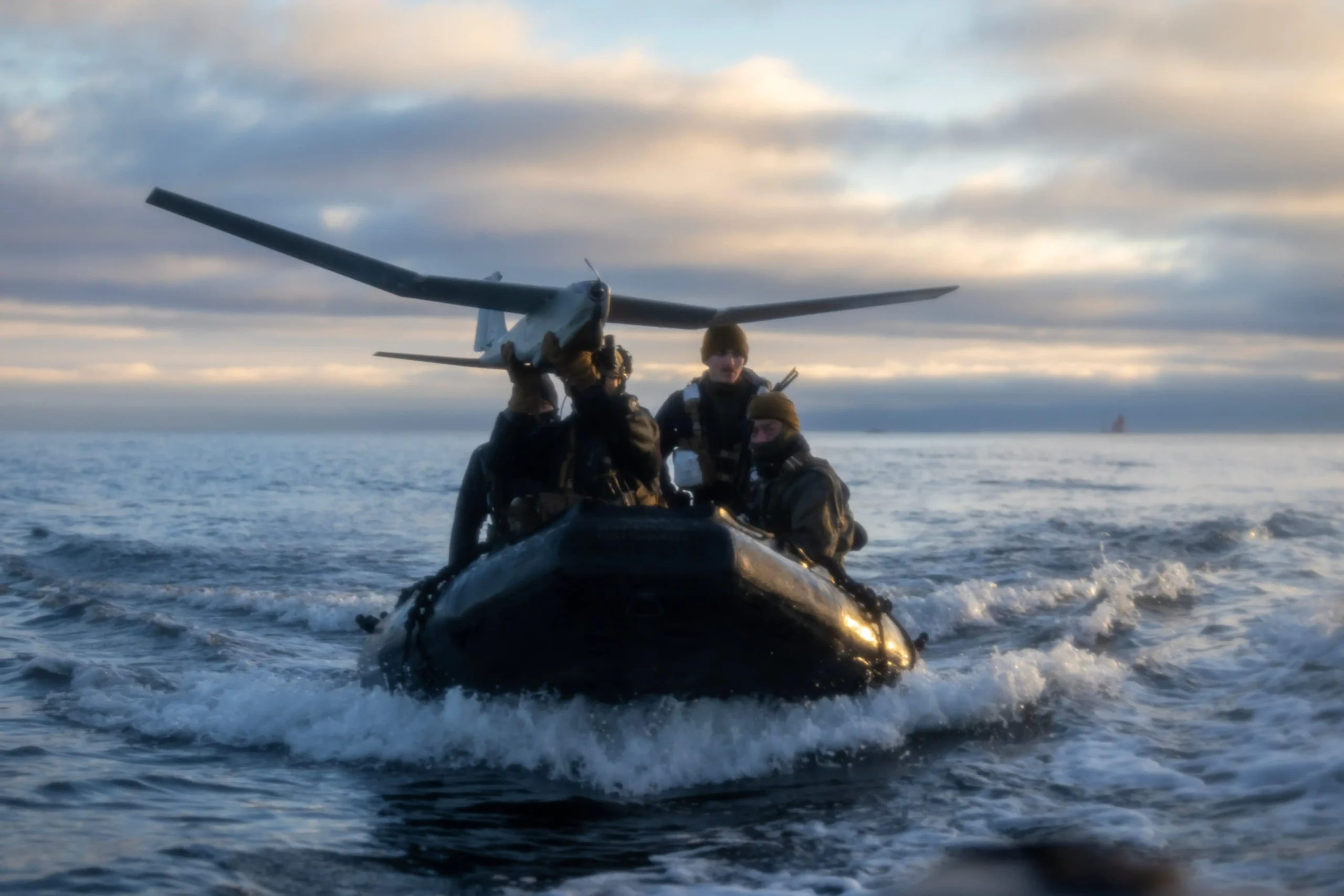
Finland’s Minister of Defence Antti Häkkänen decided on October 19, 2026, that a US Marine Corps unit will work with the Finnish Navy to enhance maritime domain awareness in the Gulf of Finland. The Marines will operate under Baltic Sentry, NATO’s enhanced Vigilance Activity (eVA) in the Baltic Sea, in the second Marine Corps rotation of this kind in Finland after a first deployment in spring 2025.
NATO launched Baltic Sentry on January 14, 2025, at a summit of Baltic Sea Allies in Helsinki. The trigger was the December 25, 2024, incident in which the Cook Islands-flagged tanker Eagle S, widely linked to Russia’s shadow fleet, damaged the Estlink 2 power cable between Finland and Estonia along with four telecommunications cables. The activity aims to strengthen NATO’s presence, prevent and counter threats to critical undersea infrastructure, and build an integrated regional picture. Häkkänen framed the new contribution as a continuation of Finland’s exercises with Allies, noting that a similar cooperation “produced great results in spring 2025.”
Reconnaissance Marines and Littoral Sensors Return to Baltic Sentry
The Finnish decision follows a Pentagon announcement on October 1, 2026, that approximately four dozen Marines from the 2nd Reconnaissance Battalion, 2nd Marine Division, and the II Marine Expeditionary Force Information Group, based at Camp Lejeune, North Carolina, would be redirected from an existing deployment in Europe to the Baltic Sea region. The team will operate alongside the Finnish Navy’s Coastal Brigade, providing expeditionary surveillance and tactical reconnaissance.
According to the Pentagon, the rotation relies on small unmanned aircraft systems (sUAS) and littoral sensors whose data feeds directly into NATO’s shared common operational picture. That architecture matters more than the headcount: each detection collected along the Finnish coast becomes available to Allied maritime commanders rather than remaining a purely national track.
Command arrangements keep Washington in a supporting role. European Allies lead Baltic Sentry through Allied Joint Force Command Brunssum and Allied Maritime Command (MARCOM), with the Marines providing an enabling capability. Major General Daniel Shipley, commander of US Marine Corps Forces, Europe and Africa, presented the deployment as evidence that the Corps can quickly project specialized capabilities and as a contribution to deterring hybrid threats in the Baltic littoral.
Several details remain undisclosed. Neither Helsinki nor the Pentagon has published the start date, the duration of the rotation, the basing location, or the specific sUAS and sensor models assigned to the team.
Spring 2025 Precedent: RQ-20 Puma Drones Over the Gulf of Finland
The template dates to February 21, 2025, when Häkkänen approved a platoon-sized Marine unit for Baltic Sentry. Roughly 40 Marines from the same battalion deployed from Camp Lejeune and worked with the Coastal Brigade from late February, identifying and tracking vessel movements and monitoring undersea infrastructure. It was the first activity between the Finnish Defence Forces and the Marine Corps since the US-Finland Defense Cooperation Agreement (DCA) entered into force in September 2024.
The signature capability was the AeroVironment RQ-20 Puma, which Marines launched from combat rubber reconnaissance craft off southern Finland. Publicly available manufacturer specifications for the Puma AE (All Environment) indicate a hand-launched, 6.3 kg air vehicle with a 2.8 m wingspan, more than three hours of endurance with a long-endurance battery, a range of about 20 km on the standard datalink, and a stabilized electro-optical and infrared gimbal with an infrared illuminator. The waterproof airframe can land at sea, allowing recovery from small boats in littoral waters. The exact Puma variant fielded has not been disclosed.
The operational payoff was identification. Commodore Marko Laaksonen, the Finnish Navy’s deputy chief of staff for operations, said in April 2025 that Marine drones could be sent to confirm the type and activity of vessels in the Gulf of Finland. He also reported that Allied response times to suspicious vessels had fallen from around 17 hours to under one hour since Baltic Sentry began.
Analysis: The Marine contribution is small, but it targets a specific gap. The Gulf of Finland is a narrow, congested waterway that carries the Estlink power links and the Balticconnector gas pipeline and leads to Russia’s Primorsk and Ust-Luga export terminals. Coastal radar and Automatic Identification System (AIS) data show where ships are; boat-launched sUAS add visual confirmation at short notice, turning radar tracks into identified contacts that national authorities can act on. Re-tasking a reconnaissance team already in Europe also fits a model in which European Allies lead and Washington supplies niche enablers rather than large formations.
The key unknowns are the rotation’s start date and length, and whether Helsinki and Washington will turn these deployments into a recurring pattern under the DCA. Further detail on the team’s sensor package and operating area is likely to emerge once the Marines begin working with the Coastal Brigade.