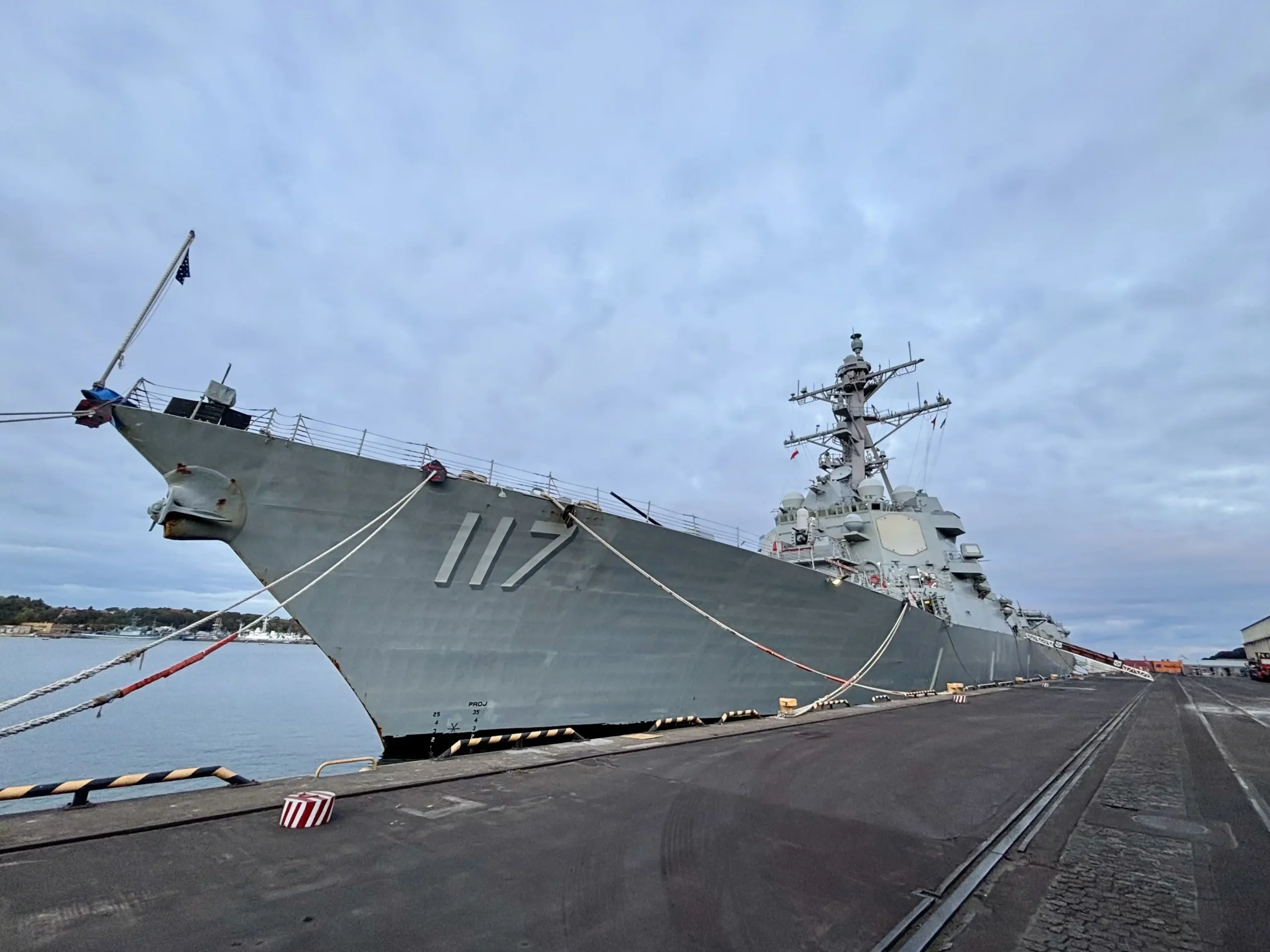
The US Navy Arleigh Burke-class guided-missile destroyer USS Paul Ignatius (DDG 117) departed Gdynia, Poland, on October 13, 2026, after a scheduled port visit that closed a two-week Nordic and Baltic sequence built around trilateral operations with the Swedish and Finnish navies in the Baltic Sea and the Gulf of Bothnia.
The Gdynia call caps roughly a month in Northern European waters for one of US 6th Fleet’s Forward Deployed Naval Forces-Europe (FDNF-E) destroyers, homeported in Rota, Spain, since June 17, 2022. The deployment unfolds in a Baltic now bordered overwhelmingly by NATO members after Finland’s accession on April 4, 2023, and Sweden’s on March 7, 2024, and alongside Baltic Sentry, the Alliance activity launched in January 2025 to protect undersea cables and pipelines.
USS Paul Ignatius Gulf of Bothnia Transit and Trilateral Live Fire
The destroyer arrived in Stockholm on October 1. On October 5, Swedish and Finnish ship riders embarked and integrated directly into its navigation department, supplying local knowledge and hydrographic expertise for the shallow, constricted channels of the northern Baltic.
Underway, the three navies ran what the Navy described as high-end air defense scenarios and live firing against unmanned surface targets to validate combined targeting procedures and joint air defense integration. The ship arrived in Helsinki on October 8. The service called the passage a milestone for regional defense integration but did not say whether Paul Ignatius was the first US destroyer to transit the gulf.
Rear Adm. Tuomas Tiilikainen, commander of the Finnish Navy, tied the drills to securing the sea lines of communication Finland and Sweden rely on for allied operations and security of supply. In Stockholm and Helsinki, Vice Adm. J.T. Anderson, commander of US 6th Fleet, met Finnish and Swedish military leaders to discuss maritime infrastructure protection, High North response options and coordination along NATO’s northern flank.
Paul Ignatius reached Gdynia, home of the Polish Navy’s 3rd Ship Flotilla, on October 11. The crew hosted shipboard tours for visitors, while sailors traveled to Naval Support Facility Redzikowo and joined a Morale, Welfare and Recreation walking tour of Gdansk.
“Poland is one of our closest Allies, and the crew is proud to bring Paul Ignatius to Gdynia,” said Cmdr. William Burke, the ship’s commanding officer. “Our time operating alongside the Swedish and Finnish navies showed what Allies can do together in the Baltic Sea, and visits like this one build the trust that makes it possible.”
Flight IIA Aegis Firepower and the Link to Aegis Ashore Poland
Built by Huntington Ingalls Industries at Pascagoula, Mississippi, and commissioned on July 27, 2019, Paul Ignatius is a Flight IIA restart hull, publicly reported as a technology insertion ship carrying selected Flight III features. Publicly available specifications indicate a length of about 155 meters, with full-load displacement cited between roughly 9,300 and 10,100 tonnes; four General Electric LM2500 gas turbines produce around 100,000 shaft horsepower for speeds above 30 knots. The AN/SPY-1D(V) radar cues a 96-cell Mk 41 Vertical Launching System able to mix SM-2, SM-3 and SM-6 interceptors, Evolved Sea Sparrow Missiles, Tomahawk land-attack missiles and vertical-launch ASROC, backed by a Mk 45 5-inch gun and two MH-60R Seahawk helicopters.
That flexibility was tested just before the Nordic leg. During Atlantic Thunder 2026, a US-UK sinking exercise off Scotland from September 14 to 25, the destroyer fired the anti-surface variant of the Standard Missile 6 at the decommissioned frigate ex-USS Klakring (FFG 42), testing it toward the upper end of its range. The Navy withheld the distance; open-source estimates put SM-6 range near 370 km, which does not establish how far the round flew. The Virginia-class attack submarine USS Massachusetts (SSN 798) then sank the hulk with a Mk 48 torpedo.
The Redzikowo visit connected the ship to its land-based twin. Aegis Ashore Poland pairs an AN/SPY-1D(V) radar with Mk 41 launchers for the SM-3 Block IIA, an exo-atmospheric hit-to-kill interceptor that engages ballistic missiles in midcourse. Part of the third phase of the European Phased Adaptive Approach alongside the Deveselu site in Romania, it reached mission readiness in July 2024 and came under NATO command that November; open-source reporting puts its load at up to 24 interceptors. Rota’s destroyers and the two ashore sites form the sea and land layers of NATO ballistic missile defense in Europe.
Analysis: The sequence shows 6th Fleet using one FDNF-E destroyer to rehearse the arc of a northern flank contingency: long-range anti-surface strike with a NATO ally in the North Atlantic, then integrated air defense and pilotage-dependent maneuver with the Alliance’s two newest members in the Baltic’s most confined waters. The ship rider model is the transferable lesson, since embedding allied navigators opens archipelago and Bothnian waters to US combatants without new infrastructure. The limit is mass. A single destroyer from the small Rota squadron can demonstrate access but not sustain presence, leaving routine Baltic surface coverage to the Swedish, Finnish and Polish navies and to NATO activities such as Baltic Sentry.
The Navy has not announced the destroyer’s next port or tasking. The Navy will analyze impact zones and other technical data from Atlantic Thunder over the coming months, work that could inform SM-6 anti-surface employment. Indicators to watch include whether 6th Fleet makes ship-rider transits of the Gulf of Bothnia a recurring event and whether more US surface combatants follow Paul Ignatius into the northern Baltic in 2027.