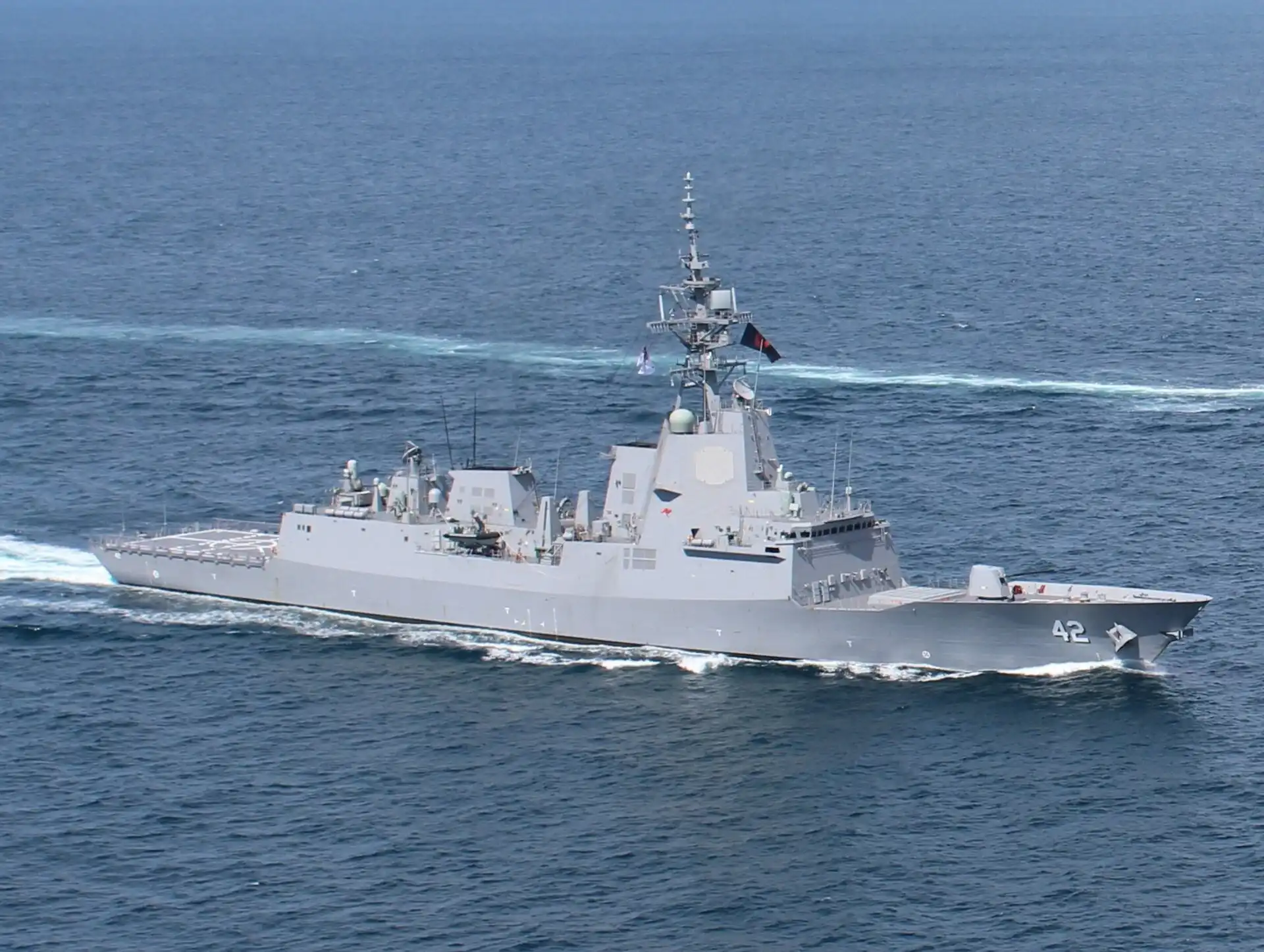
Royal Australian Navy (RAN) guided-missile destroyer HMAS Sydney (DDG 42) returned to Fleet Base East in Sydney on October 18, 2026, closing a 131-day Indo-Pacific deployment that included a live Naval Strike Missile (NSM) firing at Exercise Rim of the Pacific (RIMPAC) 2026, ballistic missile defense training off Hawaii and presence operations in the South China Sea alongside Anzac-class frigate HMAS Stuart.
Sydney sailed on June 9 under the Australian Defence Force’s Regional Presence Deployment program, the mechanism Canberra uses to sustain the near-continuous naval presence set out in the 2026 National Defence Strategy. The timing stretched a three-ship destroyer force. Lead ship HMAS Hobart has been at Osborne Naval Shipyard since February 2026 for the Destroyer Capability Enhancement (DCE) program, leaving Sydney and HMAS Brisbane as the only Hobart-class hulls available for operations. For more than four months, half of that deployable force was forward in the Pacific.
HMAS Sydney Deployment Spans RIMPAC, Pacific Dragon and Guam Drills
Sydney exercised with forces from the United States, Japan, Canada, New Zealand, the Republic of Korea, Spain, Chile, Italy and Indonesia, according to the Department of Defence. RIMPAC 2026 ran from June 24 to July 31 around the Hawaiian Islands, and Sydney’s centerpiece was a multinational sinking exercise (SINKEX) against the decommissioned Ticonderoga-class cruiser ex-USS Mobile Bay (CG 53).
The destroyer moved straight into Pacific Dragon 2026, the eighth iteration of the biennial ballistic missile defense (BMD) and tactical data link exercise run by U.S. 3rd Fleet with the Missile Defense Agency off Kauai from August 6 to 15. Sydney operated with a Royal Australian Air Force E-7A Wedgetail and warships from six nations, including Spanish frigate Álvaro de Bazán, lead ship of the Navantia F100 class from which the Hobart design derives.
Sydney then sailed to Guam for Pacific Vanguard 2026, held from August 29 to September 10 with Japanese, Canadian, South Korean, New Zealand and U.S. units. Japan Maritime Self-Defense Force (JMSDF) releases list missile firings, anti-surface gunnery, anti-air and anti-submarine warfare (ASW) and counter-unmanned aircraft system (C-UAS) serials. Exercise Nichi-Gou Trident 26-2 with JMSDF destroyer JS Fuyuzuki followed from September 12 to 14, again centered on ASW and C-UAS.
In the South China Sea, Sydney rejoined Stuart for joint training in international waters, including ASW serials. Defence described the activity as exercising rights and freedoms under international law but has not disclosed dates, positions or any interactions with Chinese forces. Sustaining the deployment required 17 replenishment-at-sea evolutions, including two helicopter resupply serials.
Naval Strike Missile Live Fire Extends Hobart-Class Strike Reach
The RIMPAC SINKEX marked the RAN’s second NSM shot at the exercise. At RIMPAC 2024, Sydney fired the service’s first NSM, striking the former amphibious assault ship USS Tarawa (LHA 1). The missile replaces the RGM-84 Harpoon across the surface fleet.
Publicly available specifications indicate the Kongsberg Defence & Aerospace weapon weighs roughly 410 kg at launch, carries a warhead of about 120 kg and reaches targets beyond 185 km in a high-subsonic, sea-skimming profile. Midcourse navigation blends GPS, inertial and terrain-referenced updates; terminal homing uses a passive imaging infrared seeker with automatic target recognition. That seeker is the operational point. Unlike the active radar seeker on Harpoon Block II, whose published range is about 124 km, NSM emits no radio-frequency signature for an adversary’s electronic support measures to detect during the terminal run. Open-source reporting indicates the RAN carries NSM in deck-mounted launchers, keeping all 48 vertical launch cells free for interceptors and, later, Tomahawk.
After the missile impact, Sydney’s embarked MH-60R Seahawk, Flight 607 “Fenrir,” fired two AGM-114 Hellfire missiles at the hulk. A second RAN MH-60R, Flight 605 “Dundee,” flying from U.S. Navy destroyer USS Wayne E. Meyer (DDG 108), fired two more. “Participation in high-end warfighting exercises throughout the deployment demonstrated Sydney’s readiness, lethality and warfighting capability,” said Commanding Officer Commander Hayden Jenkins.
Hobart-Class Specifications and the Aegis Baseline 9 Upgrade Path
Commissioned on May 18, 2020, Sydney is the third and final Hobart-class destroyer built at Osborne by the Air Warfare Destroyer Alliance. RAN figures give a full-load displacement of 7,000 tonnes, a crew of about 180, a top speed above 28 knots and a range of 4,500 nautical miles at 18 knots. The Aegis Combat System and AN/SPY-1D(V) radar guide SM-2 and Evolved Sea Sparrow Missiles from a 48-cell Mk 41 vertical launch system against air threats beyond 150 km. A 5-inch Mk 45 gun, MU90 torpedoes, hull-mounted and towed-array sonars, Phalanx, two 25 mm Bushmaster guns on Typhoon mounts and Nulka active decoys complete the fit.
In 2024, Sydney became the first Australian warship to fire the Standard Missile 6 (SM-6), during that year’s Pacific Dragon. Using SM-6 for terminal BMD, however, depends on the DCE upgrade under Project SEA 4000 Phase 6, which moves the class to Aegis Baseline 9, integrates the Tomahawk Weapon System with a published reach beyond 1,500 km and adds Saab Australia’s new combat system interface. Hobart left dry dock in August 2026 and is preparing for Combat Systems Light Off. Brisbane and Sydney will follow in the coming years; Defence has not published yard dates for either ship.
Analysis: Sydney’s cruise shows the Hobart class already functioning as a multi-mission combatant before its upgrade: a stand-off anti-ship strike, a layered helicopter attack on the same target, BMD data link work with six navies and ASW from Guam to the South China Sea. The binding constraint is depth, not capability. Three hulls and 144 vertical launch cells must cover fleet air defense, strike and regional presence while one ship at a time is withdrawn for modernization. Every mission the DCE adds will compete for the same 48 cells per ship.
Defence has not announced Sydney’s post-deployment maintenance schedule. The next milestone for the class is Hobart’s Combat Systems Light Off and return to sea under Baseline 9. Until Hobart rejoins the fleet, the RAN must keep one destroyer forward while the other regenerates.