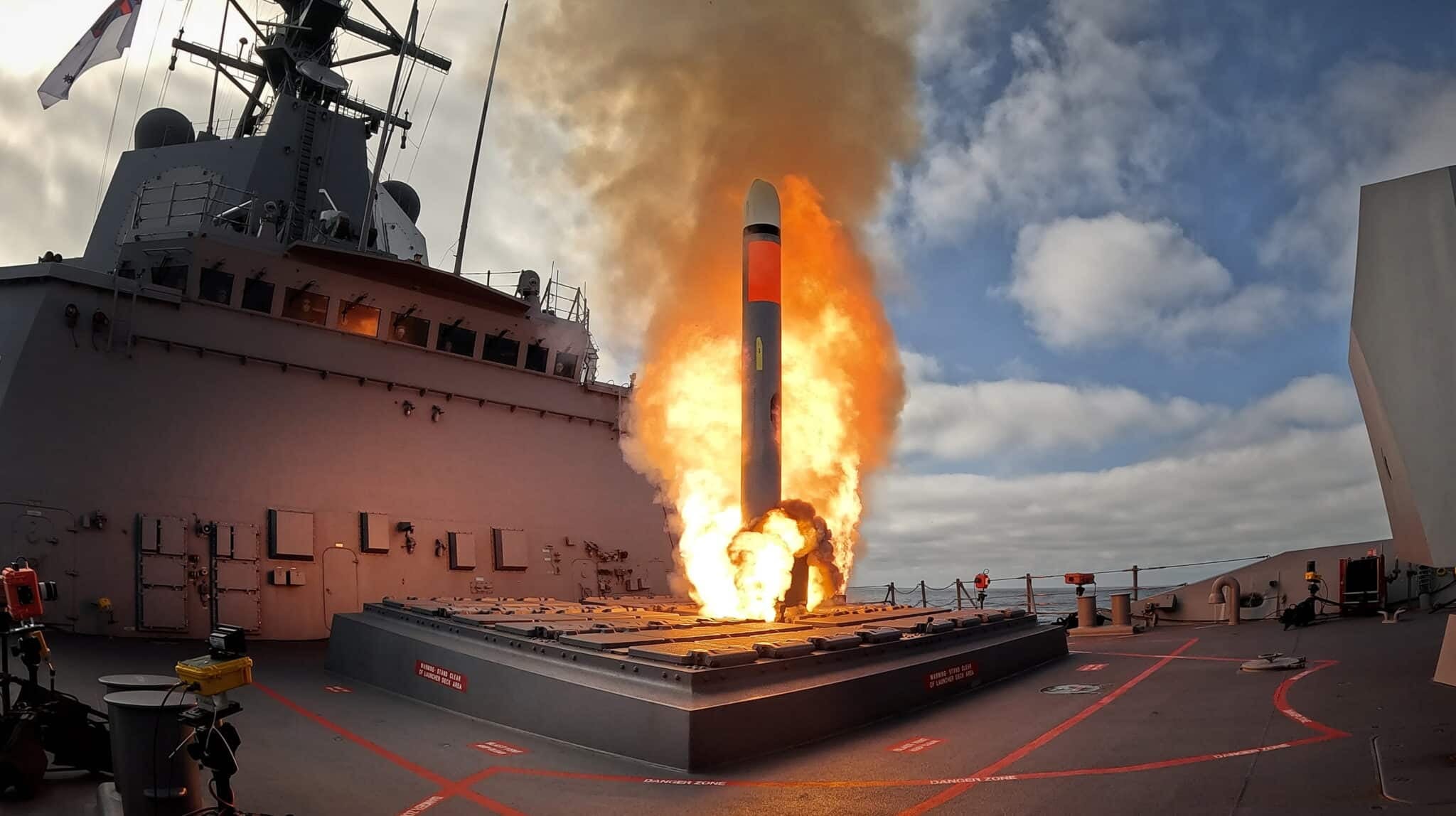
The US State Department on October 8, 2026, approved a possible $300 million Foreign Military Sale to Australia for Tomahawk mission planning infrastructure, covering a Theater Mission Planning Center (TMPC), associated communications systems and a TMPC Mission Planning System (MPS). Notified to Congress as Transmittal 26-103, the package includes no missiles. It funds the targeting and route-planning layer that turns Australia’s Tomahawk inventory into an employable strike capability.
The case is Canberra’s third Tomahawk-related notification since March 2023, when Washington cleared up to 200 Block V and 20 Block IV all-up rounds for an estimated $895 million. A $250 million case for Tomahawk Weapon System support services followed in January 2024. Australia has committed approximately A$1.3 billion to buy more than 200 missiles, and the Royal Australian Navy (RAN) became the third Tomahawk operator, after the United States and the United Kingdom, when HMAS Brisbane fired the weapon off California in December 2024.
Australia Tomahawk Mission Planning: What the $300 Million Package Buys
According to the notification, Australia requested the TMPC and its communications systems, the TMPC MPS, and program management, engineering, training and logistics services supporting the development, procurement and delivery of the MPS. The release does not break out quantities, a major defense equipment value or a delivery schedule. Its wording points to a development effort rather than an off-the-shelf transfer.
The TMPC is one of three segments of the Tomahawk Weapon System (TWS), alongside the all-up round and the Tactical Tomahawk Weapon Control System (TTWCS) installed on the firing ship. In US Navy service, the TMPC performs precision targeting, route planning, mission distribution and strike management. Planners build missions from imagery, terrain and target data, then push mission packages to firing units, where the TTWCS manages engagement planning and launch.
That workflow shapes how the missile fights. Publicly available specifications indicate that Block IV and Block V rounds combine inertial and GPS navigation with terrain contour matching and digital scene matching, carry a 1,000-pound-class warhead and use a two-way satellite datalink for in-flight retargeting and loiter. Australian Defence statements have cited ranges between 1,500 km and 2,500 km. Block V upgrades navigation and communications. Each of those modes depends on mission data that a planning system must generate, validate and update.
The four principal contractors are BAE Systems in San Diego, California; Tapestry Solutions in St. Louis, Missouri; Peraton in San Jose, California; and Leidos in Virginia Beach, Virginia. The notification does not assign work shares. Open-source contract records tie Tapestry Solutions, a Boeing subsidiary, to the Tomahawk Mission Planning System and Peraton to US Navy development and sustainment of the TMPC. No offset agreement has been proposed, and implementation requires no additional US government or contractor personnel in Australia.
Three FMS Cases and the Hobart-Class Upgrade Behind Australia’s Tomahawk Force
Read together, the three cases outline a staged build-out of the full weapon system. The 2023 approval covered missiles plus support for all three TWS segments, the 2024 case added recurring support services, and the 2026 case funds development of the planning system itself. Notified ceilings now total $1.445 billion, although congressional notifications set maximum values, not contract prices.
The platform side is moving in parallel. HMAS Hobart undocked on August 20, 2026, completing a yard period that began in February under the Destroyer Capability Enhancement, part of Project SEA 4000 Phase 6. BAE Systems Australia is performing the work at Osborne Naval Shipyard, moving the class to Aegis Baseline 9 and installing Saab Australia’s new Australian Interface, which supports Tomahawk integration alongside SM-6 and the Naval Strike Missile. HMAS Brisbane and HMAS Sydney follow in sequence, since taking two of the three hulls offline at once would leave a single destroyer available. The upgrade builds on a 2024 test series off the US West Coast in which HMAS Sydney fired the Naval Strike Missile and SM-6 before Brisbane’s Tomahawk shot.
Each Hobart-class destroyer keeps its 48-cell Mk 41 Vertical Launching System, so every Tomahawk embarked displaces an SM-2 or SM-6. That ceiling raises the premium on planning efficiency, since each round loaded for land attack must be matched to a target worth the cell. Beyond the destroyers, Australian Defence has said Tomahawk will arm the Virginia-class submarines due under AUKUS from the early 2030s and potentially the Hunter-class frigates, pending feasibility studies. The first Hunter-class hull was laid down in August 2026.
Analysis: The $300 million buys no new firepower, but it targets the element that separates owning Tomahawk from employing it at scale. Planning capacity governs how fast targets can be developed, routes deconflicted and missions retasked once a campaign is under way. Because no additional US personnel are expected in Australia, the case points toward an Australian-staffed planning node. For Washington, that adds allied strike depth in the Indo-Pacific alongside Japan’s purchase of up to 400 Tomahawks. For Canberra, it is a precondition for spreading Tomahawk fires across destroyers, submarines and possibly frigates.
Congressional notification does not mean a contract has been signed. Open questions include the MPS development timeline, where the planning center will be hosted, how work divides among the four contractors and whether the new equipment replaces or expands the TMPC support approved in 2023. The next markers are a Letter of Offer and Acceptance, Hobart’s post-refit sea trials and the induction of the next destroyer into the upgrade.