Australia and Indonesia concluded Exercise Keris Woomera 26 on October 20, 2026, closing nine days of combined joint training in East Java, the Bali Sea and surrounding waters that the Australian Defence Force (ADF) describes as its largest overseas training activity of the year. The exercise saw an Australian Army High Mobility Artillery Rocket System (HIMARS) deploy and fire outside Australia for the first time.
About 1,000 ADF personnel trained alongside 1,235 members of the Indonesian National Armed Forces (Tentara Nasional Indonesia, TNI) after an opening ceremony in the East Java port of Banyuwangi. Keris Woomera is biennial and was first staged in November 2024, weeks after Canberra and Jakarta signed the Australia-Indonesia Defence Cooperation Agreement on August 29, 2024, which Australia calls the most significant defence agreement in the history of the relationship. The 2026 iteration kept the inaugural edition’s amphibious and live-fire core, then extended it into the cyber domain and added long-range rocket artillery to the combined fires picture.
Keris Woomera 26 Force Package Across Sea, Land and Air
The amphibious line of effort centered on the Australian Amphibious Force embarked on HMAS Choules, a Bay-class landing ship dock acquired from the United Kingdom in 2011. Working with landing craft and a maritime tactical operations team, the force projected and sustained combat power from sea to shore alongside Indonesian Marine Corps infantry. The platform choice differs from 2024, when the Canberra-class landing helicopter dock HMAS Adelaide anchored the Australian contribution. Choules offers far less aviation capacity than an LHD, but its well dock and vehicle deck are built for exactly the ship-to-shore sustainment the 2026 scenario stressed.
A separate Maritime Task Group combined the Anzac-class frigate HMAS Perth and the Supply-class replenishment oiler HMAS Stalwart, with embarked MH-60R Seahawk helicopters, and an Indonesian Navy Diponegoro-class corvette operating AS565 Panther helicopters. The Diponegoro class is a Dutch-designed SIGMA 9113 corvette, so the serials tested tactical manoeuvring and joint procedures between a Royal Australian Navy group built around US-sourced rotary-wing anti-submarine warfare and an Indonesian force equipped largely from European suppliers.
Ashore, Australian M777 155mm towed howitzers fired alongside TNI 105mm howitzers and multiple launch rocket systems. Publicly available specifications credit the M777 with a range of roughly 30 km using rocket-assisted projectiles and about 40 km with the M982 Excalibur guided round. Defence did not identify which TNI rocket systems took part.
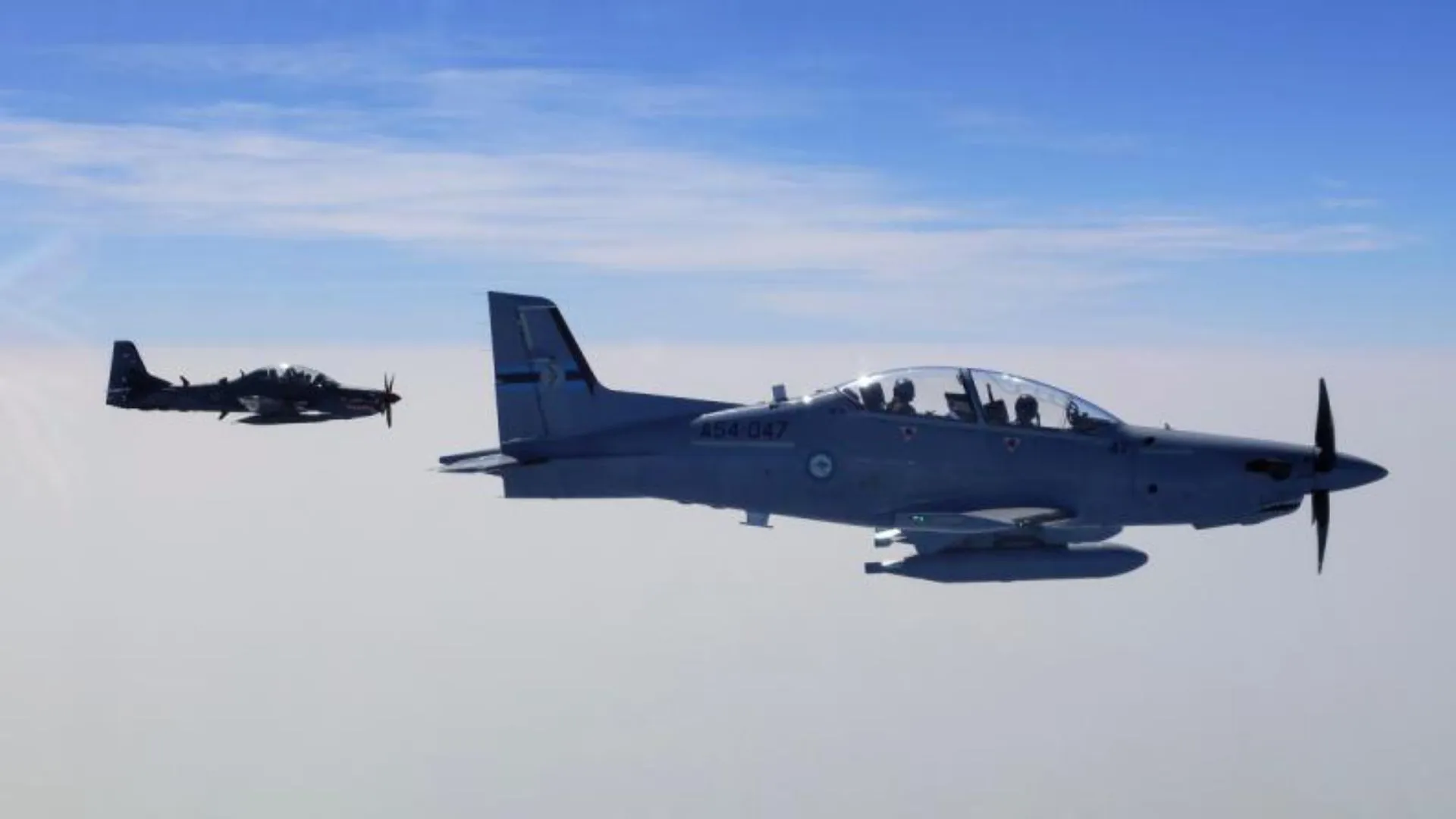
In the air, Royal Australian Air Force (RAAF) PC-21 and C-130J Hercules aircraft flew close air support, forward air control and airlift missions with TNI EMB-314 Super Tucano light attack aircraft, Bell 412 helicopters and Joint Terminal Attack Controllers (JTACs). Supporting serials brought in defensive cyber operations teams, range control parties and Role 2 Forward treatment teams, the deployable element that provides damage control surgery close to the fight.
HIMARS Overseas Live Fire and the ADF’s Three Operational Firsts
The HIMARS live fire carries the most strategic weight. The Australian Army operates the M142 launcher with 54th Siege Battery, 14th Regiment, Royal Australian Artillery, part of the Adelaide-based 10th Fires Brigade. Canberra ordered 42 launchers under Project LAND 8113 Phase 1, received its first units in early 2025 and took delivery of a second tranche earlier this month. An Australian HIMARS fired a Precision Strike Missile (PrSM) during Exercise Talisman Sabre 2025, and in April 2026 the government committed A$2.3 billion over the next decade to HIMARS and PrSM for a second long-range fires regiment that it says will contribute to sea control and sea denial.
Defence has not disclosed which munition was fired in Indonesia. The launcher carries either six Guided Multiple Launch Rocket System (GMLRS) rockets, with publicly available specifications indicating a range of about 70 km, or two PrSM, whose range exceeds 400 km. Shipping the launcher abroad and firing it alongside TNI artillery validates the deployment chain the Army needs to operate long-range fires from forward positions across Australia’s northern approaches.
The second first involved No. 4 Squadron RAAF, the Williamtown-based unit that flies the PC-21 in the forward air control role and leads ADF JTAC training. Keris Woomera 26 was the squadron’s first deployment into South-East Asia since World War II. The third was the first Australian cyber integration training with Indonesia; Defence released no detail on its scope.
Analysis: Keris Woomera 26 shows Canberra using Indonesia as a partner for rehearsing the expeditionary enablers of its strategy of denial: sea lift, sustainment, joint fires and now cyber. Firing HIMARS on Indonesian soil normalizes the presence of Australian long-range fires in the archipelago that forms Australia’s northern approaches, without implying any basing arrangement. The limits remain real. The Defence Cooperation Agreement is not a mutual defence treaty, and Jakarta’s free and active foreign policy keeps it exercising with a wide range of partners, including Russia, whose navy drilled with Indonesia in the Java Sea in November 2024.
Commander Joint Operations Vice Admiral Justin Jones said the experience “strengthens our ability to move and sustain forces when required, enhances our readiness and contributes to the collective security of our region.” On the biennial cycle, the next iteration falls in 2028. Open questions include the munition fired in East Java, whether PrSM will appear in future overseas serials and how far the new cyber track develops.