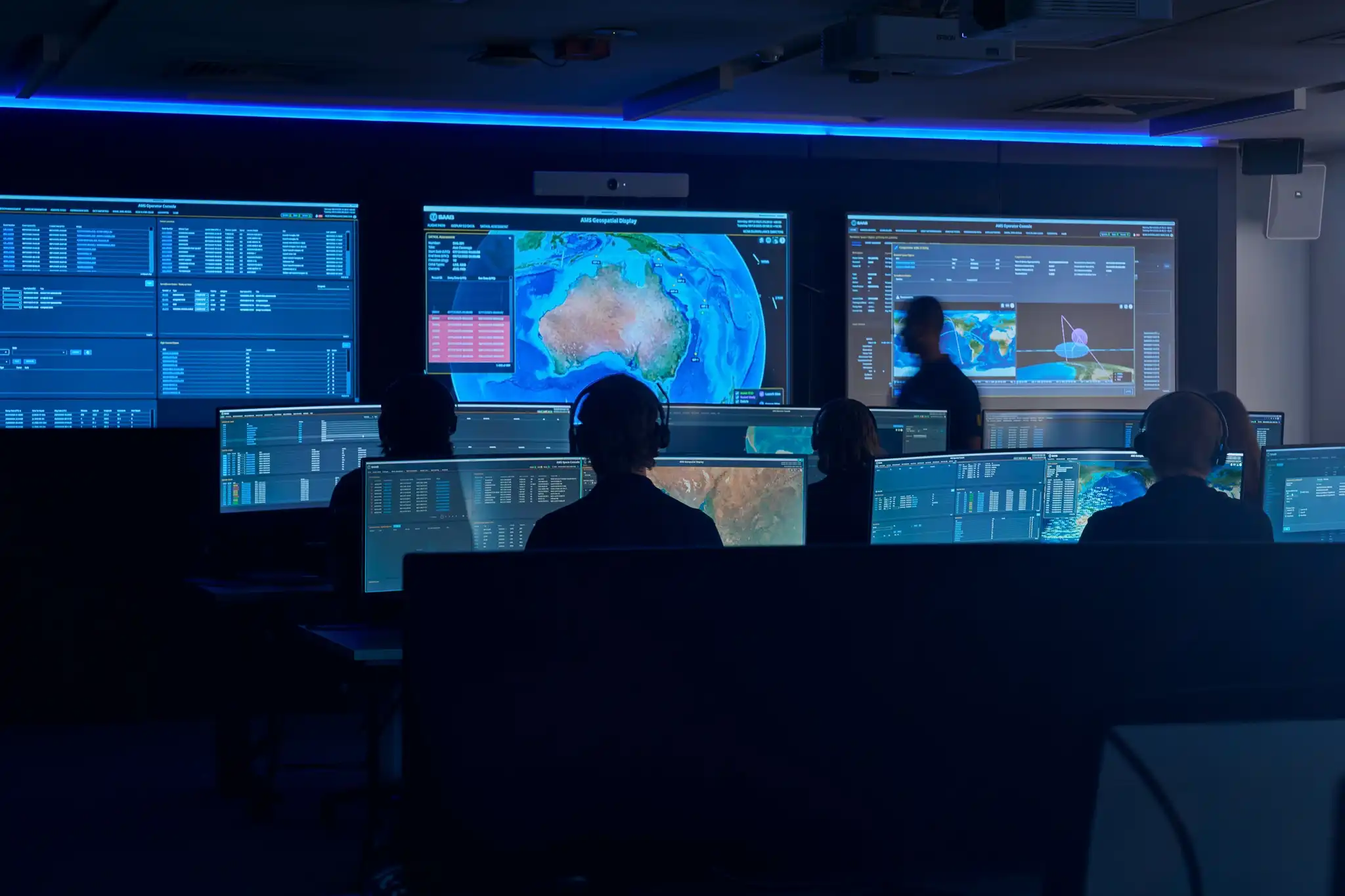
Saab launched the Allied Mission System (AMS) on October 20, 2026, a cloud-based software platform that combines space domain awareness (SDA), mission management and command and control (C2) in a single open architecture. Designed and built by Saab Australia in South Australia, the system will be offered to customers worldwide as Software as a Service (SaaS) rather than delivered as a fixed hardware and software package.
The launch comes as Canberra turns space from a supporting enabler into a funded warfighting domain. The 2026 Integrated Investment Program (IIP) allocates between A$27 billion and A$38 billion through 2035–36 to space and cyber, including space sensors and space control. The Australia-US Space Surveillance Telescope at Exmouth, Western Australia, reached Final Operating Capability in August 2025, Exmouth also hosts the first site of the trilateral Deep Space Advanced Radar Capability (DARC), and the Australian Defence Force has opened trials of domestic sensors. More sensors produce more tracks; operators still need a layer that fuses them into a usable picture and converts that picture into tasking. AMS is built to occupy that layer.
How the Allied Mission System Turns Sensor Data Into Space C2
Saab describes AMS as a three-stage chain. The platform first ingests and fuses data from integrated sensors and third-party assets. It then runs automated analysis to generate insights and decision support. Finally, it provides C2 functions that let operators coordinate assets, task systems and manage missions, closing the loop from detection to action.
The architecture is modular. Data services, mission services and applications are designed to evolve independently, which Saab says allows rapid integration of emerging technologies as threats change. The company also states that AMS is built for future integration with broader multi-domain operations ecosystems, the joint networks that link space effects to air, maritime and land operations.
The SaaS delivery model is the more consequential design choice. Rather than a capability frozen at acceptance, customers would receive continuous software updates and expand functionality to match operational requirements. For space operators tracking maneuvering satellites, proximity operations and a growing debris population, update speed matters as much as sensor coverage.
“Almost everything we do relies on space in some way and we have designed our new AMS platform to give the user the capability to act in this highly congested and contested domain,” said Andy Keough, Managing Director of Saab Australia.
Key parameters remain undisclosed. Saab has not named a launch customer, the sensors already integrated, the orbital regimes covered, the hosting environment, or the security classification at which the cloud service can operate. Nor has it specified whether the system’s response function extends beyond sensor tasking to support space control effects.
From DSTG Research Software to a Sovereign Space C2 Product
AMS builds on several years of Saab Australia work in the space segment. The company helped the Defence Science and Technology Group (DSTG) develop space domain awareness software, including algorithms to detect and monitor objects in orbit, newly launched objects and decaying objects re-entering the atmosphere. It also helped develop a space mission control system to help DSTG scientists manage their space-based research assets.
On the ground, Saab Australia develops the sovereign Australian Combat Management System (AusCMS) for the Royal Australian Navy’s Hobart-class destroyers and Hunter-class frigates, and opened a Sovereign Combat Systems Collaboration Centre at Mawson Lakes, north of Adelaide, in 2025. AMS transfers that sensor-fusion and C2 lineage to orbit.
“As space becomes an increasingly important domain for national security, South Australian based companies like Saab are helping develop the sovereign capabilities Australia needs,” said Chris Picton, South Australia’s Minister for Defence and Space Industries.
At group level, Saab announced on September 24, 2026, that it had signed memoranda of understanding with SSC Space, OHB Sweden and Ericsson to expand its role as a space system integrator. AMS gives that ambition a deployable software product.
Analysis: Saab is positioning itself in the software layer, where SDA value increasingly concentrates as sensor numbers multiply. Australia’s own trials, including a passive radio frequency sensor in South Australia and automated tasking experiments on a ground-based optical telescope, point to a growing mix of domestic sensors that will need a common fusion and tasking layer. The “Allied” branding and SaaS model signal an aim at coalition partners and mid-sized space powers, but national security space C2 depends on classification, accreditation and data sharing with US Space Force networks. Until Saab demonstrates accredited hosting and interoperability with those networks, AMS remains a credible product without a program of record.
The next markers are a launch customer, disclosure of integrated sensors and accreditation level, and whether Defence considers AMS for space sensor and space control funding under the 2026 IIP. Saab has not published a fielding timeline. Uptake in Europe, where the group is building space partnerships, would show whether an Australian-built space C2 product can travel.