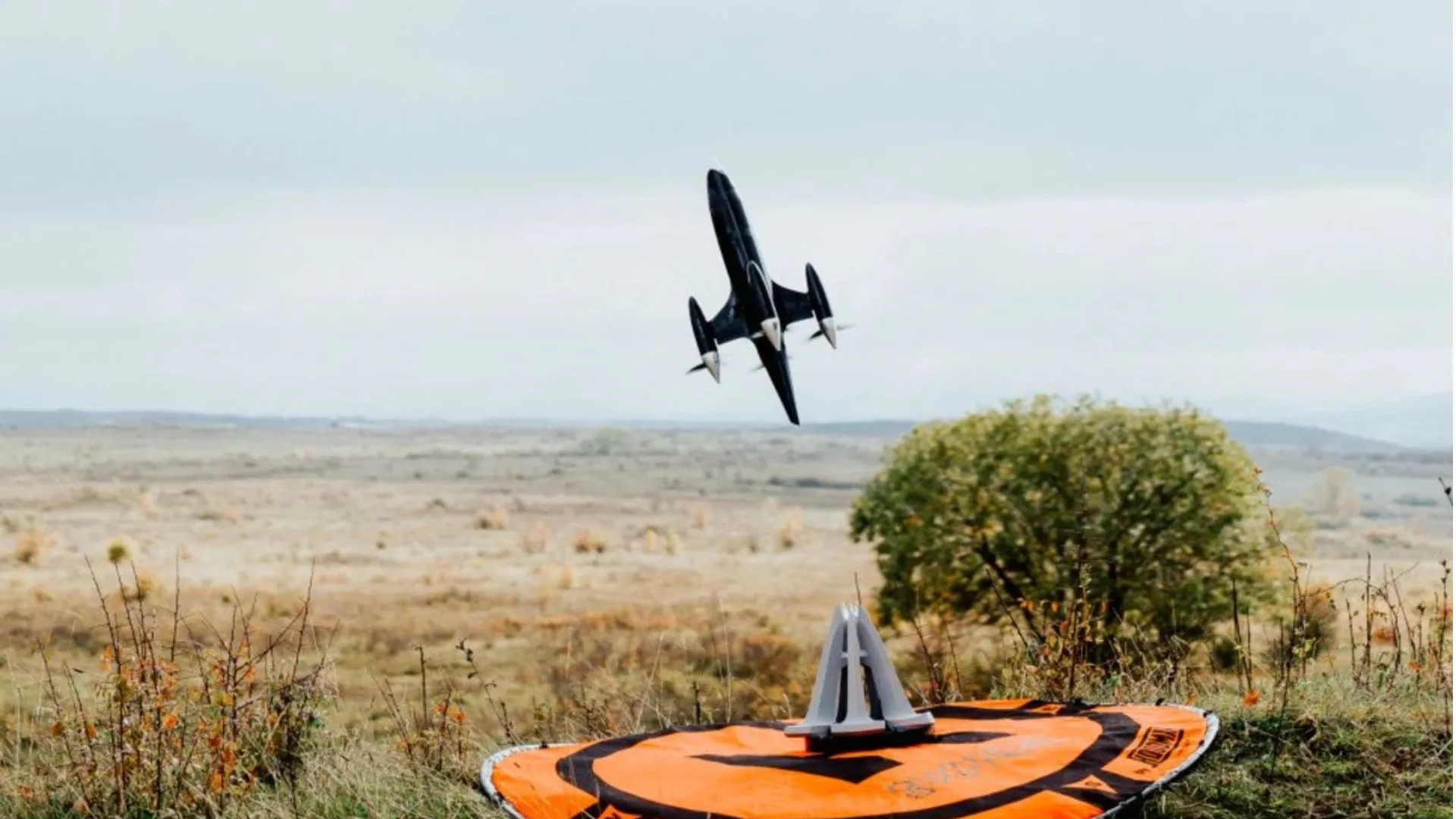
German drone maker Quantum Systems says its Apex Recordhunter experimental drone reached 777 km/h (483 mph) during a record attempt flown this week, the highest speed the company says any battery-electric aircraft has achieved. The figure, equivalent to more than 215 meters per second, remains unofficial: speed records require runs in both directions to cancel wind effects, and the company has yet to fly the return leg.
The run is a 78 km/h gain over the 699 km/h (434 mph) the demonstrator reached in straight and level flight during internal testing on June 26, 2026. Quantum Systems, headquartered in Gilching near Munich, frames the program as a propulsion and aerodynamics testbed for interceptor drones able to catch Russia’s jet-powered Geran one-way attack drones, which now outpace most of the propeller-driven interceptors Ukraine fields against Shahed-type threats.
Apex Recordhunter Climbs From 699 to 777 km/h Ahead of Certification
The Apex Recordhunter was developed in roughly one year by N3XT, Quantum Systems’ experimental engineering team in Germany, as a technology demonstrator rather than a production system. It runs on high-discharge battery cells supplied by V4Smart, a battery technology company within the Porsche group. The company has not disclosed the aircraft’s mass, dimensions, motor output or battery capacity; published imagery shows only a slender, arrow-shaped airframe optimized for straight-line speed.
The jump is harder than its 11% increase suggests. Aerodynamic drag rises with the square of airspeed and the power required to overcome it rises roughly with the cube, so with drag characteristics held constant, the latest run implies about 37% more sustained power than the June flight. That is the engineering problem Quantum Systems says it is mining: battery discharge rates, thermal management of motors and power electronics, and flight control stability above 200 meters per second.
The benchmark in play is the 657.59 km/h (408.60 mph) Guinness World Records mark for a battery-powered remote-controlled quadcopter, set by the Peregreen V4 in Cape Town, South Africa, on December 11, 2025, and averaged across two opposite-direction runs. A privately built drone has reported 730 km/h, but on a downwind run that has not been ratified. Quantum Systems has not specified which certifying body or record category its official attempt will target.
Closing the Speed Gap Between Strila Interceptors and Jet Gerans
The operational driver is the Geran family. According to Ukraine’s Main Intelligence Directorate (HUR), the Geran-3 pairs a Shahed-type airframe with a Chinese-made Telefly turbojet, while the larger Geran-5, first recorded in combat in early January 2026, uses a more powerful engine from the same family. Quantum Systems co-CEO Sven Kruck said jet-powered Gerans can reportedly reach 500 to 600 km/h. Ukrainian Air Force spokesman Yurii Ihnat has said such drones sit beyond the reach of interceptors flying at up to 300 km/h.
Quantum Systems’ own counter-drone offering illustrates the gap. Kyiv-based WIY Drones, part of the Quantum Systems Group following the German company’s investment, builds the Strila, a four-motor interceptor. Publicly available specifications indicate a top speed of 350 to 355 km/h, 15 to 20 minutes of endurance, a ceiling of up to 4 km, a payload of up to 800 g and a GPS-independent SineLink datalink designed to resist electronic warfare. Germany is funding 15,000 Strila units for Ukraine’s National Guard under an agreement announced on March 23, 2026, with WIY reportedly producing about 100 per day.
Quantum Systems says the Apex shares no hardware with its combat systems, but that its propulsion, energy management and high-speed flight lessons feed directly into interceptor development. “Russia is accelerating the threat. We are engineering the response,” Kruck said.
Analysis: The run matters less as a speed claim than as evidence that battery-electric propulsion has headroom well beyond the envelope of current jet Gerans. A 350 km/h interceptor engaging a 550 km/h target is confined to head-on geometries with seconds of reaction time; an electric interceptor holding a 150 to 200 km/h speed margin could pursue from the rear quarter and widen the engagement window for point defense. The constraint is everything a record airframe does not carry: a seeker, a warhead, useful endurance and a unit cost compatible with nightly salvos numbering in the hundreds. Strila reportedly cost about $2,300 per unit in January 2026, and translating 777 km/h into a fieldable interceptor anywhere near that price point remains unsolved.
The next milestone is the return run needed to validate the figure. Quantum Systems, which closed a $1.2 billion Series D round on July 2, 2026, at a post-money valuation of about $8 billion, has the capital to accelerate a high-speed interceptor effort, but it has not announced a designation, timeline or performance target for any Apex-derived system. Whether one reaches Ukrainian units before Russia’s next Geran iteration will determine whether the record converts into air defense capability.