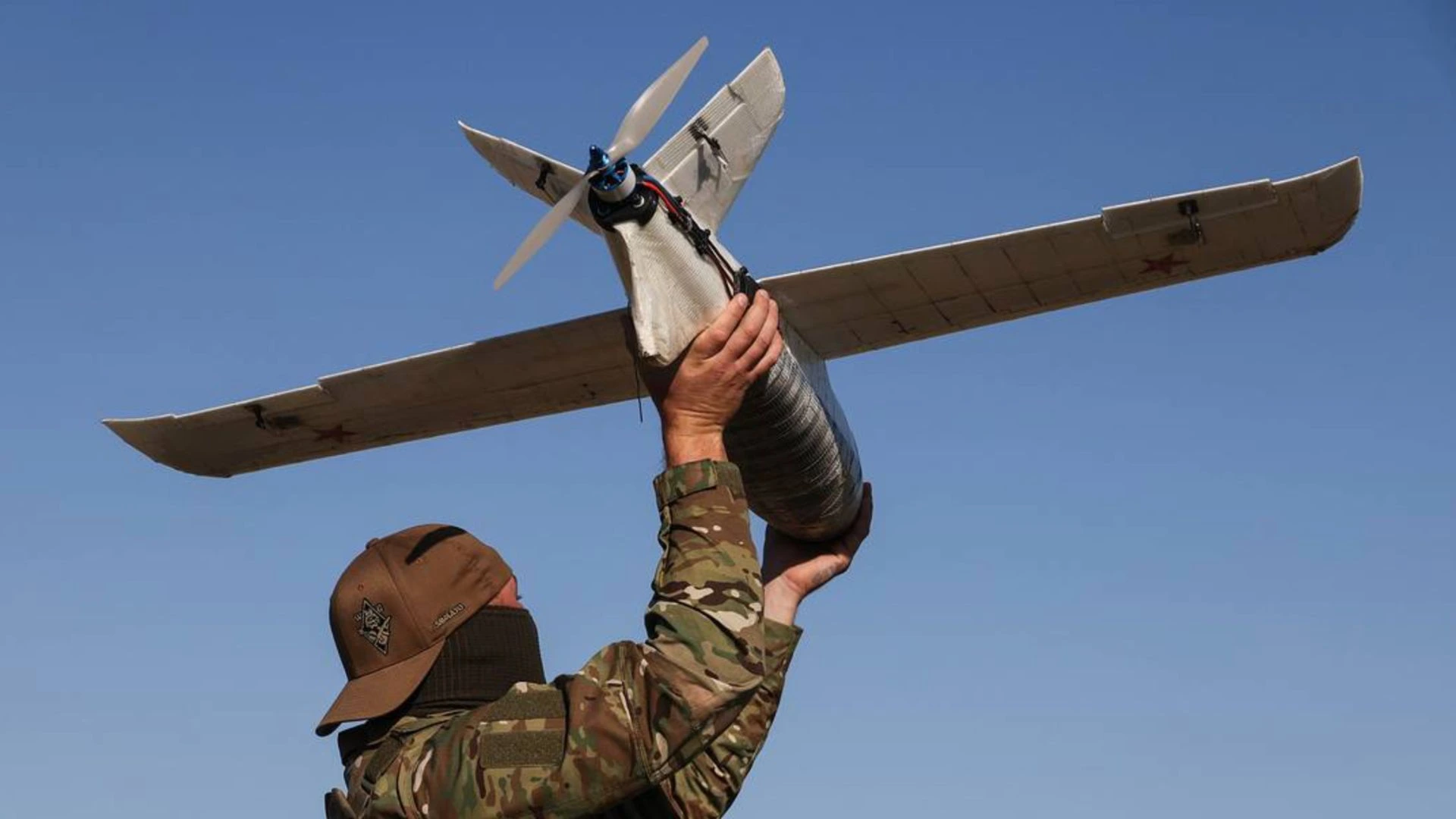
Russia’s Ministry of Defense has released footage of the Sokol-I, a hand-launched fixed-wing interceptor drone, in combat use against Ukrainian reconnaissance and strike drones. The video, posted to the ministry’s Telegram channel on October 8, 2026, shows a soldier throwing the foam-bodied aircraft into the air and an operator steering it onto targets through a first-person-view (FPV) camera feed before detonating an onboard explosive charge.
The release adds to evidence that Moscow is reorienting its tactical counter-drone effort toward simple, operator-flown interceptors. Russian state television first described the Sokol-I in March 2026, and the Defense Ministry stated on June 2, 2026, that a crew from the Center Group of Forces was destroying several Ukrainian fixed-wing drones per day with it. The design breaks with the Yolka, the AI-guided kinetic interceptor Russia promoted from mid-2025, and moves Russian practice closer to the explosive-armed FPV interceptors Ukraine has fielded at scale.
Sokol-I Interceptor Drone Design, Payload, and Flight Envelope
The Sokol-I resembles a small conventional aircraft rather than the multirotor layouts that dominate the interceptor market. Imagery shows a cylindrical fuselage, swept wings, a V-tail, and a rear-mounted pusher propeller, with a wingspan that Forbes contributor Vikram Mittal estimated at roughly 1.5 meters from the footage. Russian state media describe the airframe as polystyrene foam, light enough for a single soldier to hand-launch it in seconds without a catapult or rail. The word “Сокол,” Russian for falcon, is painted on the fuselage and wings.
According to the Defense Ministry, the Sokol-I reaches a maximum speed of 150 km/h and operates at altitudes up to 5,000 meters. Moscow has not published weight, motor output, battery capacity, or endurance. Ukraine’s Defense Intelligence (HUR) has assessed its range at up to 25 kilometers and its unit cost at about $4,000; neither figure has been independently verified. Russian outlets attribute the design to the Polet design bureau and describe the warhead as a converted hand grenade, details the ministry has not confirmed.
The configuration carries operational logic. A fixed wing delivers more endurance per watt-hour than a quadcopter, letting the operator loiter and search a sector rather than launch only after a confirmed track. The 5,000-meter ceiling also matters: Ukrainian reconnaissance crews have pushed their drones higher to stay out of reach of Russian interceptors, and the Sokol-I’s envelope suggests it was sized for exactly that target set.
Manual FPV Guidance Versus the Yolka’s Autonomous Kinetic Kill
Guidance is entirely human. A forward-facing camera and radio antennas in the nose feed video to the operator, who launches on an early-warning cue, acquires the target visually, and closes from behind to strike the engine compartment or ram the airframe. In the October footage, the operator describes aiming at the fuel tanks of larger drones and claims kills against the Hornet, Baton, Valkyrie, and Karma. The June ministry statement listed the Leleka reconnaissance drone, the Blyskavka strike drone, and the Hornet. No independent tally of Sokol-I engagements exists.
The Yolka took the opposite approach. Russian media describe the Moscow-built interceptor as a 1.3 kg airframe reaching 230 km/h out to about 3 kilometers, using AI-enabled optical and infrared target tracking, and carrying no warhead. Fire-and-forget homing removes the datalink that electronic warfare (EW) can jam. But, as Mittal has noted, kinetic-only kills are less certain against heavier airframes, the seeker and compute hardware depend on specialized components exposed to Western export controls, and documented battlefield use of the Yolka remains thin despite heavy promotion.
The Sokol-I inverts those tradeoffs. Its explosive charge widens the target set, and its components appear largely commercial, but its continuous video and control link makes it vulnerable to Ukrainian jamming. It is also slow by current standards. Ukrainian manufacturer Wild Hornets lists its Sting interceptor at 280 km/h maximum speed, a 5,000-meter ceiling, 37 kilometers of range, and a 500-gram payload, and demonstrated 315 km/h in 2025. That gap has consequences: Ukraine’s 57th Separate Motorized Infantry Brigade announced on June 29, 2026, that it had shot down a Sokol-I with a General Cherry AIR interceptor.
Sokol-I Production and Russia’s Layered Counter-Drone Architecture
Industrial simplicity is the core of the concept. Foam construction, basic electronics, and manual guidance allow production on existing commercial drone lines rather than a dedicated facility, and leave room for incremental upgrades such as thermal cameras without redesigning the airframe. HUR stated in July 2026 that serial production had begun in Taganrog, Rostov region, with claimed capacity of up to 60,000 units per month. That figure is a Ukrainian intelligence assessment and cannot be confirmed.
The Sokol-I is a tactical asset meant to protect troops and equipment near the line of contact. Its 150 km/h top speed rules it out against Ukraine’s faster long-range strike drones, which remain the responsibility of surface-to-air missile systems and radar-guided guns such as the Pantsir-S1 around strategic sites. Closer to the front, it sits between EW systems that jam control and satellite navigation signals and last-ditch gunfire: a separate ministry video shows a BMP-2M infantry fighting vehicle downing a drone with its turret-mounted 30 mm 2A42 automatic cannon.
Analysis: The Sokol-I shows that the binding constraint in drone-versus-drone combat is producible volume, not per-unit performance. Russia has demonstrated it can build autonomous interceptors, but sanctions on imaging and processing components appear to cap how many it can field; a foam aircraft built from commercial parts, which HUR prices at about $4,000, does not face that ceiling, and its main bottleneck shifts to trained FPV pilots. Both belligerents are converging on cheap, explosive-armed interceptors with a human in the loop, a lesson NATO armies building counter-UAS layers should weigh against programs optimized for exquisite single-shot effectors.
Key unknowns remain the scale of fielding beyond the Center Group of Forces, the system’s real kill rate against Ukrainian EW, and whether Russia adds thermal optics or terminal autonomy to close the speed gap. Independent confirmation of the Taganrog production figures, and any sign that the Yolka is being quietly displaced rather than complemented, will indicate how far Moscow intends to bet on mass over sophistication.