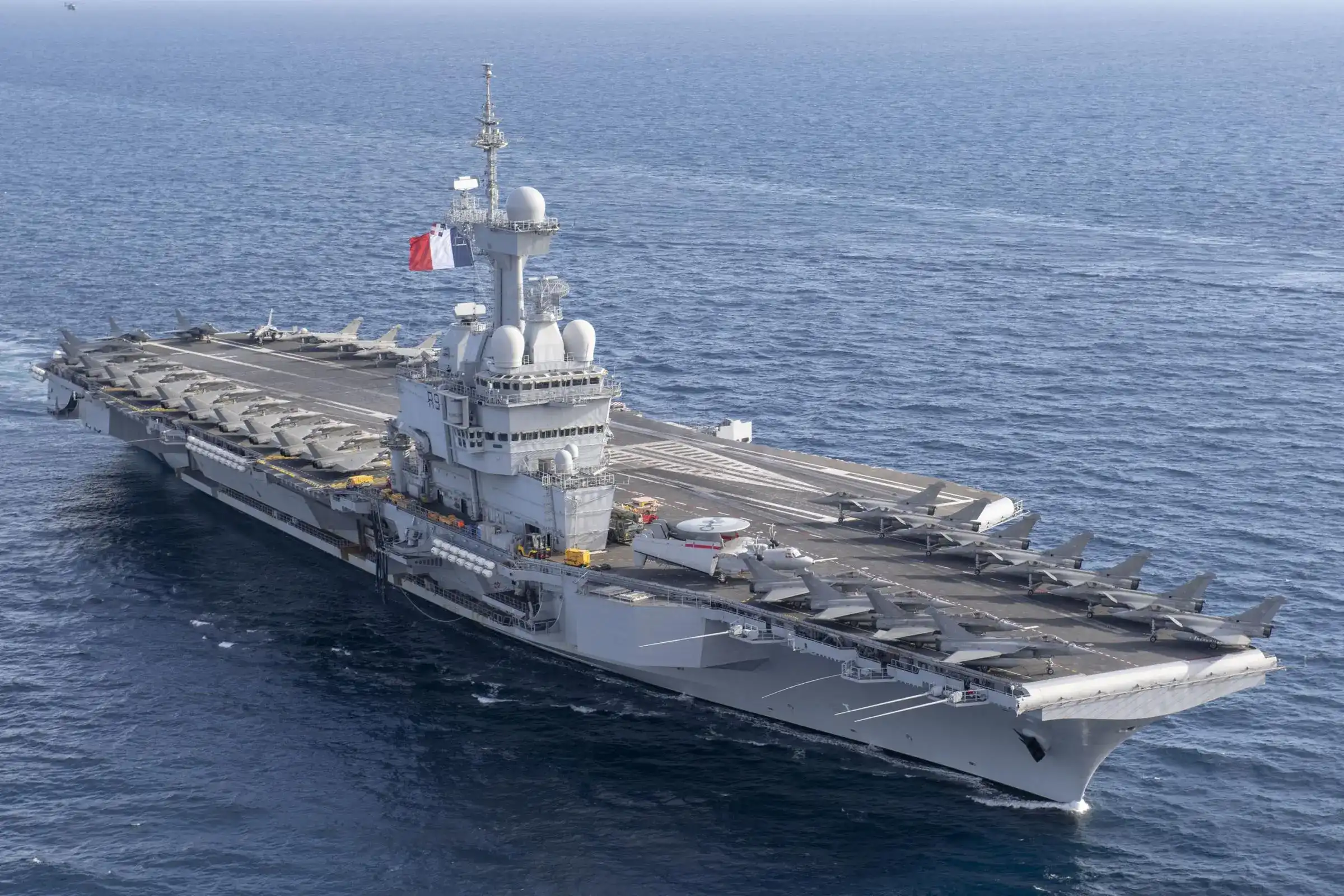
France is studying whether its only aircraft carrier, the nuclear-powered Charles de Gaulle (R91), can sail beyond its scheduled 2038 retirement and potentially remain in service until 2040, French Navy Chief of Staff Adm. Christophe Cluzel told the National Assembly’s defense committee on October 14, 2026. Conclusions are expected in early 2029, and no decision on an extension has been taken.
The assessment is tied to the carrier’s third and final major refit, known as ATM3 (arrêt technique majeur), due to begin in Toulon in spring 2027. Its successor, France Libre, formerly the Porte-Avions de Nouvelle Génération (PANG) program, is scheduled to begin sea trials in 2036 and enter service in 2038. Since 2001, France has fielded a single carrier, leaving it with none whenever Charles de Gaulle is in dock; the Navy puts the ship’s availability at about 65%. The question surfaced during hearings on the 2027 defense budget, when National Assembly member Daniel Grenon asked whether one carrier is enough for high-intensity warfare.
Charles de Gaulle Carrier Extension Study: Reactors, Fuel, and Auxiliaries
According to Cluzel, the studies will examine wear on the cores of the ship’s two K15 pressurized water reactors and whether operations can be extended by keeping fuel on board longer. Publicly available specifications indicate each K15 is rated at about 150 megawatts thermal, driving two shafts for a top speed of roughly 27 knots. The carrier refuels about every 10 years, with earlier core reloads during ATM1 in 2007-2008 and ATM2 in 2017-2018. The ATM3 reload was sized to carry the ship to 2038, so an extension depends on stretching that fuel; a 2020 French Senate report indicated that operating beyond 2038 would otherwise require a fourth refueling.
Cluzel said the ship is “as old as its arteries” and that its availability must not hinge on a single auxiliary system, meaning piping, power generation and the plant feeding its two US-built C-13-3 steam catapults will be assessed alongside the reactors. That scope matters for a 261.5-meter, 42,000-tonne hull launched in 1994, which would approach four decades of service by 2040. Parliament has pressed the point before: during debate on the 2024-2030 military programming law, lawmakers adopted an amendment asking the government to report on the cost and viability of keeping the carrier in service after 2040.
ATM3 Refit in 2027: Refueling, Sea Fire Radar, and SETIS 3.0
The French defense procurement agency (DGA) awarded Naval Group the ATM3 contract on December 28, 2023, without disclosing its value. The refit will reload both reactor cores, inspect every major equipment item and deliver the ship’s last combat system modernization. Reported durations range from 18 to 24 months from an April 2027 start, with a return to the fleet planned before the end of 2028. France will have no carrier available in the interval.
The centerpiece is the Thales Sea Fire, a fully digital S-band active electronically scanned array radar with four fixed panels, already fitted to the Navy’s new Frégate de Défense et d’Intervention (FDI). It replaces the rotating DRBV-26D and Arabel radars for air surveillance and fire control of the carrier’s Aster 15 surface-to-air missiles. Naval Group’s SETIS 3.0 combat management system and a reconfigurable MBDA firing installation for Aster complete the package, aimed at sustaining self-defense against anti-ship missiles and drones. A combat suite installed in 2028 would be only a decade old in 2038 and would share sensors and software with the FDI fleet, easing logistics if the hull stays in service.
France Libre Overlap and the Two-Carrier Question for the French Navy
France Libre will measure 310 meters and displace about 80,000 tonnes, nearly twice the tonnage of Charles de Gaulle. Two K22 reactors will power it, and it will operate three General Atomics electromagnetic aircraft launch system (EMALS) catapults with Advanced Arresting Gear, embarking about 30 combat aircraft, two airborne early warning aircraft, helicopters and drones. The program is estimated at about €10 billion, and the ship is designed to serve until around 2080.
The current plan already provides a 2036-2038 overlap, with both ships able to be at sea and two carrier crews on active duty, which Cluzel described as essential to transfer skills without a break. It would be the first time France has two carriers in service since the late 1990s, when the Navy operated the conventionally powered Foch and Clemenceau. Extending Charles de Gaulle to 2040 would stretch that window to four years. Cluzel said two carriers would allow a standing alert from Toulon, while a permanent presence at sea would require three, but he declined to endorse a second ship, calling it “a political ambition” for elected officials to settle.
Analysis: A 2040 extension is less a two-carrier strategy than an insurance policy on France Libre. The successor relies on new K22 reactors and on a US catapult supply chain clouded by President Donald Trump’s August 2026 order for the US Navy to return to steam catapults, although Cluzel said the US decision is not final and he does not see France’s contract at risk. Any slip past 2038 without a fallback would leave France without carrier aviation. Keeping the older ship viable closes that gap at a fraction of new-build cost. The binding constraints are people and fuel rather than steel: two carrier crews, Rafale M squadrons and catapult-qualified aviators would compete with frigate and submarine manning, and a stretched core could cap the old ship’s availability exactly when it is needed.
The next milestones are a final pre-refit deployment in early 2027, the start of ATM3 in spring 2027 and the carrier’s return in late 2028, followed by the extension findings in early 2029. Under the current military programming law, the government is also due to give Parliament a cost estimate for a second new-generation carrier in 2028. Key unknowns remain the cost of an extension, the margin left in the reloaded cores and whether the Navy can man two carrier crews beyond 2038.