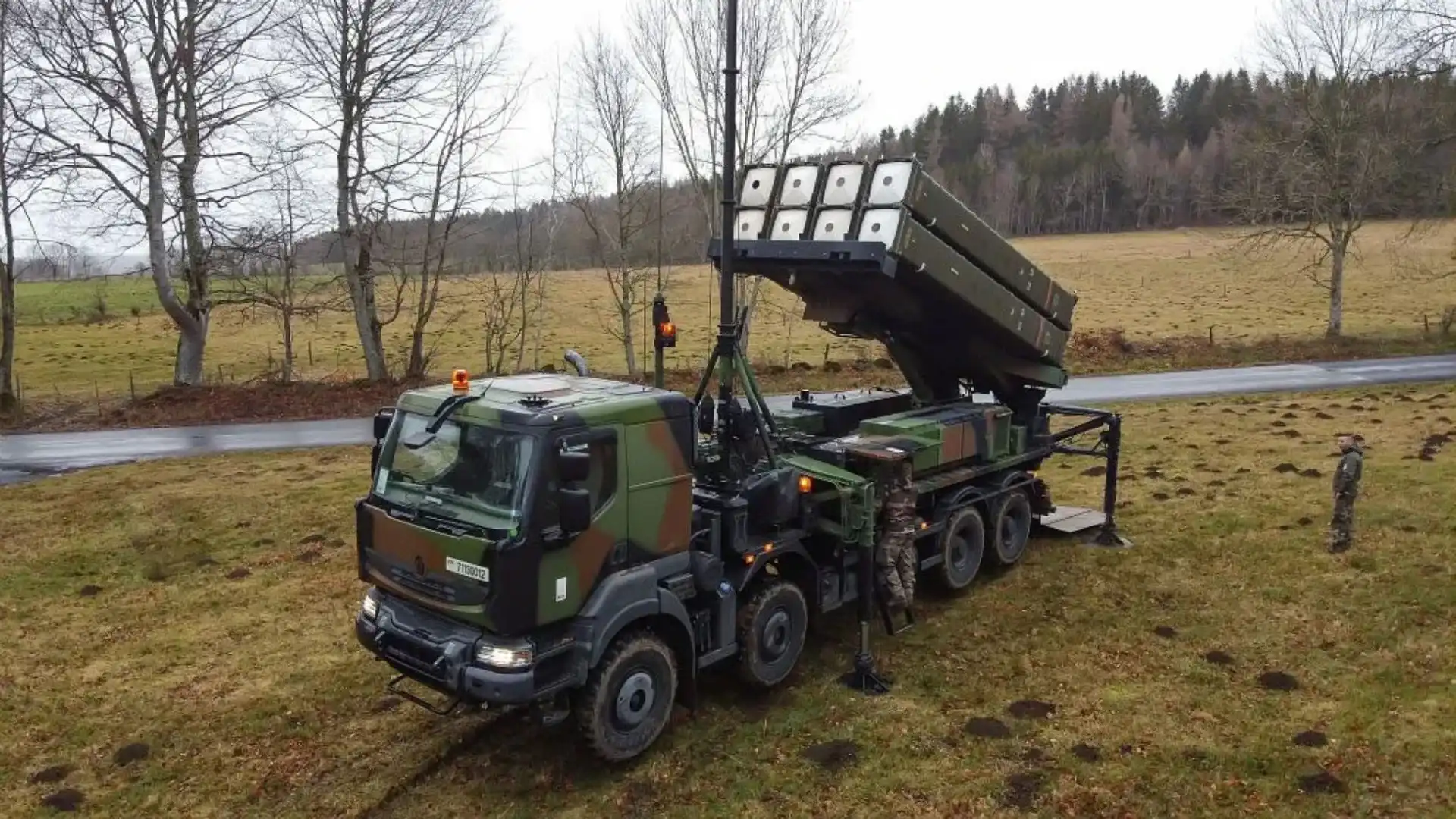
France’s defense procurement agency, the Direction générale de l’armement (DGA), has ordered four additional SAMP/T NG ground-based air defense sections for the French Air and Space Force, the Ministry of Armed Forces and Veterans Affairs announced on October 21, 2026. The order, placed with the Eurosam consortium through the Organisation for Joint Armament Cooperation (OCCAR), brings the planned SAMP/T NG fleet to 12 sections, with 10 due by the end of 2030.
The order pulls forward the trajectory set by the 2024-2030 Military Programming Law (LPM), which originally called for eight sections by 2030 and 12 by 2035, with the four extra sections slated for order in 2027. The updated LPM adds two sections to the 2030 window and keeps the 12-section target for 2035. The ministry did not disclose the contract value. The first SAMP/T NG reached the Military Air Expertise Center (CEAM) in April 2026 for in-depth technical and operational evaluation.
How the SAMP/T NG Order Reshapes the French Air Defense Timeline
France and Italy launched SAMP/T NG development in 2021 to replace the SAMP/T, known in French service as Mamba. Eurosam, formed by MBDA France, MBDA Italia and Thales, is prime contractor. On September 17, 2024, Paris made official a serial production contract for seven sections, taking the French fleet to eight; the 2024 defense budget carried a €674 million authorization for that tranche.
The first Aster 30 Block 1 New Technology (B1NT) interceptor was launched from a SAMP/T NG in October 2024, a second followed in August 2025, and the French variant completed its first qualification firings in December 2025. CEAM’s ground-based air defense and counter-drone (DSA-LADA) evaluation team, which draws on the center’s long experience with the legacy system, is now working through deployment, mobility, energy autonomy, rapid activation and integration into the national air defense command chain, along with documentation and maintenance.
The delivered configuration is also changing. On April 30, 2026, OCCAR awarded Eurosam a contract, on behalf of France, to develop a multi-layer version that adds the short-range VL MICA and VL MICA NG missiles to the Aster family. The work integrates the VL MICA Tactical Operating Centre into the SAMP/T NG command post and requires hardware and software changes to the New Generation Engagement Module (ME-NG) and the GF300 radar. For crews, the change means a single engagement module coordinating Aster and VL MICA launchers and assigning each threat to the most suitable interceptor. The LPM sections will be delivered in this configuration from 2030, and Eurosam says the architecture can later absorb Mistral 3 and counter-drone effectors.
Aster 30 B1NT and GF300 Radar: What Each Section Brings
Each French section pairs a Thales GF300 rotating active electronically scanned array (AESA) radar with IFF, the ME-NG engagement module, and up to six launchers carrying eight missiles each, for 48 Aster rounds ready to fire. Eurosam credits the radar with detecting and identifying targets beyond 350 km with 360-degree coverage, and says a section can be operational in under 30 minutes. The ME-NG, developed by Thales with MBDA Italia, runs open-architecture software, and published French-variant figures indicate it can manage up to 100 targets. Italy’s variant uses the Leonardo Kronos Grand Mobile High Power radar instead.
The interceptor drives the capability jump. Official French figures credit the B1NT with engaging aircraft and missiles, including hypersonic threats, at altitudes up to 25,000 meters and ranges of 150 km. Publicly available specifications indicate it introduces a new Ka-band seeker, and Eurosam states it covers short- and medium-range tactical ballistic missiles. Open-source estimates place the legacy Aster 30 Block 1 against ballistic missiles of up to about 600 km range, and the B1NT against threats in the 1,500 km class.
For the warfighter, the gain is reach. The legacy SAMP/T, built around the Arabel radar, engages air-breathing targets out to about 120 km per open-source figures; the NG section pushes beyond 150 km, widening the defended footprint around air bases and sensitive sites. The hypersonic claim rests on design requirements and qualification testing: the legacy system has fought in Ukraine since 2023, but no combat interception by a B1NT has been publicly reported.
Analysis: The order narrows but does not close the gap flagged by the National Assembly’s defense committee, which advised in 2022 that France needed 16 sections to meet its commitments. Twelve sections must cover the permanent air security posture at home, overseas deployments and contributions to NATO integrated air and missile defense. A full French fleet represents 576 ready-to-fire rounds, and every reload draws on Aster lines that also serve Italy, Denmark, which selected SAMP/T NG in September 2025, and Ukraine. Accelerating fire units without a matching ramp in B1NT output would leave launchers ahead of missiles.
The next markers are the close of CEAM’s evaluation and the system’s entry into operational service, followed by a delivery cadence steep enough to field 10 sections by the end of 2030, the same year the multi-layer configuration arrives. Still unknown are the value of the October order, the delivery schedule for the final two sections, and whether B1NT production commitments will grow in step.