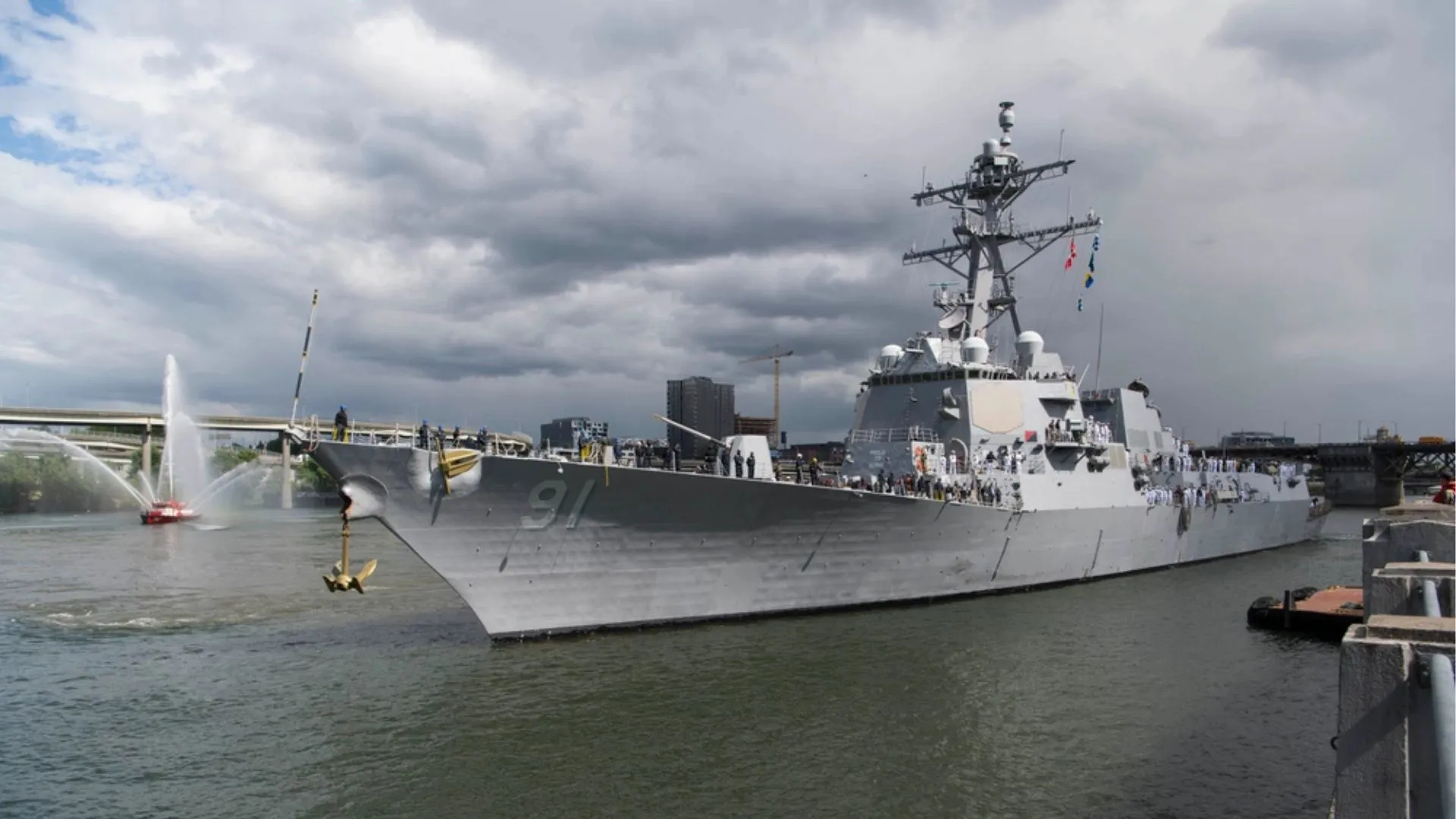
The U.S. Navy has started the first AN/SPY-6(V)4 radar backfit on an in-service destroyer, with USS Pinckney (DDG 91) entering its second Depot Modernization Period (DMP2) under the Destroyer Modernization 2.0 (DDG MOD 2.0) program at General Dynamics NASSCO in San Diego. The Portfolio Acquisition Executive (PAE) for Maritime announced the start of work on October 22, 2026, describing it as the Navy’s first installation of both the SPY-6(V)4 and the new High Efficiency Super-Capacity (HESC) air conditioning plants.
NASSCO received a $149.6 million fixed-price incentive fee contract for the availability in early September 2026, with options worth up to $149.9 million and completion set for September 2028; fiscal 2026 Other Procurement funds cover $135.8 million of the award. Pinckney entered the yard weeks after returning to San Diego on August 9, 2026, from a 3rd, 5th and 7th Fleet deployment covering more than 48,000 nautical miles. DDG MOD 2.0 aims to give Flight IIA Arleigh Burke-class destroyers Flight III-like air and missile defense capability as Ticonderoga-class cruisers leave service.
USS Pinckney Leads the DDG MOD 2.0 Split Start Approach
The program uses what the Navy calls a Split Start approach: the first ships receive the electronic warfare upgrade in one availability, return to the fleet, then come back for the radar. Pinckney completed what the Navy designates a DMP 1.5 availability in 2024, becoming the first warship fitted with the AN/SLQ-32(V)7 Surface Electronic Warfare Improvement Program (SEWIP) Block 3 and its associated sponson modifications.
Built by Northrop Grumman, SEWIP Block 3 adds an active electronic attack capability to the AN/SLQ-32 suite, giving the destroyer onboard jamming against radio frequency-guided anti-ship missiles. The system is far larger and more power-hungry than earlier SLQ-32 variants and requires added cooling and power conditioning, a substantial burden on a hull commissioned in May 2004.
The Navy says the subsequent Pacific and Middle East deployment validated those capabilities in contested environments. USS Chung-Hoon (DDG 93) and USS James E. Williams (DDG 95) have since completed SEWIP-phase availabilities, and USS Halsey (DDG 97) is the fourth ship in the learning group.
“Upon Depot Modernization Period completion, USS Pinckney will rejoin the Fleet equipped with the most comprehensive multi-spectral integrated sensor suite designed to maintain maritime superiority for decades to come,” said Capt. Tim Moore, the DDG MOD 2.0 program manager.
How SPY-6(V)4 and Aegis Baseline 10 Upgrade Flight IIA Air Defense
Raytheon’s SPY-6(V)4 is an S-band active electronically scanned array that replaces the Lockheed Martin AN/SPY-1D(V) passive phased array Flight IIA ships have carried since construction. Like the SPY-6(V)1 on Flight III destroyers, it uses four fixed faces for 360-degree coverage, but each face carries 24 Radar Modular Assemblies (RMAs) instead of 37, for 96 in total against 148.
Each RMA is a self-contained radar antenna in a 2-foot cube built on gallium nitride technology, and Raytheon says the modular design makes the radar family more reliable and less expensive to maintain. Raytheon has said the aperture was scaled to 24 RMAs to fit the smaller Flight IIA ships, with processing, cooling and power scaled to match.
Raytheon’s public material gives no sensitivity figure for the (V)4. The 37-RMA (V)1 is estimated to offer roughly a 15-decibel gain over SPY-1, equivalent to detecting a target half the size at twice the distance. The (V)4’s smaller aperture implies less margin, though Raytheon says it offers significantly enhanced range and sensitivity over the radar it replaces.
The radar is fully integrated with Aegis Combat System Baseline 10, the Lockheed Martin configuration that pairs with SPY-6 for simultaneous air and ballistic missile defense and is intended to let Flight III ships take on the air and missile defense commander role in carrier strike groups. In August 2026, Raytheon installed the first (V)4 array at the Navy’s Wallops Island land-based test site in Virginia to test power and combat system interfaces ahead of Pinckney’s installation.
HESC Cooling Plants and the Next DDG MOD 2.0 Destroyers
Active arrays and electronic attack emitters draw more power and shed more heat than the systems they replace, so DMP2 also installs the Navy’s new HESC plants. Publicly available information indicates the HESC chiller was developed jointly by Johnson Controls Navy Systems and Calnetix Technologies and passed MIL-S-901D Grade A shock testing in 2017.
After the four-ship learning group, the Navy plans to combine SEWIP Block 3 and SPY-6(V)4 work in a single availability, starting with USS Sterett (DDG 104), according to the program office. USS Kidd (DDG 100) leads a handful of ships slated for SEWIP Block 3 only, with no radar backfit. In 2023, the Navy reportedly estimated about $17 billion to backfit around 20 Flight IIA destroyers, and a Navy official put yard time at 18 to 24 months per hull.
Analysis: Backfitting SPY-6(V)4 fields SPY-6-class sensors faster than Flight III construction alone, which has faced cost growth and delivery delays. The binding constraint is time out of service: Pinckney entered its first DDG MOD 2.0 yard period in late 2021 and is contracted to stay at NASSCO until September 2028, putting the lead ship in the yard for at least four of roughly seven years. Program leaders cite the cruiser modernization effort, in which four upgraded Ticonderoga-class ships were retired without returning to sea, as the outcome to avoid. Pinckney’s redelivery date and cost performance will show whether the backfit scales toward 20 hulls or more destroyers follow Kidd’s SEWIP-only path.
Next come interface testing at Wallops Island, installation of the four arrays aboard Pinckney, then combat system testing and sea trials before redelivery. Neither the PAE Maritime announcement nor Raytheon’s Wallops Island release gives the total number of Flight IIA ships slated for SPY-6(V)4, the per-hull cost of the full package, or a firm date for Sterett’s combined availability. Those figures will determine how many Flight IIA destroyers reach the DDG MOD 2.0 standard.