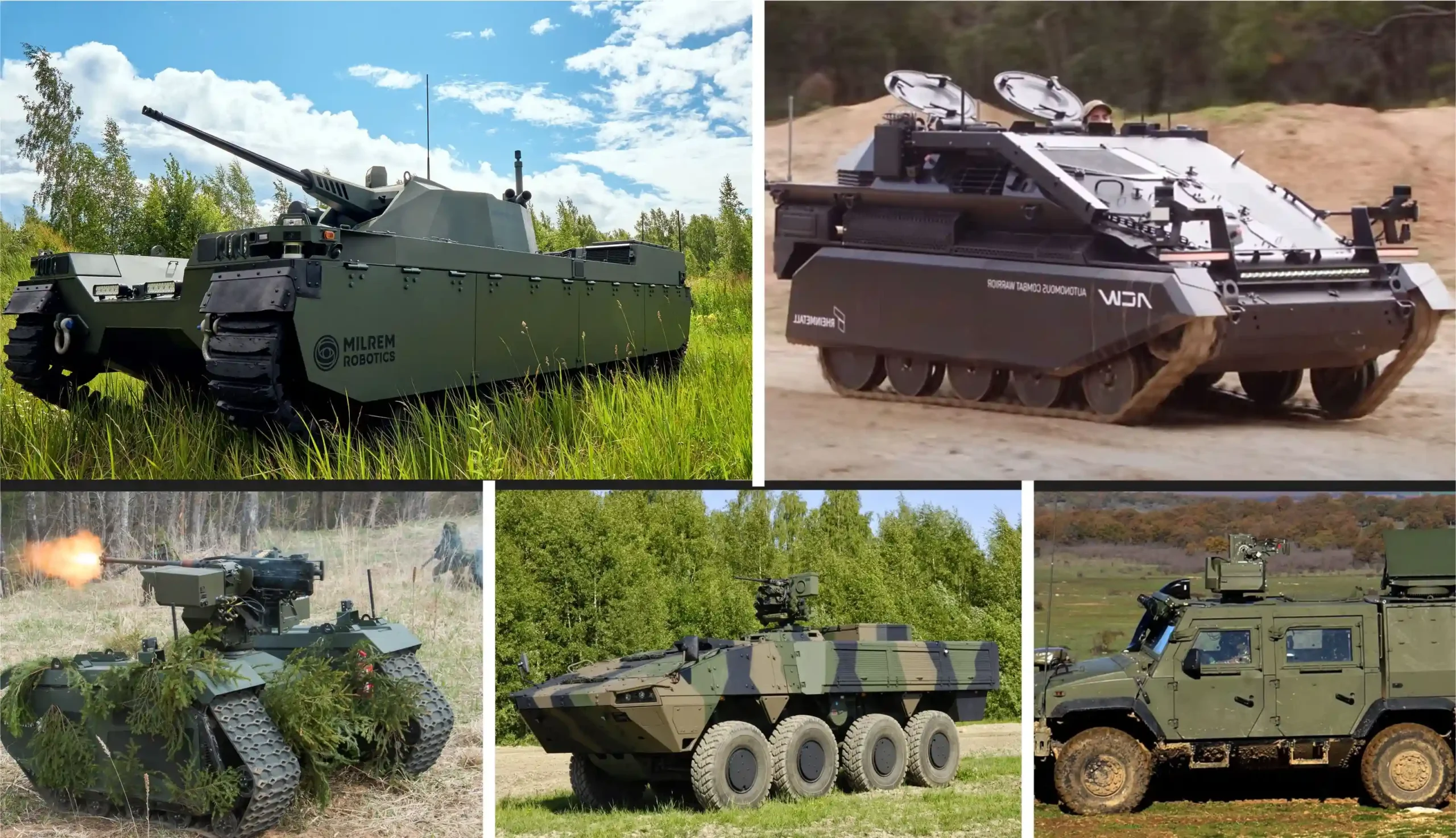
The European Defence Agency’s (EDA) Combat Unmanned Ground Systems (CUGS) project has completed its final demonstration, running uncrewed ground vehicles (UGVs), remote weapon stations, a reconnaissance drone and loitering munitions through three simulated combat scenarios controlled from a command post several kilometers away. Leonardo, which coordinates the industrial consortium, announced the milestone on October 21, 2026.
Launched on February 1, 2023, CUGS is the EDA’s largest research and technology (R&T) project, with a €35.5 million budget, nine contributing nations and 28 European industry partners. Italy is lead nation alongside Belgium, Estonia, Finland, France, Germany, the Netherlands and Poland, with Norway taking part under its cooperation arrangement with the agency. Rather than design a new robot, CUGS set out to build combat functional modules that fit vehicles already in European inventories, as armed and logistics UGVs move from trials into frontline use in Ukraine.
Inside the CUGS Final Demonstration of Combat Unmanned Ground Systems
The line-up paired the Lince VTLM-2 with a Hitrole weapon station (Iveco Defence Vehicles, or IDV, and Leonardo, Italy) and Milrem Robotics’ THeMIS with an Arquus Hornet station (Estonia and France). It also included the ZSMU-1276 remote weapon station from Zakłady Mechaniczne Tarnów (Poland), Rheinmetall’s Wiesel (Germany), a reconnaissance vehicle from Poland’s Military University of Technology (WAT) and the Industrial Research Institute for Automation and Measurements (PIAP), Finland’s Patria Armored Modular Vehicle (AMV), a Thales reconnaissance unmanned aerial vehicle (UAV) and MBDA loitering munitions. Each system deployed from a separate location with orders to reach and identify a set of simulated threats.
The CUGS modules covered three functions: autonomous navigation with situational awareness from onboard sensors; communication, command and control (C3) plus cooperation between platforms; and effector management. According to Leonardo, the land and air systems autonomously moved, detected, tracked, classified and engaged targets with artificial intelligence (AI) support, while human operators stayed in the loop and could take control of any platform at any time.
That control model follows the brief the EDA set at launch, when it said the test phase would cover autonomous navigation, target identification and lock-on, weapon selection, firing sequences and safety. Project documentation also tied the work to the European Parliament’s 2018 resolution on autonomous weapon systems.
Lince VTLM-2, THeMIS and Patria AMV: The Platforms Under Test
CUGS set out to adapt three categories of platform, and the final line-up spans that range. The Lince VTLM-2 is the Italian Army’s second-generation 4×4 light multirole vehicle, now a Leonardo product after the company closed its €1.6 billion purchase of Iveco Group’s defense business on March 18, 2026. Publicly available specifications indicate a gross vehicle weight of 8,100 kg, a 1,500 kg payload, a 220 hp Iveco F1C turbodiesel and five blast-attenuating seats. Its Hitrole station accepts a 7.62 mm or 12.7 mm machine gun or a 40 mm automatic grenade launcher, giving an in-service vehicle an uncrewed combat role without a new hull.
THeMIS is a tracked diesel-electric hybrid. Open-source data put its kerb weight near 1,650 kg, maximum payload at 1,200 kg and top speed at 20 km/h, with about 15 hours of endurance in hybrid mode and 1.5 hours in silent electric mode. Arquus derived the Hornet from the remote weapon stations it developed for France’s Scorpion vehicles; the baseline unit weighs about 145 kg without weapon and elevates from minus 20 to plus 60 degrees. An Estonian chassis carrying a French turret under a shared control layer is the cross-border integration CUGS was built to prove.
Poland’s ZSMU-1276 family, fitted to Rosomak variants, mounts 12.7 mm WKM-B or 7.62 mm UKM-2000C machine guns; its CUGS host vehicle was not identified. The Patria AMV anchors the heavy end as an 8×8 armored vehicle, and the Wiesel is an air-transportable tracked weapons carrier. The Thales drone and MBDA munition types were not named, and Milrem’s 12-tonne Type-X, listed as a candidate platform in 2023, does not appear in Leonardo’s account.
Arctic Trials and the Push for a Common Open Architecture
The Italian event followed a 10-day Arctic trial in early February 2026 at the Regionfelt Østlandet range near Rena, about 180 km north of Oslo. Coordinated by the Norwegian Defence Research Establishment (FFI), it tested autonomous and remotely operated vehicles in snow and degraded connectivity. Norway fielded a THeMIS fitted with a Kongsberg Protector remote weapon station and drone radar, operating alongside a Patria AMV.
FFI’s own account was candid about the integration burden. Researchers reported that interfaces on several vehicles and subsystems were incompatible with the mission control system, forcing the team to build software bridges, and that communications suffered interference even with no jamming applied. Agreeing on common terminology across partners also consumed significant time.
Leonardo now states that the final demonstration showed full interoperability on a common open architecture, but its statement includes no test data. It gives neither the date nor the exact site of the trial, though partners had placed it in Italy in autumn 2026, and it does not specify whether live ammunition was fired or which platforms ran autonomously rather than under remote control.
Analysis: The real CUGS deliverable is an integration layer rather than a vehicle: navigation, C3 and effector-management modules built to ride on chassis European armies already own. For forces operating Lince, AMV, Wiesel or Rosomak fleets, that points to a retrofit path toward uncrewed and optionally crewed combat systems without a decade-long platform program, and the human-in-the-loop engagement chain offers a control model governments can defend politically. The weakness is structural. CUGS produces technology demonstrators, not procurement-ready systems, and EDA research funding stops short of production. Without a national or European Defence Fund (EDF) follow-on, the architecture stays a demonstrator.
The next decisions sit with the contributing nations: whether to adopt the CUGS architecture as a reference standard, fund a follow-on phase and feed the modules into national programs. Leonardo, which now owns IDV’s Lince line and the CL2X and Viking UGVs shown at Eurosatory 2026, is positioned to push that standard. No timeline has been announced.