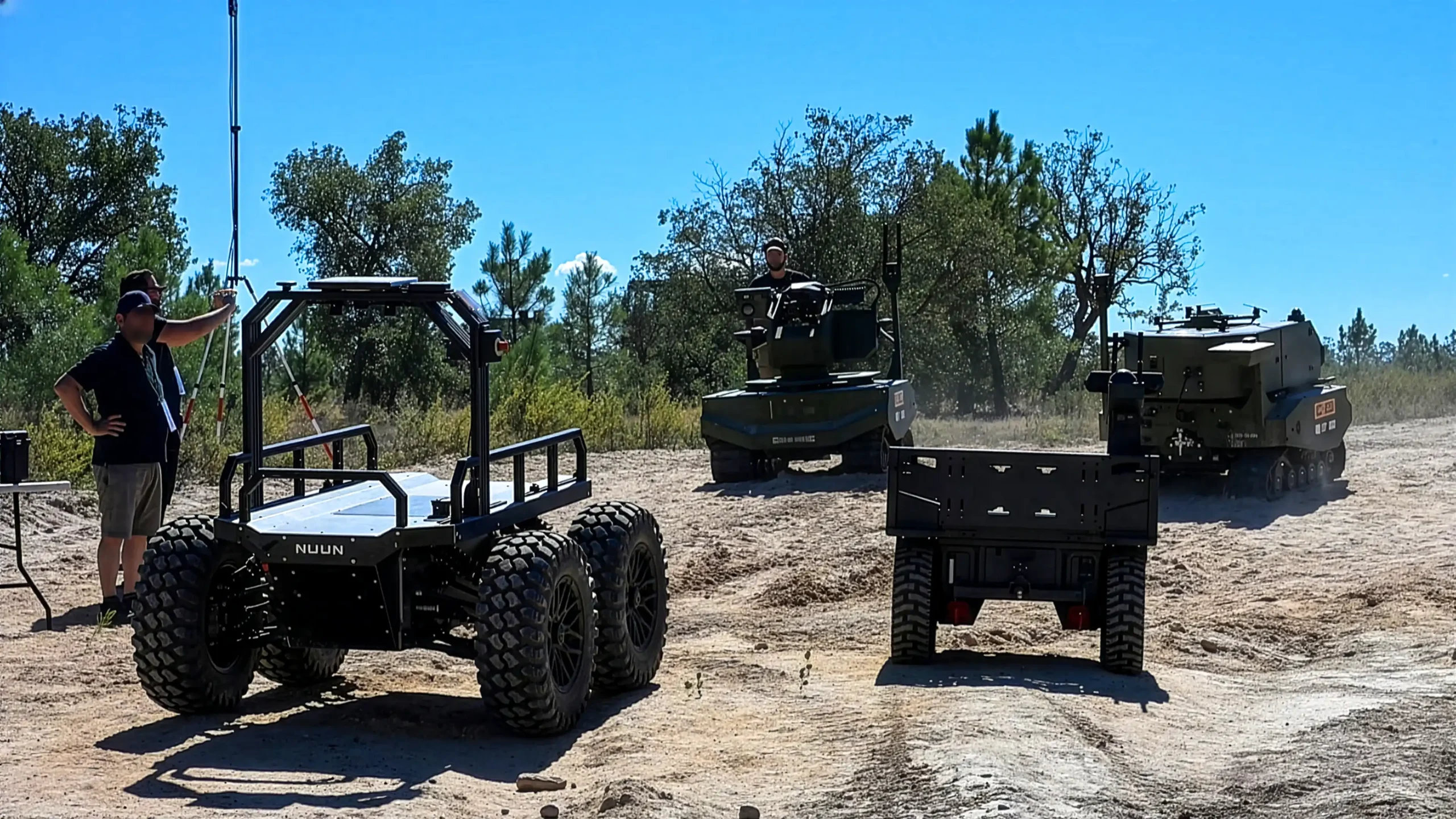
The European Defence Agency (EDA) closed its 2026 EU OPEX operational experimentation campaign at Portugal’s Santa Margarida military camp on October 14, 2026, after European companies spent more than three weeks testing loitering munitions, unmanned aerial and ground systems, and counter-drone solutions alongside the Portuguese Army. The campaign, which opened September 21, was the first EU OPEX embedded inside a national military exercise, the Portuguese Army’s Army Technological Experimentation Exercise (ARTEX 26).
EDA launched EU OPEX in 2025 under its Hub for European Defence Innovation (HEDI). The first edition ran for five weeks that summer at Italian Army sites in Montelibretti and Nettuno, testing six companies’ autonomous systems for cross-domain logistics. The Portuguese edition widened the scope to precision strike, reconnaissance, and EU-Ukraine technology transfer, involving more than 40 companies, according to EDA. Faster adoption of emerging technologies is a stated objective of the EU’s Defence Readiness 2030 agenda, and EDA Chief Executive André Denk argued that “no single Member State can address the defence innovation challenge alone.”
How EU OPEX Embedded Experimentation in Portugal’s ARTEX 26
Embedding the campaign in ARTEX 26 gave participants what a range demonstration cannot: troops, tactical scenarios, and a live training area run under military authority. Portugal is establishing Santa Margarida as a national regulatory sandbox that eases peacetime rules for experimentation. Every system had to pass a mandatory Pre-Trial System Acceptance gate before formal trials, and cross-domain field experiments followed on October 7 and 8. The October 14 final demonstration drew more than 400 guests, including Portuguese President António José Seguro, Defense Minister Nuno Melo, and Army Chief of Staff Gen. Eduardo Mendes Ferrão.
EDA also brought back three 2025 participants it judged most promising for specific cross-domain logistics use cases: Austria’s Schiebel with a heavy-lift vertical take-off and landing (VTOL) unmanned aerial system (UAS), Portugal’s Beyond Vision with a low-cost attritable UAS for high-risk missions, and Germany’s ARX Robotics with a tracked logistics unmanned ground vehicle (UGV). In Italy, Schiebel flew two CAMCOPTER S-100s carrying payloads above 50 kg on an underslung net, while ARX fielded four GEREON tracked platforms. Publicly available specifications put the S-100 at a 200 kg maximum take-off weight with roughly six hours of endurance, a profile suited to urgent small-lot resupply of dispersed units. EDA has not disclosed which configurations each company brought to Portugal or how they performed.
Sentinel Strike Challenge Tests Loitering Munitions in Contested Conditions
The sharpest edge of the campaign was the Sentinel Strike Challenge, a HEDI prize contest that EDA describes as Europe’s first loitering munition challenge giving member states comparative data and hands-on experience. Eligibility was limited to complete Class I aerial loitering munition systems with a maximum take-off mass of 25 kg and an operational range of up to 40 km, an envelope covering man-portable and light vehicle-launched systems for tactical units.
Five finalists reached the field phase: Helsing (Germany), Destinus (Netherlands), C-Astral (Slovenia), UAVision (Portugal), and Spirit Aeronautical Systems (Greece), each already paid €30,000 as a Stage 1 winner in July. At Santa Margarida, crews launched munitions, identified stationary and moving targets, and struck them by day and night, including in denied and contested environments. Evaluators scored the full mission cycle, from planning and launch through tracking, engagement, and post-strike damage assessment.
The contest carries a €2 million prize budget, with up to €1.8 million reserved for Stage 2. EDA has not named the specific munition each finalist entered and has released no hit rates, electronic warfare conditions, or navigation data. Results are due in early 2027.
BraveTech EU Awards €1.2 Million to Four Ukraine-Driven Startups
Santa Margarida also hosted the second phase of BraveTech EU, an EU-Ukraine innovation scheme funded by the European Commission and implemented with EDA and Ukraine’s Brave1 defense technology cluster. EDA runs this test-and-evaluation phase under a €35 million agreement with the Commission announced April 29, 2026.
Six Phase I winners selected in Kyiv in July entered the Portuguese trials. After evaluation by experts from EDA, the Commission, Brave1, EU member states, and the Portuguese Armed Forces, four received €300,000 each:
- EdgeX Robotics (Poland): a rugged, low-cost UGV.
- Kova Labs (Finland): an autonomous navigation system built for complex terrain, including forests and obstacle-dense ground.
- Soraccel (France): an AI-driven mission system that navigates without GPS.
- Tempterno Defence (Estonia): a low-cost rocket system whose launcher mounts on a vehicle or a drone.
The four solutions map onto recurring requirements from the Ukrainian front: navigation under satellite jamming, low unit cost, and mobility in cluttered terrain. All four advance to further field experimentation in 2027. EDA has not published unit cost, range, or payload figures for the winning systems.
Analysis: EU OPEX is building something European procurement has lacked: a shared, government-run evidence base generated under identical scenarios, safety gates, and scoring for every entrant. Member states have largely evaluated loitering munitions through separate national trials; a common Sentinel Strike dataset lowers the barrier to the joint purchases that EDA’s planned collaborative procurement centre is meant to drive. The constraint is scale. Prize pools of €1.2 million and €2 million are seed funding, not production volume, and the real test is whether any of these systems reaches a multinational contract inside the Defence Readiness 2030 window.
The next milestones are close. The Centre for European Defence Innovation (CEDI), approved by EU defense ministers on September 28, stands up inside EDA on November 1, 2026, succeeding HEDI and making operational experimentation a core activity. A second 2026 EU OPEX runs in Switzerland from November 16 to 20 at the Bure military area, focused on unmanned aerial and ground logistics in urban terrain. Sentinel Strike winners are expected in early 2027. The open question is whether EDA will publish comparative results or restrict them to participating governments.