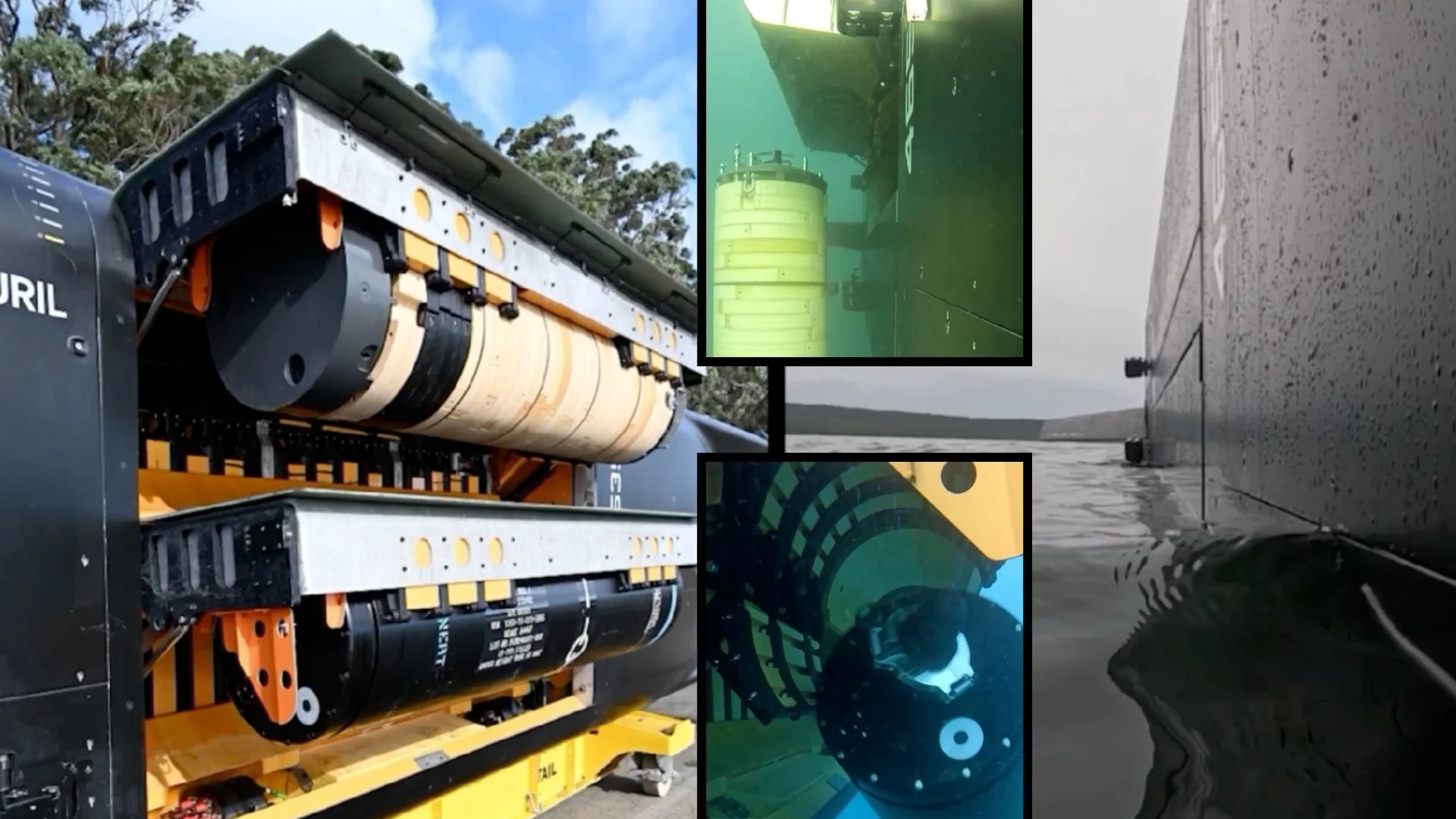
Anduril Industries released test footage on October 21, 2026, that it says shows its Ghost Shark extra-large autonomous undersea vehicle (XL-AUV) deploying sea mines and logistics caches, two of three previously classified payloads Australia revealed two days earlier. The 29-second clip surfaced as Australia, the United States and the United Kingdom run Exercise Maritime Big Play Pacific off San Diego, where Canberra said some of the new payloads would take part.
On October 19, 2026, Minister for Defence Industry Pat Conroy unveiled the payloads at Anduril Australia’s Sydney factory, declaring that Ghost Shark “now has teeth.” The Royal Australian Navy (RAN) is acquiring dozens of the vehicles under an A$1.7 billion (about $1.2 billion) contract signed on September 10, 2025, part of up to A$5.8 billion that the 2026 National Defence Strategy and Integrated Investment Program commit to autonomous and uncrewed undersea warfare over the decade.
Ghost Shark Sea Mines and Seabed Caches Enter Payload Testing
Anduril did not say where or when the footage was filmed. Its preview frame shows a Ghost Shark on a yellow transport cradle rated at 22.5 tonnes, with what appears to be a long cylindrical store secured in a carriage along the hull’s flank.
Conroy said a single Ghost Shark can deploy 12 sea mines at a time. Anduril Australia said at the Sydney event that the vehicle would lay mines autonomously and precisely, generating rapid area denial around key geography and critical infrastructure at lower cost and risk than a surface ship or crewed platform. A Rheinmetall Asteria mine, a 533 mm multi-influence weapon that its manufacturer says can be laid from ships, aircraft or submarine torpedo tubes, stood beside the vehicle, though Australia’s Department of Defence has not confirmed it as Ghost Shark’s mine.
The logistics cache comes from the Defence Science and Technology Group (DSTG). Chief Defence Scientist Tanya Monro said DSTG took it from concept to integration, letting supplies wait on the seabed until a unit recovers them. Conroy declined to name the intended users. Factory photos showed segmented spacers, apparently plywood, inside an open payload bay rather than live stores, a sign that integration work continues.
Publicly available specifications indicate an electrically propelled vehicle with a largely free-flooding hull, sealed compartments for electronics and propulsion, and interchangeable mid-body payload sections. Conroy said Ghost Shark can launch from a standard shipping container or be craned off the stern of a small vessel, requiring no dedicated mothership.
Maritime Big Play Pacific Tests AUKUS Payloads off San Diego
Maritime Big Play Pacific runs from October 5 to 25, 2026, in the Southern California operating area, hosted by Naval Information Warfare Center (NIWC) Pacific with U.S. Pacific Fleet and the U.S. Marine Corps. According to the U.S. Navy, the AUKUS partners are testing more than 40 technologies, including live-fire events focused on strike, resupplying forces under attack and undersea warfare, mission sets that map directly onto Ghost Shark’s new payloads.
Earlier on October 21, Anduril released separate footage of a surfaced Ghost Shark opening its upper payload doors and elevating an angled 12-tube launcher before firing an Altius uncrewed aircraft. A second launcher remained stowed in the adjacent bay, suggesting up to 24 drones per sortie in that configuration, and two deployable masts not previously seen on the vehicle were raised. Canberra has not named the Altius variant or the swarm size. Anduril markets the Altius-600 for intelligence, surveillance and reconnaissance (ISR) and the Altius-600M for strike, rating the Altius-600 at roughly 275 miles (440 km) of range and at least four hours of endurance.
Ghost Shark is one of three Australian platforms receiving new payloads, alongside C2 Robotics’ Speartooth large uncrewed underwater vehicle (LUUV) and the Ocius Bluebottle uncrewed surface vessel (USV), which will carry a thin-line towed array sonar for submarine detection. The Pillar II signature undersea project aims to deliver payloads installable on uncrewed undersea vehicles from all three nations by 2027.
Analysis: The mine payload carries the greatest strategic weight. A containerized vehicle that can be craned off a small boat and lay 12 mines without a crew aboard gives the RAN an offensive mining option that would otherwise fall to its six Collins-class submarines, surface ships or aircraft. It also complicates adversary surveillance, since Conroy suggested any container on an Australian wharf could now hide a minelayer. For AUKUS, the payload-first model matters as much as the hull, since whatever performs off San Diego becomes a candidate for U.S. and British uncrewed submarines.
Maritime Big Play Pacific concludes on October 25. Neither Defence nor Anduril has published trial results, confirmed the mine type, or detailed the cache’s capacity and recovery method. Anduril is reportedly pursuing lightweight and heavyweight torpedo integration with no timeline set, as production deliveries to the RAN continue.