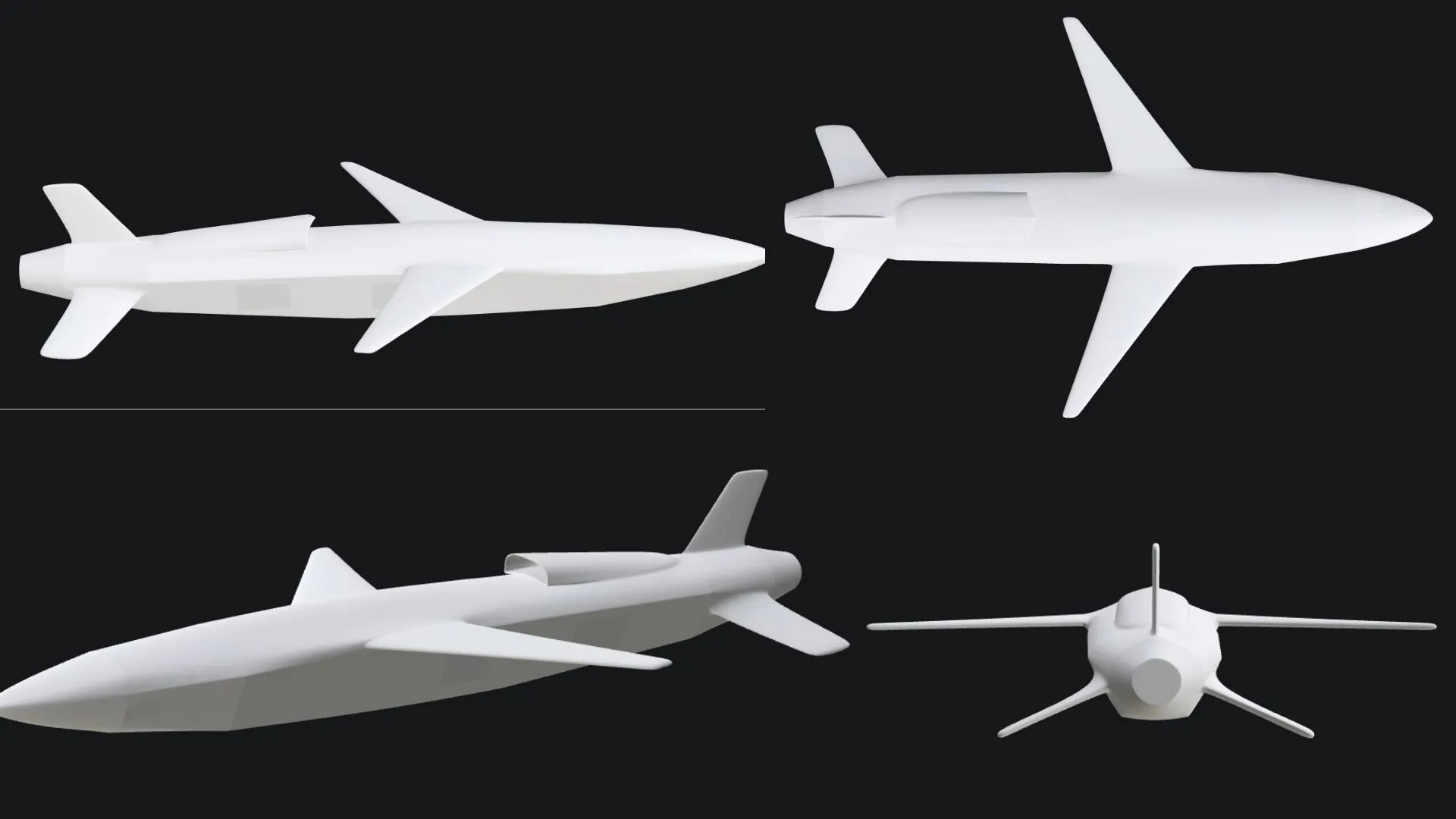
Russia has been firing the Filin cruise missile, a new ground-launched weapon, at Ukraine since late summer 2026, Defense Intelligence of Ukraine (HUR) disclosed on October 22, 2026. Developed by JSC NPO Molniya, the missile carries a 50 or 100 kg warhead over a range of up to 1,200 km, and HUR counted 35 US-made and 22 Chinese-made components in its onboard electronics.
HUR published an interactive 3D model, a parts breakdown and an electronic component database for the Filin on its War&Sanctions portal, the same format it used for the S-71K Kover air-launched cruise missile in April 2026. NPO Molniya, the Moscow design bureau best known for the Soviet Buran orbiter, belongs to the Tactical Missiles Corporation (KTRV), and HUR described the Filin as the latest step in a Russian push toward inexpensive, jet-powered, ground-launched strike weapons. The push is visible in the salvos: during the overnight attack on October 22, Ukraine’s Air Force counted 110 jet-powered drones among the 210 drones launched alongside Iskander-M, Zircon and Onyx missiles.
Filin Cruise Missile Airframe, Warheads and Flight Profile
The Filin’s fuselage is built from carbon fiber and fiberglass composites, measuring 3.5 m long with a 3 m wingspan, and HUR said some elements are 3D printed. The portal lists a maximum takeoff weight of 210 kg, close to the roughly 200 kg publicly attributed to the Shahed-136 one-way attack drone. Composite and additive construction cuts tooling costs and lead times for an expendable weapon.
Russia claims a top speed of 800 km/h, placing the Filin in the subsonic class. The missile can fly at ultra-low altitude or at up to 6 km, giving planners a choice between terrain masking against ground-based radar and a more fuel-efficient cruise profile. The portal gives a range envelope of 600 to 1,200 km; HUR has not said whether the lower figure reflects the heavier warhead or a low-altitude profile.
Warhead options include high-explosive fragmentation, penetrating and thermobaric types in 50 and 100 kg classes. Publicly available data put the Kh-101 and 3M14 Kalibr warheads at roughly 450 kg, so even the heavier Filin variant points to softer point targets such as power substations and fuel storage. The missile leaves a ground launcher on a solid-propellant booster; HUR released no imagery or designation for the launcher.
R500 Engine and Kometa Guidance Link Filin to Drone Production
Propulsion comes from the R500 turbojet built by Reynolds LLC, which HUR has previously described as part of United Aircraft Corporation (UAC). The same engine powers the S-71K Kover, the UAC missile developed for the Su-57 that HUR said entered combat in late 2025, as well as the S-71M Monokhrom. One engine type now serves UAC air-launched weapons and a KTRV ground-launched missile.
Guidance relies on a Chinese-made inertial navigation system paired with a 16-channel Kometa satellite navigation module. Built by VNIIR-Progress in Cheboksary, Kometa uses a controlled reception pattern antenna (CRPA) array to suppress jamming, and open-source reporting places it in Shahed-type drones, Iskander-M and Kalibr missiles and UMPK glide-bomb kits. HUR’s parts breakdown lists no terminal seeker, which points to strikes against fixed, pre-programmed coordinates.
HUR also found that the onboard equipment is manufactured by PLAZ LLC, a company involved in producing IEMZ Kupol’s Garpiya drone and its Geran-2 modifications. Filin and Garpiya units share similar layouts and markings. The parts list names a K-101 flight controller, a K-103-01 inertial navigation unit, a K-109 engine control unit, a K-110 warhead control unit and a K-112 avionics panel.
Filin Electronics Show Rising Chinese Share Alongside 35 US Parts
The War&Sanctions database catalogs 81 component entries for the Filin from manufacturers headquartered in the United States, China, Switzerland, the Netherlands, Japan and Taiwan. US suppliers include Texas Instruments, Analog Devices, Microchip Technology’s Micrel line, ON Semiconductor and Vishay Intertechnology. Chinese parts include a WinChipHead CH32V307 microcontroller, a MORNSUN CAN transceiver and components from GigaDevice and Novosense.
Date codes sharpen the enforcement picture. A Micrel KSZ8795 Ethernet switch recovered from the missile carries a production date of week 19 of 2022, about three months after Russia’s full-scale invasion and the sweeping US export controls imposed in February 2022. The marking does not show when or through which channel the chip reached Russia, but it narrows the window investigators must trace.
HUR said the component base resembles that of other Russian missiles and drones but stands out for a larger Chinese share and for design solutions reused across different units and circuit boards. On October 16, HUR specialists showed a US Senate Foreign Relations Committee delegation physical samples of foreign components recovered from Russian weapons.
Analysis: The Filin closes part of the gap between Russia’s one-way attack drones and its cruise missiles. It borrows Garpiya-family avionics, the S-71K engine and the Kometa module common across the Shahed fleet, yet claims a top speed more than four times the roughly 185 km/h publicly reported for the piston-engine Geran-2. That compresses Ukrainian reaction time without forcing Russia to spend Kh-101 or Kalibr inventories on lower-value targets. A ground-launched cruise missile with up to 1,200 km of range would also have fallen inside the 500 to 5,500 km band banned under the INF Treaty before its 2019 collapse, giving NATO planners a low-cost data point on Russian theater strike capacity. The shared architecture cuts both ways: Reynolds, PLAZ and VNIIR-Progress each feed several strike programs, which makes them sanctions and targeting chokepoints.
HUR did not disclose the Filin’s unit cost, production rate, launcher design or the number already fired, and those figures will decide whether it becomes a mass-fire weapon or a niche supplement. The next indicators are new sanctions designations reaching NPO Molniya, PLAZ and the supply chains behind the 2022-dated Micrel parts, further Ukrainian strikes on the Cheboksary plant that builds Kometa modules, hit repeatedly since June 2025 and most recently in June 2026, and whether Russia mixes Filins into jet-drone salvos against the power grid this winter.