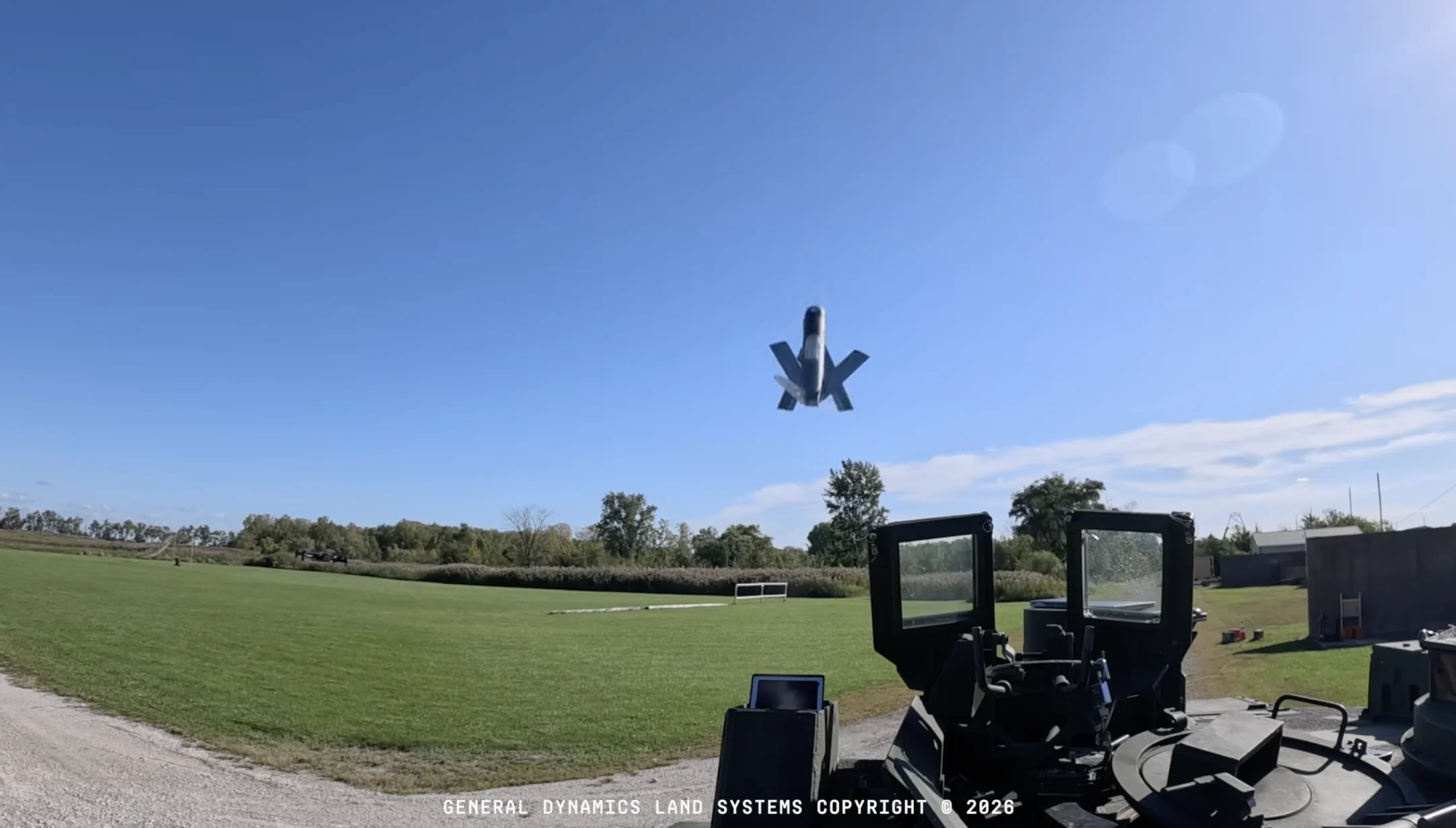
Soldiers from the US Army’s 1st Cavalry Division have begun testing PERCH 2.0 at Fort Hood, Texas, a General Dynamics Land Systems (GDLS) launcher kit that lets M1A2 Abrams SEPv3 crews fire AeroVironment Switchblade 300 loitering munitions, commonly called kamikaze drones, from under armor. GDLS unveiled the upgraded system at the Association of the United States Army (AUSA) annual meeting in Washington in October 2026, presenting it as a common modular kit for the Abrams and the Stryker.
PERCH, short for Precision Effects and Reconnaissance, Canister-Housed, aims to give heavy armor an organic beyond-line-of-sight (BLOS) reconnaissance and strike layer. It draws on the war in Ukraine, where armor maneuvering without its own overhead sensors has suffered heavy losses to first-person-view (FPV) drones, loitering munitions and concealed anti-tank teams. The Army’s August 2026 purchase of three prototypes moved the effort from company-funded demonstration to unit-level experimentation.
From MARS to Fort Hood: How the Abrams Switchblade Launcher Evolved
GDLS built the first PERCH in less than four months after senior Army leaders discussed battlefield observations from Ukraine at a 2025 event, according to Scott Taylor, the company’s director of US growth. Co-developed with AeroVironment, it debuted at the Army’s Machine Assisted Rugged Sapper (MARS) event at Fort Hood from October 26 to 30, 2025, where soldiers used a Switchblade 300 and a Switchblade 600 launched from an Abrams to support a complex obstacle breach.
That first configuration bolted onto existing attachment points in place of the loader’s sponson box, with no welding or cutting, carried three Switchblade 300s and one Switchblade 600, and was operated from a tablet. Soldiers from the 1st Cavalry Division who evaluated it pushed for changes to loading procedures, use of space and integration with the tank’s loader display, and the Army asked GDLS to concentrate on the smaller Switchblade 300.
GDLS financed PERCH 2.0 with independent research and development funds until the Army added three prototypes to the Abrams System Technical Support (STS) contract in August 2026, a periodically updated vehicle the company says lets the service move quickly. One prototype is already with 2nd Battalion, 12th Cavalry Regiment, known as Thunder Horse, in the 1st Brigade Combat Team; the remaining units are due by the end of October, bringing the total to four. The first PERCH 2.0 prototype was built with company funds.
Switchblade 300 Block 20 Specifications Inside the PERCH 2.0 Kit
PERCH 2.0 drops the Switchblade 600 and is built around the Switchblade 300. Its two headline changes answer the Fort Hood feedback: hatch-closed launch and a simplified reload. Published descriptions show the launcher integrated inside the left turret stowage box rather than replacing it, leaving the turret mounting points for Abrams Reactive Armor Tiles (ARAT) and the Trophy active protection system free. Control of a munition in flight can reportedly pass to another vehicle or to dismounted infantry. GDLS has not disclosed how many rounds a single PERCH 2.0 canister holds.
GDLS has not confirmed which Switchblade 300 block equips the kit or whether manufacturer figures hold for a vehicle installation. AeroVironment data for the current Block 20 list a 1.68 kg (3.69 lb) munition and a 3.27 kg (7.2 lb) all-up round with launch tube. The manufacturer cites a range of up to 30 km with an extended-range antenna, endurance above 20 minutes, a cruise speed of 101 km/h (63 mph) and a dash speed of 161 km/h (100 mph). The Block 20 carries an electro-optical and infrared (EO/IR) panning camera, a frequency-hopping digital datalink with AES-256 encryption, and a modular payload bay that accepts either a fragmentation or an explosively formed penetrator (EFP) warhead. The original Switchblade 300 offered roughly 10 km of range and 15 minutes of flight time.
For an Abrams crew, those numbers matter more as a sensor horizon than as a strike radius: a 30 km link, if achievable from the vehicle, would let the crew inspect a reverse slope or tree line far beyond the direct-fire envelope of the M256 120 mm gun before committing the tank.
What Dropping Switchblade 600 Means for Abrams Lethality
The all-Switchblade 300 loadout trades reach and armor-killing power for magazine depth. Publicly available specifications credit the Switchblade 600 with about 40 km of range, roughly 40 minutes of endurance and an anti-armor warhead. The Switchblade 300 targets personnel, crew-served weapons and light vehicles, with the EFP option extending its effect against light armor.
That trade fits the threats tank crews most often face at the forward edge: dismounted anti-tank guided missile teams, FPV drone operators and concealed observers. Engaging them with the main gun means exposing the tank; a Switchblade 300 can strike them while the Abrams stays in defilade. Heavy armor remains a task for the 120 mm gun and for dedicated assets such as the Switchblade 600s the Army has bought for infantry under its Low Altitude Stalking and Strike Ordnance (LASSO) effort.
The same kit is intended for the Stryker, giving Stryker brigades a reconnaissance-strike layer that moves with the formation. Both competitors for the Army’s XM30 Mechanized Infantry Combat Vehicle, the GDLS Wolf and the American Rheinmetall Lynx, also include options for loitering munition integration.
Analysis: The more consequential detail is the acquisition path. Buying prototypes through an existing Abrams support contract lets the Army put a new weapon on frontline tanks within weeks and gather requirements data from an operational brigade without first creating a program of record. That speed mirrors the iteration cycle seen in Ukraine, but it defers the harder questions: datalink resilience to electronic warfare, workload for a loader who must also feed the main gun, and munition resupply in sustained combat.
Taylor said the Army could either compete the capability or buy PERCH 2.0 outright once experimentation ends. Open points include canister capacity, the Stryker integration timeline, deeper links to Abrams fire control, and whether the concept migrates to the M1E3 Abrams now in development. No production order or fleet-wide installation schedule has been announced.