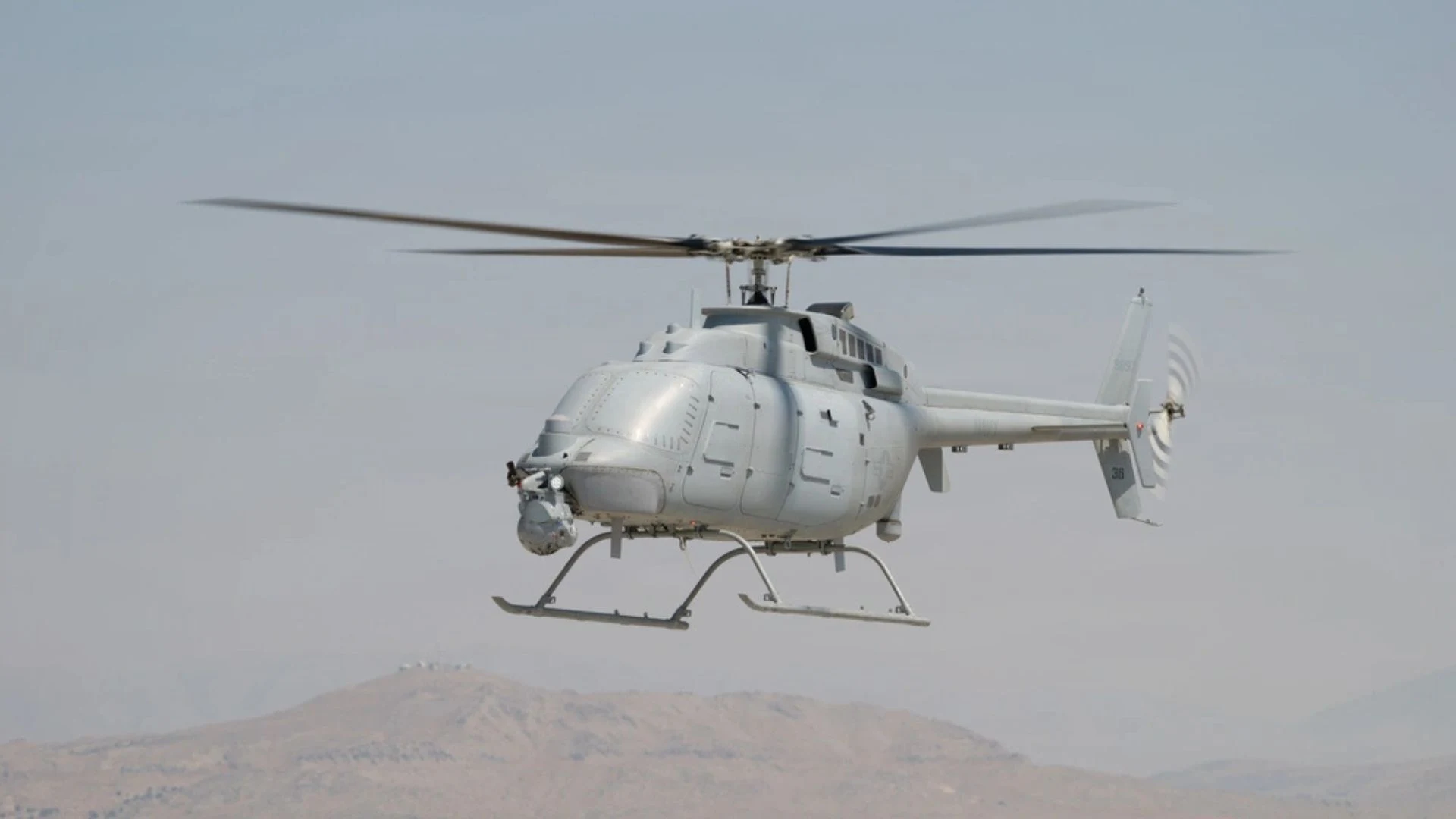
The U.S. Army Redstone Test Center (RTC) has begun flight testing four MQ-8C Fire Scout unmanned helicopters pulled from Navy divestment, turning the retired shipborne aircraft into captive carry testbeds for Army sensor packages. Flights began in August 2026 at Dugway Proving Ground, Utah, and Redstone Arsenal, Alabama, and the transfer saved the Army just over $70 million in procurement costs, according to the Navy’s Multi-Mission Tactical Unmanned Aircraft Systems (UAS) Program Office (PMA-266).
The Navy began divesting the MQ-8C in February 2024 at the direction of the Office of the Chief of Naval Operations Air Warfare Division (OPNAV N98), with final sundown set for the end of fiscal 2026. The service completed procurement of 38 MQ-8Cs in fiscal 2019 and first deployed the type in December 2021 aboard USS Milwaukee (LCS 5). In August 2024, the Pentagon’s Director, Operational Test and Evaluation (DOT&E) assessed the MQ-8C Surface Warfare (SUW) Increment as not operationally effective or suitable. The Army canceled its RQ-8B Fire Scout in January 2010; it now inherits the larger variant as test infrastructure.
How Redstone Test Center Pulled MQ-8C Fire Scout Out of Divestment
PMA-266 was roughly 60 percent through transferring aircraft, mobile control systems and support equipment to the 309th Aerospace Maintenance and Regeneration Group (AMARG) in Tucson, Arizona, when an Army request for information arrived. In November 2024, the program office was asked to evaluate whether the MQ-8C could serve as a captive carry testbed for RTC, a subordinate organization of the Army Test and Evaluation Command (ATEC). By December, the teams had scheduled a site visit to Point Mugu, California, to evaluate the aircraft and its mission control systems.
In January 2025, RTC formally requested four MQ-8Cs, two Mobile Mission Control Systems (MMCS), spare engines and associated support equipment from OPNAV N98. The Navy approved the request in May 2025, and all four aircraft, both MMCS units and dual-site support equipment reached Redstone Arsenal by July 2025.
The airframes moved faster than the enablers. Communications security (COMSEC) equipment, including radios, transponders and modems, had already been returned to common stock at Naval Supply Systems Command (NAVSUP) Weapon Systems Support earlier in the divestment. Recovering it took a year of negotiations, and the final assets arrived at Redstone in July 2026. RTC then completed ground testing and moved into flight tests aimed at building aircrew confidence and giving maintainers hands-on experience. The Navy says the transition through first flight tests took 14 months.
Chief Warrant Officer 4 Taylor Kiel, test director and experimental test pilot with RTC’s Aviation Flight Test Directorate, noted the team started with “zero experience with these systems.” Col. Leigh Irwin, PMA-266 program manager, said, “Repurposing these MQ-8C assets from storage to active testing is a major acquisition win for both services, demonstrating how we can supercharge existing capabilities and increase acquisition velocity to support joint operations.”
Bell 407 Airframe and 12-Hour Endurance: Why the MQ-8C Fits Sensor Testing
The Northrop Grumman MQ-8C pairs the autonomous flight control system, avionics and ship equipment of the smaller MQ-8B with a modified Bell 407 commercial airframe. Publicly available specifications indicate a single Rolls-Royce M250-C47E turboshaft rated at 700 shp (522 kW), with dual-channel full authority digital engine control (FADEC). Navy figures list a 34.7-foot overall length, a 3,200-pound zero-fuel weight, a 6,000-pound standard-day weight with fuel and payload, a 135-knot top speed, 115-knot cruise and a 16,000-foot service ceiling. Standard-day endurance reaches 12 hours with a 300-pound payload, and payload capacity exceeds 700 pounds, roughly double the endurance and triple the payload of the MQ-8B.
In fleet service, the aircraft carried the BRITE Star II electro-optical/infrared turret with laser rangefinder and designator, plus the Leonardo Osprey 30 active electronically scanned array (AESA) radar, designated AN/ZPY-8 in Navy service, a multimode set built for maritime surveillance. For RTC, the host matters more than the mission system: a stable, long-endurance rotary-wing platform able to carry a developmental sensor through repeatable low-altitude and hover profiles with no crew aboard.
The Navy has not disclosed which Army sensor packages will fly, whether the Navy payloads remain installed, or what modifications RTC has made to the airframes. The DOT&E finding addressed the SUW Increment as a shipborne mission system; a captive carry testbed is judged against a different standard.
Analysis: The $70 million reflects avoided procurement, not new capability, but the episode shows where divestment erodes reuse value: the aircraft reached Redstone two months after approval, while COMSEC gear absorbed into NAVSUP common stock took a year to recover. Keeping air vehicles, ground stations and crypto-bearing communications together until other users can claim them would compress future transfers. For the Army, the payoff is a low-cost uncrewed sensor host, provided RTC can sustain a type the Navy no longer supports.
The Navy’s sundown deadline of September 30, 2026, has passed, and PMA-266 has not said whether more MQ-8Cs remain available. Open questions include which sensors RTC will fly first, how long the Army will fund engine and parts support for an orphaned fleet, and whether the model is repeated as PMA-266 focuses on the MQ-9 Marine Air-Ground Task Force UAS Expeditionary (MUX) program and Group 4 and 5 vertical lift platforms.