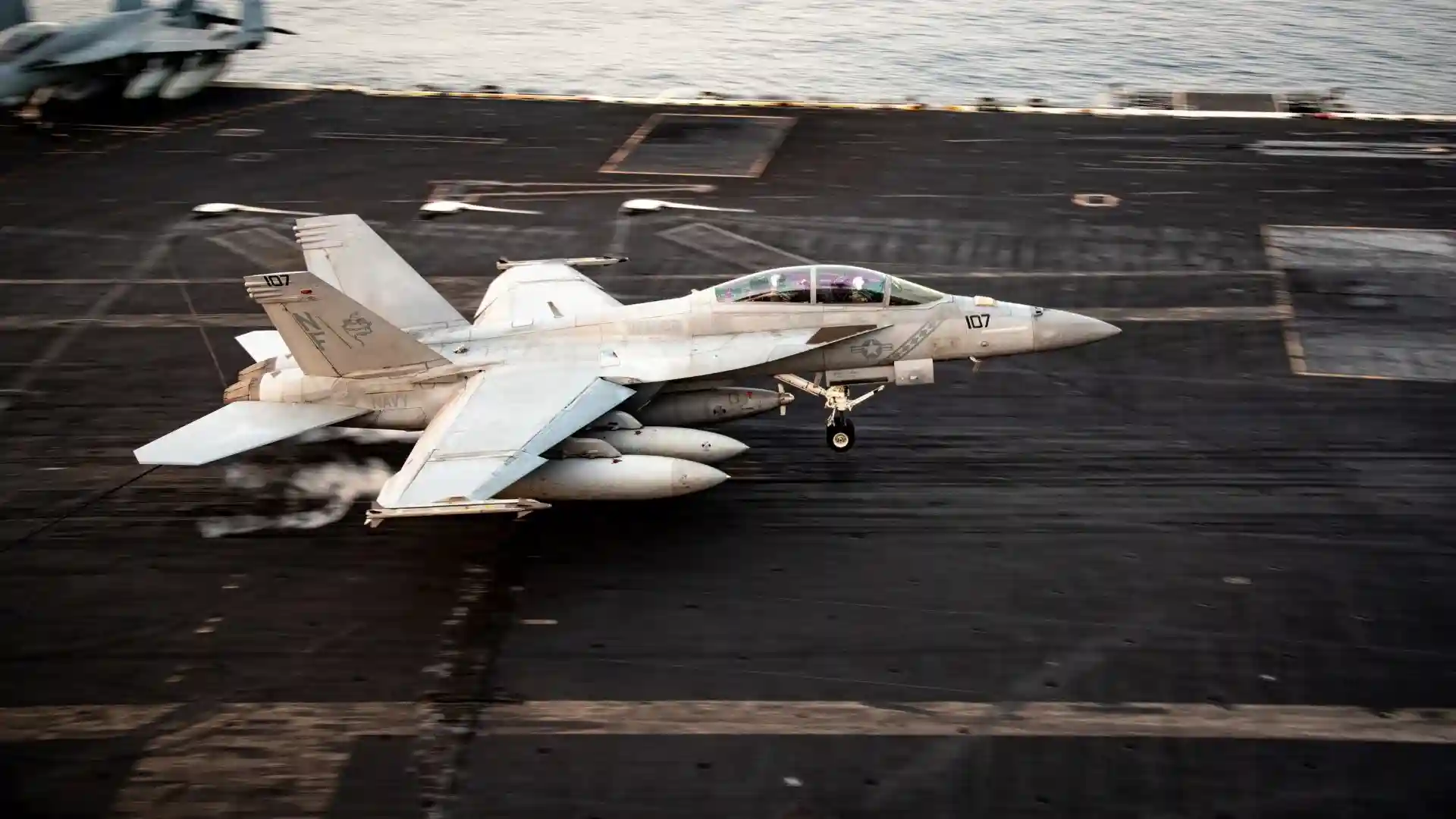
The U.S. Navy has awarded Boeing a $23.8 million firm-fixed-price contract modification to buy 64 Distributed Targeting Processor-Networked (DTP-N) A-Kits and 32 DTP-N B-Kits for F/A-18 Super Hornet service life modifications, the Pentagon announced on October 30, 2026. The award, valued at exactly $23,805,339, also funds associated cybersecurity and obsolescence support for the processor.
The order feeds the Service Life Modification (SLM) program, which rebuilds Block II Super Hornets to extend airframe life from 6,000 to 10,000 flight hours while installing the Block III avionics suite. DTP-N sits at the core of that suite. The award lands one month after the Navy selected Boeing on September 29, 2026, to develop the sixth-generation F/A-XX that will eventually replace the Super Hornet, and with Boeing set to end Super Hornet production in 2027. Upgraded Block II jets will therefore make up a growing share of the carrier air wing’s strike fighter inventory through the 2030s.
Contract Terms and Work Split for the DTP-N Kits Order
Naval Air Systems Command (NAVAIR), Patuxent River, Maryland, issued the action as modification P00004 to delivery order N0001925F0280, placed against basic ordering agreement N0001921G0006. The modification exercises existing options rather than adding new scope, and the Navy did not compete it, consistent with Boeing’s role as the Super Hornet original equipment manufacturer and Block III integrator.
Work will be split between Melbourne, Florida (60%), and St. Louis, Missouri (40%), with completion expected in January 2028. The contract announcement does not name the Melbourne partner, but L3Harris Technologies, headquartered in Melbourne, manufactures the DTP-N B-Kit. The Navy obligated the full $23,805,339 at award from fiscal 2027 aircraft procurement (Navy) funds.
In standard aircraft modification practice, A-Kits comprise the permanent installation provisions, such as wiring harnesses, mounting structure and cooling interfaces, while B-Kits contain the removable mission hardware itself. The announcement does not break out unit prices, and because the total also covers cybersecurity and obsolescence work, a per-kit cost cannot be derived from the published figure. The modification builds on the same delivery order, announced on March 6, 2025, as a $33.2 million order for 41 B-Kits, five B-Kit lab assets and nine Processor eXpress Mezzanine Cards, and expanded in December 2025 with 30 more B-Kits for $22.2 million.
What DTP-N Brings to the Block III Super Hornet
DTP-N is the adjunct mission processor at the center of the Block III configuration. Open-source assessments credit it with about 17 times the computing power of the Super Hornet’s previous mission computer, and L3Harris lists its raw processing speed at about 919 billion floating-point operations per second. It is built on a multi-level secure architecture, allowing data at different classification levels to be handled on one system, and on an open architecture designed to let the Navy load new software without swapping hardware.
Its operational value comes from pairing with the Tactical Targeting Network Technology (TTNT) datalink. Together, the two allow the aircraft to fuse onboard sensor data with off-board tracks from other aircraft and platforms, building a shared tactical picture across the air wing. Open-source reporting links this combination to long-range passive targeting when used with the Infrared Search and Track (IRST) Block II pod, reducing reliance on the jet’s own radar emissions.
The processor has also served as a testbed for manned-unmanned teaming. In 2022, Boeing and the Navy flew a Block III test jet that commanded three unmanned aerial vehicles over a two-week campaign, with DTP-N processing pilot inputs from a third-party tablet.
The cybersecurity and obsolescence elements of this award address a different problem: keeping a processor first delivered on Block III test jets in June 2020 secure and supportable on an airframe now planned to serve into the 2040s.
Analysis: This tranche buys two A-Kits for every B-Kit, but it follows 71 B-Kits ordered under the same delivery order in March and December 2025, bringing B-Kit purchases on the order to 103 against 64 A-Kits. The ratio in this modification alone therefore says little about how many SLM aircraft will receive processors, and the contract does not explain the split. The sustainment content carries more weight. In July 2026, NAVAIR sought sources for a life-of-type buy of nine obsolete electronic components it described as critical to DTP-N production and sustainment. In October 2026, the Navy also sought industry sources to replace out-of-production components in the AN/AYK-22 weapons control processor used on Super Hornets and EA-18G Growlers, with responses due October 28, 2026. Read together, these actions show the Navy treating electronic obsolescence, not airframe fatigue alone, as the binding constraint on how long the Super Hornet remains combat-relevant while F/A-XX development begins.
Deliveries under this modification run to January 2028. Markers to watch include the pace of SLM inductions under Boeing’s $930.8 million indefinite-delivery contract awarded in December 2025 for up to 60 aircraft, the ramp-up at Fleet Readiness Center Southwest after it completed its first fully in-house Block III modification in April 2026, and whether follow-on DTP-N B-Kit orders appear in fiscal 2027 or 2028 contract actions. The announcement does not state how many DTP-N kits remain to be ordered to complete the fleet conversion.