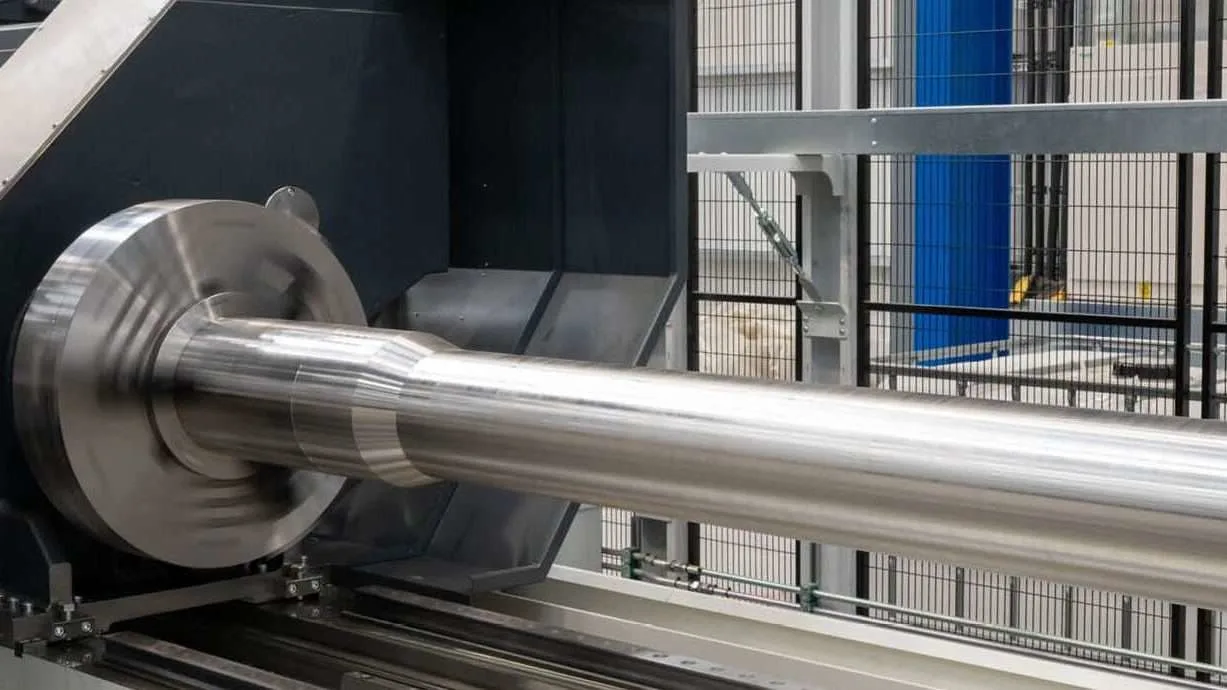
Rheinmetall has officially opened its UK Gun Hall in Telford, Shropshire, restoring domestic production of 120mm and 155mm gun barrels and breeches to Britain. The German group announced the opening on October 22, 2026, at a ceremony hosted by Rheinmetall AG Chief Executive Officer Armin Papperger and Secretary of State for Defence Wes Streeting, with representatives of government, the Armed Forces and industry in attendance.
The facility closes a gap that has persisted since 2016, when, according to Rheinmetall, the United Kingdom lost its ability to manufacture large-calibre barrels. Rheinmetall confirmed Telford as the site on May 19, 2025, under the Trinity House Agreement, the UK-Germany defence pact signed in October 2024, and held a virtual ground-breaking at DSEI on September 11, 2025. The Gun Hall forms part of more than £200 million that Rheinmetall says it has invested across its UK operations over the past five years, alongside its work on the Boxer Mechanised Infantry Vehicle and the Challenger 3 Main Battle Tank (MBT).
Inside the UK Gun Hall: Capacity, Calibres, and Production Timeline
The plant offers 11,500 square meters of production space. At peak capacity, Rheinmetall says it can produce up to 245 barrels per year across both calibres, plus more than 50 breeches annually. The company has not disclosed how that output splits between 120mm tank guns and 155mm artillery tubes.
Rheinmetall converted an empty building into an operating line in eight months. Production of breeches and breech blocks began in May 2026, followed by barrel production in June 2026. That is earlier than the by-2027 production target the company set when it announced the project in May 2025. Advanced machining equipment was installed and commissioned during that window, and UK employees trained at Rheinmetall’s Unterlüß plant in Germany in precision manufacturing, quality assurance and specialist weapon production before returning to Telford.
Rheinmetall employs around 685 people in Telford, 35 of them currently at the Gun Hall. The company expects the facility to support more than 100 skilled jobs as production develops. The 2025 announcement cited a broader figure of more than 400 jobs and over £400 million in economic investment over a decade. Rheinmetall also intends to introduce British steel from Sheffield Forgemasters into production, but has given no timeline for the switch.
Challenger 3 and RCH 155: The Programs Behind Telford’s Order Book
Two British Army programs anchor demand. Challenger 3, built by the Rheinmetall BAE Systems Land (RBSL) joint venture, also in Telford, upgrades 148 Challenger 2 tanks under a contract worth more than £800 million. Its central change is the switch from the rifled L30A1 gun to Rheinmetall’s L55A1 120mm smoothbore, which fires kinetic energy anti-tank rounds and programmable multi-purpose ammunition. Initial Operating Capability was planned for November 2027 and Full Operating Capability for November 2030, but the program is under a performance review, with reapproval expected in Financial Year 2026-27. The Ministry of Defence (MoD) has not quantified potential delays.
The second is the Remote Controlled Howitzer (RCH) 155, the Army’s long-term Mobile Fires Platform replacing the AS90 howitzers gifted to Ukraine. On March 13, 2026, the MoD announced a £53 million contract, awarded through the Organisation for Joint Armament Co-operation (OCCAR) to ARTEC GmbH, for long-lead production of 37 weapon systems: barrel, muzzle brake, breech, recoil system and trunnions. £30 million of that value was directed to developing the Gun Hall. OCCAR followed on April 30, 2026, with a contract for 72 Boxer RCH 155 platforms, which the MoD valued at nearly £1 billion including initial training and in-service support. According to the MoD, the system fires eight rounds per minute at targets up to 70 kilometers away, depending on ammunition.
Analysis: The capacity figure matters more than the ribbon-cutting. Barrels are consumables in high-intensity artillery warfare, and a fleet of 72 howitzers firing at sustained rates will wear through tubes far faster than peacetime planning assumes. Up to 245 barrels a year exceeds steady-state UK demand from Challenger 3 and RCH 155 combined, which positions Telford as a surge and export node for NATO rather than a purely national line. Sovereignty remains partial for now: the gun designs and production expertise come from Rheinmetall in Germany, and domestic steel supply depends on the Sheffield Forgemasters integration that has yet to be scheduled.
Next milestones include the ramp toward 100-plus staff, the introduction of UK-sourced steel, the Challenger 3 reapproval decision in Financial Year 2026-27 and the first RCH 155 deliveries. Streeting called the eight-month build “rapid reindustrialisation in action.” Whether Telford reaches its 245-barrel peak will depend on export orders and on UK funding decisions that remain open.