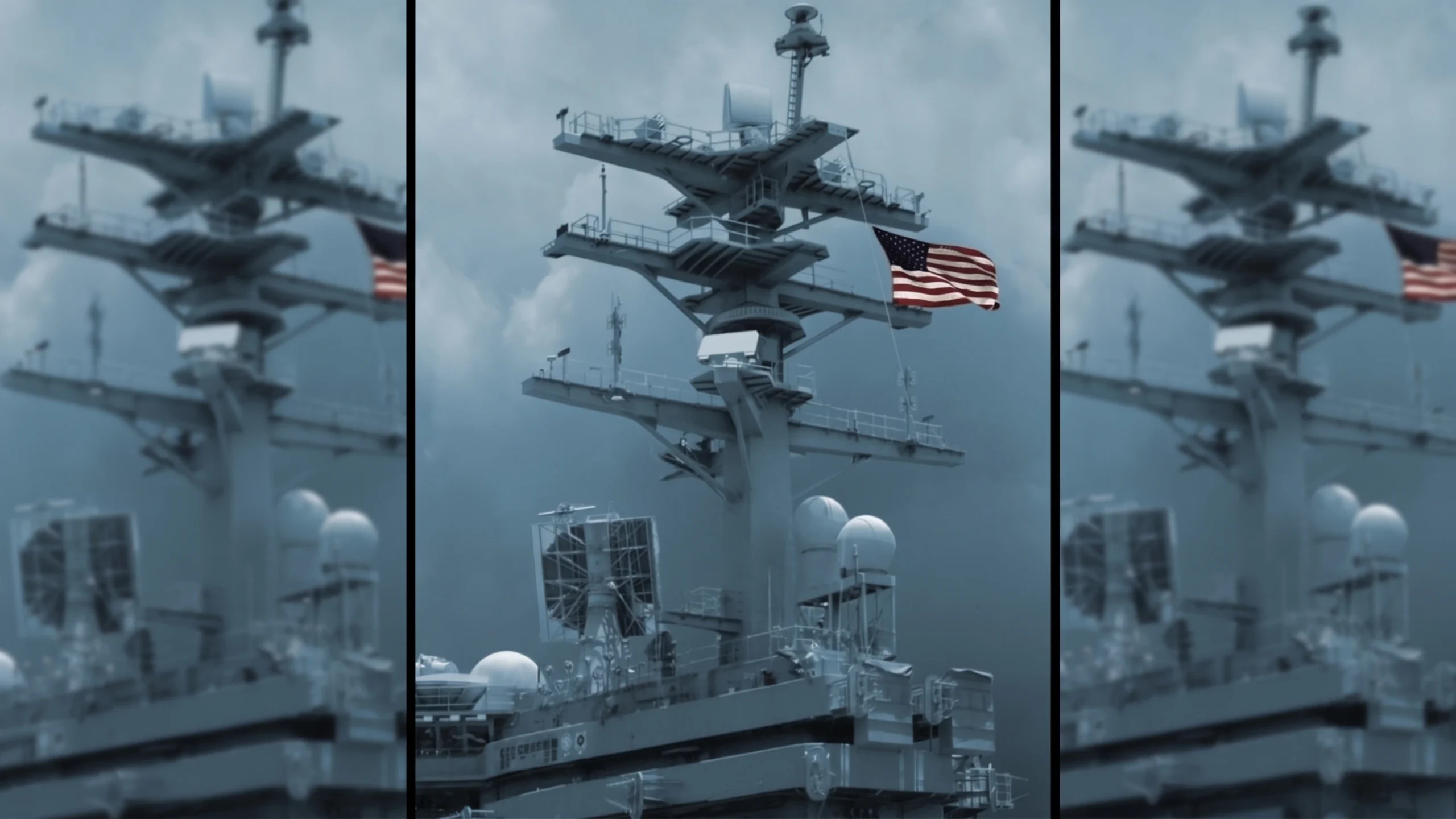
The US Navy has ordered another AN/SPN-50 radar for shipboard air traffic control from Saab Inc., awarding a $14,308,164 firm-fixed-price contract modification on October 22, 2026, for one low-rate initial production (LRIP) unit. Naval Air Systems Command (NAVAIR), Patuxent River, Maryland, issued modification P00026 to contract N0001923C0049 by exercising an existing option. Saab will build the radar in East Syracuse, New York, by June 2028, using fiscal 2027 Other Procurement, Navy (OPN) funds obligated at award. The modification was not competitively procured.
The SPN-50 replaces the AN/SPN-43C, the air search radar that has controlled traffic around aircraft carriers and large-deck amphibious assault ships since the mid-1960s. Age is only part of the problem. According to Navy officials, the top 25 percent of the SPN-43C frequency band has been reallocated to commercial fixed wireless access, prohibiting air traffic control and air search operation with the legacy set within 50 nautical miles of the coast, the waters where ships work up near homeport.
SPN-50 Radar Design: Sea Giraffe Lineage and C-Band Coverage
The AN/SPN-50(V)1 is a US Navy derivative of Saab’s Sea Giraffe Agile Multi-Beam (AMB) radar, the family the Navy already fields as the AN/SPS-77 on Independence-class Littoral Combat Ships (LCS). NAVAIR describes it as a fully coherent, multiple-beam, three-dimensional C-band sensor with high output power, built for air traffic control in congested electromagnetic environments and all weather. Operating in C-band takes the function out of the band segment the SPN-43C now shares with commercial wireless users.
Publicly available specifications for the Sea Giraffe AMB baseline indicate 14 stacked elevation beams covering 0 to 70 degrees, refreshed on every antenna revolution, and an instrumented range of about 180 kilometers. NAVAIR says the SPN-50 pairs Saab hardware and software with government-developed target processing algorithms; its air traffic control modes have not been published.
Controllers use the radar to identify, marshal, and direct aircraft within 50 nautical miles of the ship, drawing on its position, radar, and weather data for sequencing, separation, safety alerts, and landing guidance. It serves as the primary air traffic control surveillance radar for manned and unmanned aviation, a role that grows as the Navy brings the MQ-25 Stingray into carrier air wings. NAVAIR has also cited better compatibility with the Enterprise Air Surveillance Radar (EASR) than the SPN-43C offered.
Sole-Source Production Lots and the SPN-43C Replacement Timeline
Saab has held the program since a $38.1 million engineering and manufacturing development award in 2016. The radar was first demonstrated on October 23, 2019, and a September 2020 production award funded units for USS Dwight D. Eisenhower (CVN 69) and USS Bougainville (LHA 8). Recent lots include three radars for $47.5 million in December 2023, three for $41.7 million in October 2024, and five for $74.6 million in fiscal 2026, that last lot split 58.9 percent in Syracuse and 41.1 percent in Gothenburg, Sweden.
At $14.3 million, the new order sits near the roughly $13.9 million per radar implied by the October 2024 lot, which also bundled repair parts kits. The October 22 announcement lists no spares.
In a market notice covering fiscal 2026 and 2027 buys, NAVAIR stated that Saab is the sole SPN-50 designer, developer, and manufacturer, and that the Navy did not procure the technical data package another source would need. The notice ties deliveries to installation schedules on Wasp-class and America-class amphibious assault ships.
Analysis: Ten years after development began, the SPN-50 is still bought in low-rate lots sized to installation windows, as NAVAIR’s own delivery language suggests. The larger exposure is data rights: without the technical data package, the Navy has no second source and limited leverage over a unit price that has held between roughly $14 million and $15 million. For the sensor that governs flight operations around carriers and big-deck amphibs, the Navy has traded competition for continuity with a radar family it already operates on the LCS.
Saab must deliver this unit by June 2028, and further fiscal 2027 options on the same contract remain possible. Open questions include how many SPN-43C sets remain in service, whether the Navy still targets the 25 radars through fiscal 2028 it planned in 2019, and when the program will seek a full-rate production decision.