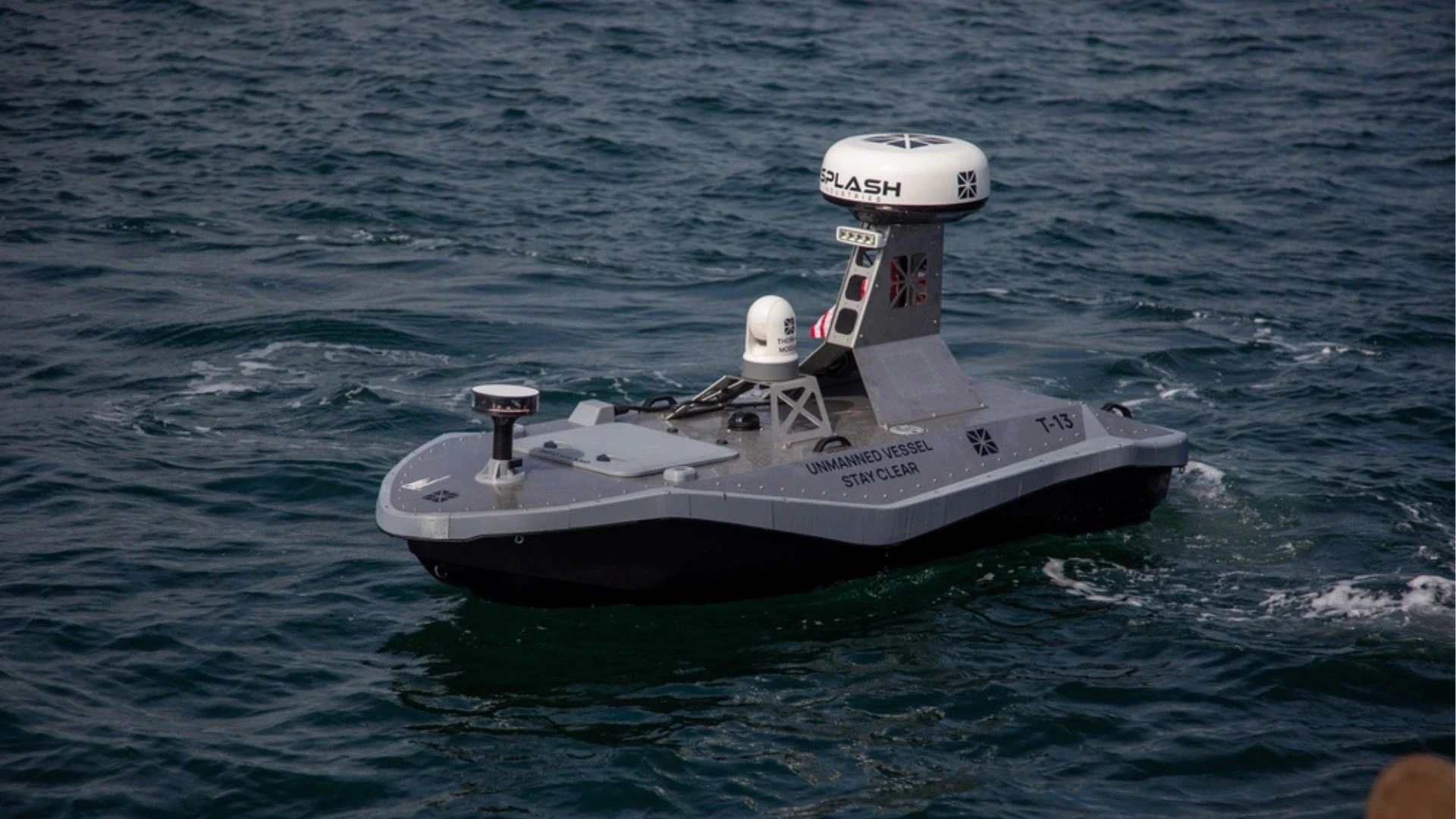
A Typhoon uncrewed surface vessel (USV) built by Splash Industries demonstrated a naval interception at Marine Corps Air Station (MCAS) Iwakuni, Japan, on October 21, 2026, during Exercise Keen Sword 27 (KS27). Official U.S. Marine Corps imagery released October 23, 2026, shows the 11-foot boat on the water at the air station during a drone demonstration organized for the exercise.
Keen Sword is a biennial bilateral field training exercise between the U.S. military and the Japan Self-Defense Forces (JSDF), with multinational participation. The 2026 iteration runs through October 29 and involves roughly 45,000 JSDF personnel and 11,000 U.S. troops. Its scenario has shifted toward ground-based, multi-island sea denial across Japan’s southwestern islands: the Marine Corps is deploying the Navy-Marine Expeditionary Ship Interdiction System (NMESIS) and the Marine Air Defense Integrated System (MADIS) to Yonaguni for the first time, while the Japan Ground Self-Defense Force (JGSDF) trains with its new Type 25 surface-to-ship guided missile. The drone demonstration took place at MCAS Iwakuni in Yamaguchi Prefecture, a base on the Seto Inland Sea that the Marine Corps shares with the Japan Maritime Self-Defense Force (JMSDF).
Typhoon USV Design, Speed, and Range Specifications
Splash Industries, based in Inglewood, California, builds the Typhoon as an 11-foot (3.4-meter) jet-propelled USV for defense roles such as maritime surveillance and cargo delivery. Company figures rate the boat at a sustained speed above 50 knots, with runs beyond 70 knots in testing, and a range of more than 600 nautical miles. These are manufacturer claims and have not been independently verified.
Speed is the attribute most relevant to an intercept mission. A boat sustaining 50 knots can keep pace with fast attack craft and close on surface contacts faster than most small USVs, which typically trade speed for endurance. The 600-nautical-mile figure would allow a single Typhoon to patrol or loiter well beyond the littoral, although Splash has not published range at sprint speed.
Imagery released from Iwakuni shows the boat fitted with a mast-mounted radome and a smaller secondary dome. Neither the sensor suite nor the communications architecture used during the intercept has been disclosed. Splash designs its electronics, software, and sensors in-house, and the company says a Typhoon can be assembled in eight hours and sells for roughly one-tenth the price of comparable systems.
The intercept scenario itself remains thinly documented. Official material does not identify the operating unit, the nature of the target, whether the boat ran autonomously or under remote control, or whether the interception involved any effector beyond shadowing or physically blocking a contact.
From RIMPAC Resupply to Airstrike Pack: Typhoon’s 2026 Test Record
Iwakuni follows other Typhoon exercise appearances in 2026. During the Rim of the Pacific (RIMPAC) exercise off Hawaii in July, a Typhoon crossed the wake of the Wasp-class amphibious assault ship USS Essex (LHD 2) and entered its flooded well deck while the ship was underway, in what Splash described as the first fully autonomous underway resupply of a U.S. Navy warship. Within the same 24 hours, a Typhoon carried uncrewed aircraft components that Marines had manufactured aboard Essex back to shore, and another Typhoon autonomously rendezvoused with an aircraft carrier operating more than 100 miles offshore. The Naval Postgraduate School’s Consortium for Advanced Manufacturing Research and Education oversaw the demonstrations.
In August 2026, Splash unveiled the Airstrike Pack, a modular payload that allows one-way aerial drones to be fired from the Typhoon’s deck, controlled through the company’s Splash C2 command-and-control software. The company said the module had been tested in a force-on-force exercise but has not disclosed the drone model or how many the boat carries. Splash is also preparing a larger vessel, the Tempest, for U.S. Navy testing, with a stated payload of 1,500 pounds and a range of 300 nautical miles.
Analysis: The Iwakuni demonstration places a low-cost, commercially developed USV inside a U.S.-Japan exercise that is rehearsing distributed sea denial along the first island chain. In that construct, small fast boats can extend the sensor picture of land-based shooters such as NMESIS and the Type 25, screen littoral approaches, and shuttle cargo between dispersed sites without exposing crewed craft. The unresolved issue is resilience: an intercept against a peer adversary would take place in a contested electromagnetic environment, and the Essex well-deck approach remains the main public evidence that the Typhoon can navigate autonomously in demanding conditions.
Keen Sword 27 runs through October 29, 2026, and further imagery or official readouts may clarify which unit operated the Typhoon and how the intercept was conducted. Neither the Marine Corps nor the Navy has announced a procurement decision for the boat, and no program of record has been identified. The next markers are the Tempest’s Navy test schedule and whether Splash discloses Airstrike Pack payload figures.