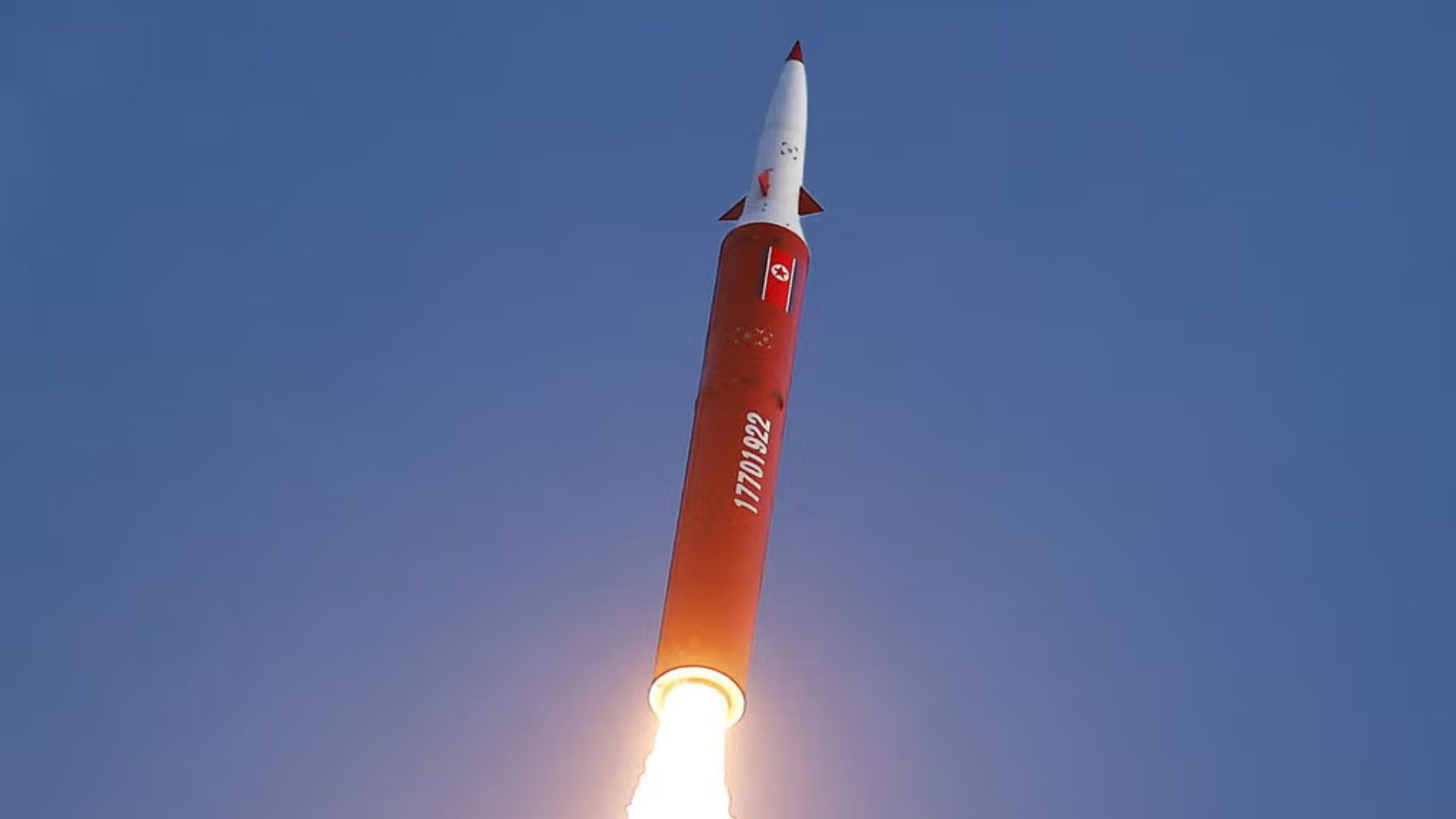
North Korea and South Korea traded hypersonic missile tests five days apart this month, exposing an accelerating arms race on the Korean Peninsula as Pyongyang turns its wartime partnership with Russia into missile and drone capability. Kim Jong Un oversaw an intermediate-range launch on October 3, 2026, and President Lee Jae Myung attended South Korea’s first flight test of a domestically developed hypersonic glide vehicle (HGV) on October 8.
The exchange follows weeks of friction along the Demilitarized Zone (DMZ). On September 21, mines exploded about 10 meters south of the Military Demarcation Line, injuring three South Korean soldiers. On October 5, Seoul’s Joint Chiefs of Staff (JCS) said a joint investigation with the U.S.-led United Nations Command found the mines were North Korean and deliberately emplaced more than a year earlier. Pyongyang denies responsibility.
North Korea Hypersonic Missile Test and Seoul’s First HGV Launch
The October 3 missile lifted off from the Wonsan area. The Korean Central News Agency (KCNA) said it struck a target 1,000 kilometers (621 miles) away during a drill for units operating what Pyongyang calls its hypersonic strategic weapon system. The JCS tracked the flight beyond 700 kilometers, while Japan’s Defense Ministry assessed about 680 kilometers with an apogee near 90 kilometers. Pyongyang has not named the missile; analysts in Seoul pointed to the Hwasong-16B, an unconfirmed identification.
Publicly available specifications indicate the Hwasong-16B is a two-stage, solid-propellant intermediate-range ballistic missile (IRBM) flown since 2024 with both an HGV and a maneuverable reentry vehicle (MaRV). Solid fuel sharply reduces launch preparation time, letting road-mobile launchers stay concealed until firing. Pyongyang claimed the warhead flew a low-altitude, wave-like trajectory, adjusted by artificial intelligence (AI), that South Korean and Japanese sensors could not follow. Seoul’s Defense Ministry disputed the claim, saying the missile was within allied interception capabilities. Kim called for making the enemy recognize “the reliability and fatality” of North Korea’s strategic offensive weapons.
South Korea’s answer came five days later. According to the presidential office, the HGV developed by the Agency for Defense Development (ADD) separated from its booster at the planned altitude, descended to low altitude and maneuvered vertically and horizontally before hitting a test target. The flight evaluated heat-resistant materials, guidance and control, and low-altitude maneuvering at hypersonic speed. No range has been released.
How Russia’s War Is Scaling North Korean Drone and Missile Production
Anton Ponomarenko, a Pacific Forum researcher who monitors Russia-North Korea military cooperation, told The New York Times that battlefield data gathered while supporting Russia’s war in Ukraine has improved North Korean warhead accuracy and maneuverability. The drone pipeline is better documented. Ukraine’s Defense Intelligence directorate (HUR) reported in November 2025 that Russia planned to bring roughly 12,000 North Korean workers to the Alabuga special economic zone in Tatarstan, the main production site for the Geran-2, Russia’s derivative of Iran’s Shahed-136. HUR also said in June 2025 that Moscow had agreed to help Pyongyang localize Geran-2 production.
The lessons are now visible at home. On September 12, five artillery and missile units staged what KCNA called a joint firepower attack drill against an island target off the east coast, combining several types of one-way attack drones, a tactical cruise missile, a large-caliber thermobaric multiple rocket launcher and tactical ballistic missiles under an integrated fire-control system. In mid-September, Kim toured munitions plants with assembly lines for at least three drone types, including the large Saetbyol and an unnamed one-way attack drone. Output rates remain undisclosed.
The tactic mirrors Ukraine: low-cost drones saturate layered defenses such as Patriot and the Korean Air and Missile Defense (KAMD) network while missiles arrive on different vectors, forcing defenders to spend interceptors worth far more than their targets.
Hyunmoo-5 vs Hwasong-11C: Bunker Busters and Seoul’s Three-Axis Response
Lee also inspected the Hyunmoo-5 on October 8. Seoul keeps most specifications classified, but published assessments describe a cold-launched, two-stage solid-fuel ballistic missile carried on a nine-axle transporter-erector-launcher, with a conventional penetrator warhead of 8 to 9 tons built to destroy deeply buried command bunkers. Reported range exceeds 300 kilometers with an 8-ton warhead and 600 kilometers with a 6-ton warhead; analysts estimate a 1-ton payload could theoretically extend it to about 3,000 kilometers. The ADD developed the missile with Hanwha Aerospace; deployment began in late 2025.
Pyongyang replied on October 12 with several ballistic missiles of different types, one flying more than 900 kilometers, according to the JCS. KCNA said the launch verified a technical upgrade to a core element of a tactical ballistic missile. Analysts assess the weapon as an upgraded Hwasong-11 series variant, likely derived from the Hwasong-11C, which North Korea credits with a 2.5-ton warhead.
The Hyunmoo-5 serves both the Kill Chain preemptive-strike and Korea Massive Punishment and Retaliation (KMPR) pillars of Seoul’s three-axis strategy, with KAMD as the third. Seoul has also committed to raise defense spending from about 2.8 percent to 3.5 percent of gross domestic product (GDP), the first U.S. treaty ally outside the North Atlantic Treaty Organization to adopt that standard. “Our security must be secured by our own strength,” Lee said after the HGV test.
Analysis: The October exchange shows the peninsula’s military balance shifting from a contest of platforms to a contest of production rates and sensor coverage. South Korea retains superiority in airpower, naval forces and allied surveillance. Russian combat feedback and drone know-how let Pyongyang attack the cost side of that advantage, forcing Seoul and U.S. Forces Korea to buy interceptors faster than North Korea builds threats. Dual-capable North Korean missiles also compress decision time: Kim Yong-ho, a former director of strategic intelligence at the South Korean Defense Ministry, told the Times that a launch alone may not reveal whether a warhead is conventional or nuclear. Lami Kim, Korea chair at the International Institute for Strategic Studies (IISS), told the paper that Russian help toward a nuclear strike capability against the U.S. homeland would undermine the credibility of U.S. extended deterrence.
Near-term indicators include whether North Korea names and deploys the October 3 system, a first flight of the solid-fuel Hwasong-20 intercontinental ballistic missile (ICBM), and the launch of the 8,700-ton-class nuclear-powered submarine whose hull Kim inspected in December 2025. Seoul has disclosed no HGV fielding timeline. The depth of Russian technology transfer remains the central unknown.