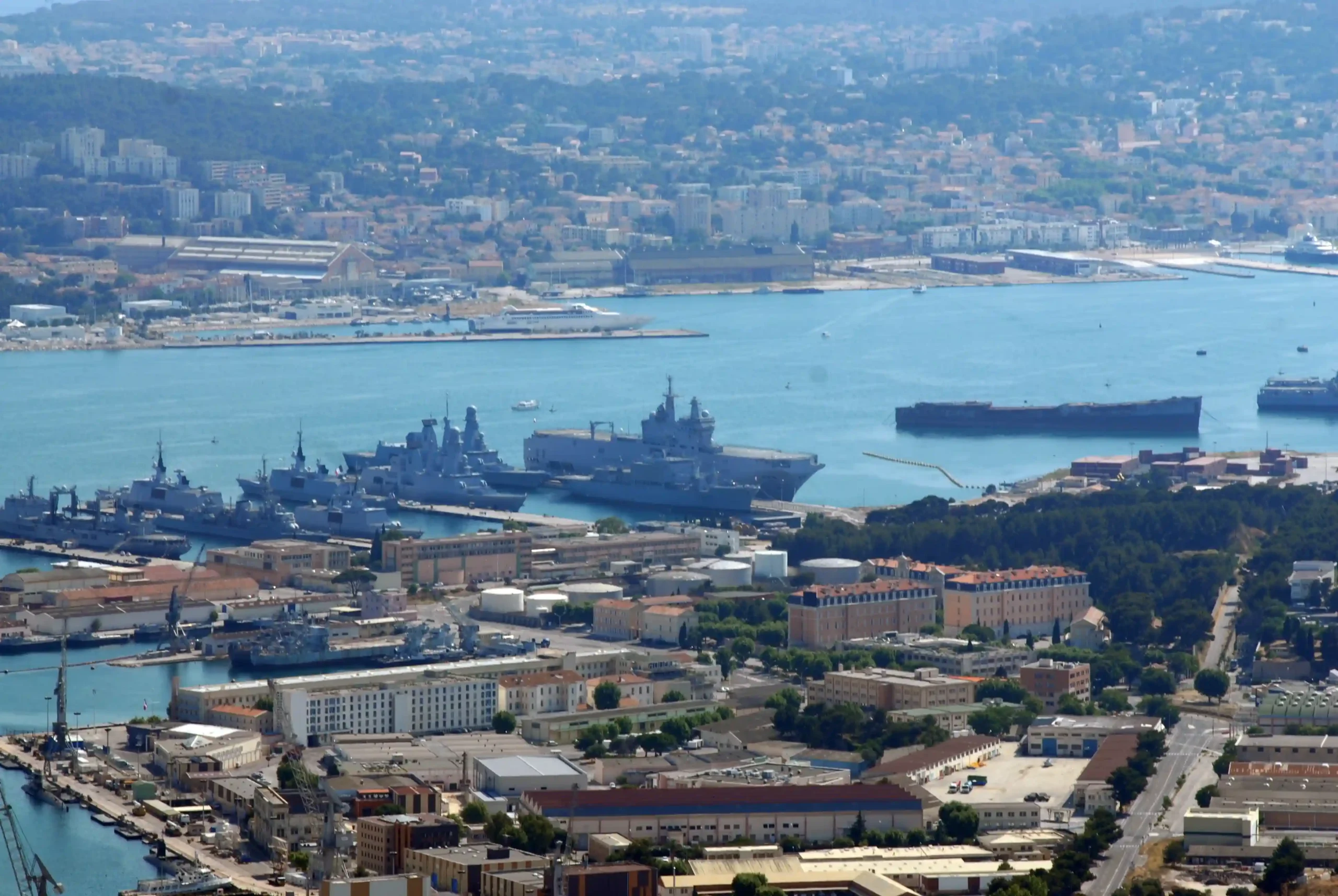
The French Navy confirmed on October 21, 2026, that unauthorized drones flew near and over military sites around Toulon, France’s principal naval base, during Exercise Typhon, a joint harbor-defense exercise held from October 5 to October 16. The navy’s Mediterranean Zone Command said counter-drone systems were activated for each occurrence, in coordination with domestic security forces, and that a judicial investigation has been opened.
The timing gives the episode its weight. Typhon, led by Vice Admiral Laurent Hermann, commander-in-chief for the Mediterranean, combined land, air and maritime maneuvers across 11 municipalities to train forces in protecting installations in and around Toulon harbor, including against drones. According to French local media, the intrusions occurred at night between October 9 and October 13 over the naval base, a Directorate General for Armament (DGA) facility in Toulon and the 54th Artillery Regiment (54e RA) in Hyères. The flights extend a wave of drone activity over European military and defense-industrial sites; in July 2026, a Moldovan national was arrested in Munich on suspicion of espionage after flying a drone over what a security source identified as a KNDS facility.
Toulon Drone Incursions Inside the LF-P 62 Prohibited Zone
The navy said the drones were “detected in the no-fly zone, near and above military sites.” That zone is LF-P 62 Toulon, a permanent prohibited area created by an order of September 20, 2017. French reporting indicates it covers eight municipalities of the Toulon area from the surface up to 5,950 meters, roughly 19,500 feet, with exemptions limited to military flights and emergency services. The maritime prefecture confirmed the intruders had no connection to the drones flown as part of Typhon.
Officials have released few operational details. The Mediterranean command declined to specify the number of incidents, the type of drones involved, or whether any were neutralized. Local reporting states that electromagnetic jamming equipment was used, that no aircraft was recovered, and that neither the number nor the models of the drones have been established. A source quoted by local media described “several of them each time, and they were large aircraft.” The navy was also reportedly trialing a tethered aerostat for drone detection over the base during Typhon, but raised it only from October 13, the last day of reported overflights.
The three sites form a coherent target set. Toulon is home port of the nuclear-powered aircraft carrier Charles de Gaulle (R91) and the navy’s nuclear-powered attack submarine force, now transitioning from the Rubis class to the Suffren class. The 54e RA is the French Army’s only ground-based air defense regiment, with about 1,000 active and reserve personnel operating Mistral short-range surface-to-air missiles and the MARTHA air defense command-and-control network, and specializes in counter-drone warfare. The navy stated that no sensitive infrastructure was threatened.
Jamming Without Capture: Limits of French Counter-Drone Architecture
The navy has not identified which counter-drone systems were engaged. France’s principal deployable capability is PARADE (Protection déployable modulaire anti-drones), developed by a Thales and CS Group consortium under a program notified by the DGA in 2022, with a total budget of €350 million over 11 years. PARADE links radar, optical and radio-frequency direction-finding sensors to a common command-and-control post and neutralizes drones with radio-frequency jammers. The DGA’s 2021 contract notice targeted micro-drones of 100 grams to 2 kilograms and mini-drones of 2 to 25 kilograms. French small and midsize firms CerbAir, Exavision and MC2 Technologies, maker of the NEROD RF portable jammer, contribute to the program.
Soft-kill effectors sever a drone’s control link or degrade its satellite navigation, forcing it to land, return to its launch point or drift off course. They protect the airspace in the moment but rarely deliver an airframe to investigators, which is consistent with the outcome reported at Toulon. Drones flying preprogrammed routes without an active datalink, using inertial or visual navigation, or guided through fiber-optic cable, as seen in Ukraine, are largely immune to radio-frequency jamming. Nothing published indicates the Toulon drones used these techniques. Kinetic interception, meanwhile, carries collateral-damage risk over a densely populated harbor city.
The pattern is not new. On December 4, 2025, five drones were reportedly detected over Île Longue, home of France’s ballistic missile submarines; marine fusiliers used jammers, but no drone was reported downed and no operator was identified at the time. By contrast, when a drone approached the Toulon naval base on March 24, 2026, maritime gendarmes detained its operator, according to the maritime prefecture.
Analysis: The significance of the Toulon episode lies in its timing more than in the overflights themselves. An operator flying into LF-P 62 while the garrison rehearsed base defense could observe detection timelines, effector deployment and coordination between naval, army and domestic security forces under realistic conditions, precisely the data a planner would need before any sabotage scenario. The navy has not linked the flights to any state actor. Yet Île Longue and Toulon point to the same gap: French bases can detect and disrupt intruders but struggle to capture airframes or operators, leaving investigators without the physical evidence attribution requires.
The military affairs division of the Marseille prosecutor’s office now leads the inquiry. Under the French Transport Code, intentionally flying a drone over a prohibited zone carries up to one year in prison and a €45,000 fine. Key markers include whether authorities disclose drone types, whether the aerostat detection trial becomes permanent at Toulon, and whether overflights resume now that Typhon has ended.