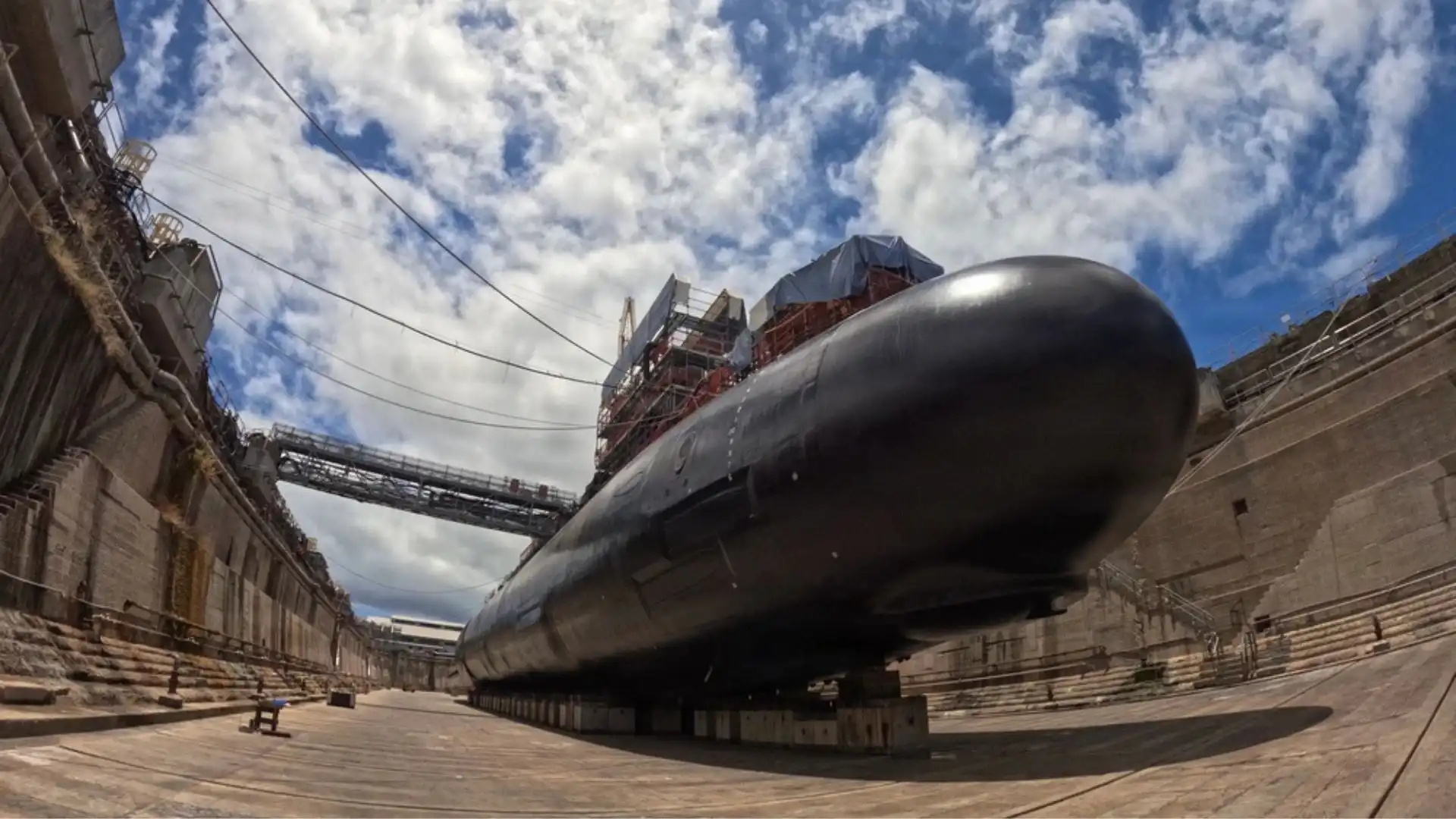
The US Navy on October 23, 2026, awarded a shared $98,078,464 ceiling increase to its Submarine Safety (SUBSAFE) multiple-award contract, sustaining SUBSAFE and Level 1 hardware fabrication and associated technical and engineering services through November 2029. The modification covers four holders: Huntington Ingalls Inc.’s Newport News Shipbuilding of Newport News, Virginia; Oceaneering International Inc. of Chesapeake, Virginia; Epsilon Systems Solutions Inc. of San Diego, California; and Delphinus Engineering Inc. of Eddystone, Pennsylvania, a small business. The Naval Undersea Warfare Center (NUWC) Division Newport, Rhode Island, is the contracting activity.
The award follows a Government Accountability Office (GAO) report, released August 27, 2026, finding that only about 11% of attack submarine depot maintenance periods at public shipyards finished on time between fiscal 2016 and fiscal 2025, with more than 15,000 operational days lost to delays and idle time. SUBSAFE hardware sits on that critical path. The program was created in 1963 after USS Thresher (SSN 593) was lost with all 129 people aboard during a deep test dive, and a submarine whose SUBSAFE certification lapses may not submerge until it is restored.
How the SUBSAFE Contract Supports Level 1 Hardware Fabrication
SUBSAFE aims to assure that a submarine’s hull stays watertight and that its crew can recover from a flooding casualty. The certification boundary covers structures, systems and components exposed to sea pressure or critical to recovery, and certification rests on four elements: design, material, fabrication and testing. Every item inside the boundary requires objective quality evidence (OQE) tracing it from raw material through installation and test, retained for the life of the ship. No SUBSAFE-certified submarine has been lost since the program began; USS Scorpion (SSN 589), lost in 1968, had not been certified.
Level 1 designates material held to the strictest verification and traceability controls, applied where a component failure could have catastrophic consequences for the boat or crew. Solicitation documents place the NUWC Newport vehicle under the center’s Undersea Warfare Platforms and Payload Integration Department, Code 45, with a scope spanning systems engineering, mechanical and electrical design, manufacturing, installation, test and evaluation, and field repair for SUBSAFE and non-SUBSAFE systems.
Work will be performed at the contractors’ facilities and minimally at government locations. No funding was obligated at award because the minimum guarantee was met with the initial contracts; funds will be obligated at the delivery and task order level as requirements arise. The announcement does not break out the ceiling by holder.
Four Qualified Suppliers and the Submarine Maintenance Bottleneck
NUWC Newport awarded the original vehicle in November 2019 to General Dynamics Electric Boat, Huntington Ingalls and Oceaneering, with a shared ceiling of $49,921,536. The center later opened a rolling-admissions on-ramp limited to firms holding Naval Sea Systems Command (NAVSEA) Note 5000 SUBSAFE qualification at the time of proposal. Epsilon and Delphinus joined under fiscal 2024 contract numbers; federal procurement records date Epsilon’s award to December 2023. Electric Boat, an original awardee, is not named in this modification; the announcement gives no reason.
The holder mix spreads work beyond the construction yards. Newport News Shipbuilding is one of only two US builders of nuclear-powered submarines, and its capacity is also committed to Virginia-class and Columbia-class construction. Oceaneering describes itself as the only non-shipyard activity authorized under NAVSEA Note 5000 to perform both SUBSAFE and Deep Submergence Systems certification work. Epsilon and Delphinus also hold positions on a separate $892 million SUBSAFE engineering services vehicle awarded in 2021 by Naval Surface Warfare Center Philadelphia.
Material availability is a recurring driver of maintenance delays. In 2022, the Navy’s program executive officer for attack submarines said the service funded only 40% to 50% of availability material before work started, with a target of 90% to 95% on hand by fiscal 2026. SUBSAFE and Level 1 components cannot be swapped for commercial substitutes, which narrows the Navy’s options when parts arrive late.
Analysis: At roughly $98 million, the modification is modest next to the Navy’s submarine construction accounts, but it buys certified throughput rather than new capability. SUBSAFE hardware is a gating item: an availability cannot close, and a boat cannot dive, until every component inside the boundary carries its quality evidence. Sustaining three non-construction suppliers alongside Newport News gives NUWC alternatives to two nuclear yards already stretched by new construction, while GAO estimates the Navy spent $3.4 billion over the past decade supporting attack submarines unable to operate at sea.
Funding will be obligated task order by task order through November 2029. Open questions include the vehicle’s current cumulative ceiling after any intermediate modifications, the split among the four holders, which submarine classes the hardware will support, and whether NUWC Newport will on-ramp additional suppliers. Task order activity will show whether the added ceiling shortens the time boats wait on certified hardware.