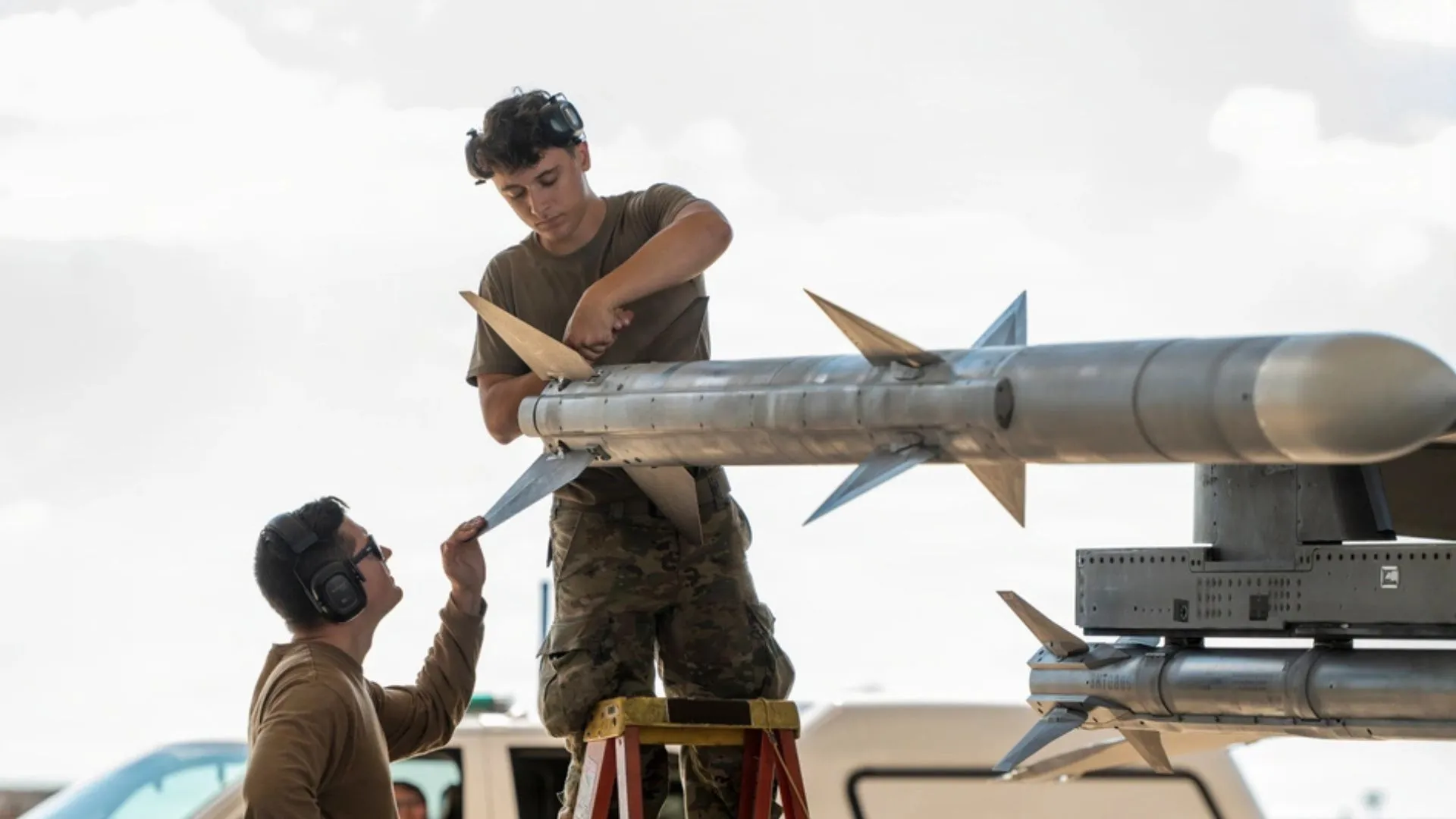
The U.S. Air Force has posted the award and justification notices for its $20.7 billion sole-source contract with Raytheon for the Advanced Medium-Range Air-to-Air Missile (AMRAAM), confirming that the deal covers Production Lots 41 through 47 and keeps the AIM-120 line in Tucson, Arizona, busy until June 30, 2033. Both notices went up on October 23, 2026.
The contract, signed on September 25 and announced three days later, is the largest in the program’s 35 years of production. It is nearly six times the size of the $3.5 billion undefinitized award for Lots 39 and 40 in July 2025, which had itself overtaken the $1.19 billion Lot 38 award of September 2024. It follows the framework agreement of February 4, 2026, under which Raytheon’s parent RTX committed to building at least 1,900 AMRAAMs a year as the Pentagon rebuilds stocks drawn down by conflicts in the Middle East and Ukraine.
How the $20.7 Billion AMRAAM Contract Was Structured and Justified
The award notice describes contract FA8556-26-C-B001, run by the Air Force Life Cycle Management Center’s Weapons directorate, as a non-competitive fixed-price incentive (firm) contract with a base and all options value of $20,699,334,581. It funds AMRAAM missiles, AMRAAM Telemetry Sets for test firings, initial and field spares, and related production components. The Pentagon framed it as a five-year multiyear contract with two option years, issued as an undefinitized contract action for all-up rounds, guidance sections and Foreign Military Sales (FMS) offsets. Neither document discloses quantities.
Sixteen FMS customers are named: Australia, Belgium, Canada, the Czech Republic, Denmark, Finland, Germany, Italy, Japan, Kuwait, the Netherlands, Norway, Poland, Sweden, Taiwan and the United Kingdom. Six buyers listed on the Lots 39 and 40 award, including Ukraine, Israel and Switzerland, are absent, while the Czech Republic, Italy and Norway are new; buyers can be added by later modification. Only $154.4 million was obligated at award, nearly all of it FMS money; the Air Force put in $85,715 of fiscal 2026 weapons procurement funds.
The Air Force cited FAR 6.302-1, the only-one-responsible-source exception. The redacted justification released with the award is a class Justification and Approval (J&A) signed on May 16, 2018 by Will Roper, then Assistant Secretary of the Air Force for Acquisition, Technology and Logistics. It recounts that the government paid in 1986 to qualify Raytheon as a second source to Hughes Missile System Company, an arrangement that ended in 1997 when the two merged into Raytheon Missile Systems.
The program office judged that buying the technical data package, replicating the factory and requalifying suppliers would cost more than competition could recover, and a 2017 sources-sought notice drew interest only in obsolescence management. That J&A covers sole-source awards only through Lot 43 and fiscal 2029; the public notices do not identify the approval for Lots 44 through 47.
AIM-120D-3 and AIM-120C-8 Production Ramp Toward 1,900 Missiles a Year
Current lots build what RTX calls the fifth-generation AMRAAM: the AIM-120D-3 for U.S. services and the AIM-120C-8 for export. Both come from the Form, Fit, Function Refresh (F3R) program, which replaced 15 circuit cards in the guidance section to clear obsolete parts and rehosted System Improvement Program-3F software on the new hardware. The AIM-120D-3 completed its Functional Configuration Audit in April 2023, clearing the way for Air Force and Navy fielding. All planned production now uses the F3R configuration.
Publicly available specifications indicate an airframe about 3.65 m long and 178 mm in diameter, weighing roughly 152 kg in C-series form, with a solid-propellant rocket motor driving it to around Mach 4. The D model pairs GPS-aided inertial navigation with a two-way datalink that lets the launching aircraft update the missile in flight before its active radar seeker takes over. Open-source estimates put D-3 and C-8 range near 160 km; official figures are classified. Unlike Europe’s ramjet-powered Meteor, which sustains thrust to intercept, the AMRAAM coasts after burnout, trading end-game energy for a compact airframe that fits rails and internal bays across fleets.
That commonality drives demand. RTX says the missile is integrated on 14 platforms and fielded by 44 countries; launchers include the F-15, F-16, F/A-18, F-22, F-35, Eurofighter Typhoon, JAS 39 Gripen and the National Advanced Surface-to-Air Missile System (NASAMS). The company says it nearly doubled AMRAAM output in 2025. The Navy’s fiscal 2027 request seeks 494 AMRAAMs for about $804 million, roughly a 370 percent increase over fiscal 2026, while the Air Force has requested $2.2 billion for the missile.
Analysis: The $20.7 billion AMRAAM contract ceiling overstates what is locked in. Less than 1 percent was obligated at award, the action remains undefinitized, and industry executives have cautioned that Congress had not appropriated the money behind the full multiyear commitment. With no second source, cost discipline rests on fixed-price incentive terms and certified cost or pricing data rather than competition. What the award secures is a long-term framework that lets Raytheon commit its supply chain to the 1,900-missile rate if appropriations follow. The 2033 end date also signals that AMRAAM will remain the volume beyond-visual-range weapon for U.S. and allied fleets well into the next decade, even as Lockheed Martin’s AIM-260 Joint Advanced Tactical Missile (JATM) moves toward its own multiyear deal under a framework announced on September 17, 2026.
The next decision points are definitization of the contract and final fiscal 2027 appropriations, which will set how many missiles each lot buys. Quantities, unit prices and the approval basis for Lots 44 through 47 remain undisclosed.