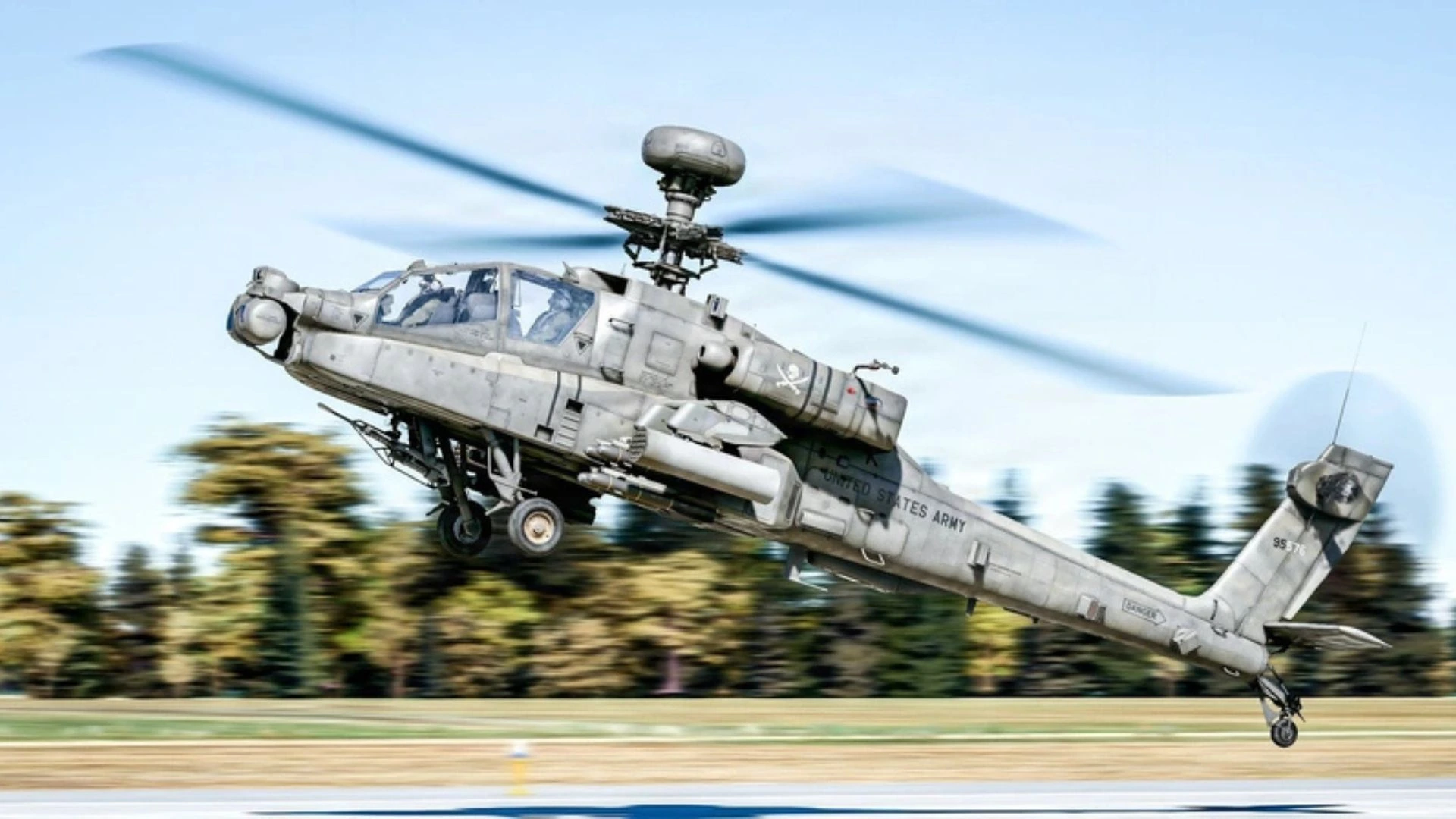
Longbow LLC of Orlando, Florida, received a $419,607,961 contract on October 22, 2026, to deliver fire control radar systems and post-production support services for the AH-64D and AH-64E Apache attack helicopter, according to the Pentagon. Army Contracting Command at Redstone Arsenal, Alabama, awarded the vehicle, W58RGZ-27-D-A008, after soliciting one bid and receiving one. The estimated completion date is January 31, 2032.
Longbow LLC, a joint venture of Lockheed Martin and Northrop Grumman, produces the AN/APG-78 Longbow radar, the mast-mounted sensor that underpins the Apache’s adverse-weather attack role. The award lands as the Army retires its AH-64D fleet under the Army Transformation Initiative, with nearly 60 percent of D models divested by April 2026, while export demand grows. Poland has 96 AH-64Es on order with deliveries from 2028, and the State Department approved a $1.2 billion AH-64E upgrade for South Korea on May 18, 2026. The new vehicle’s value is nearly 1.8 times the $235.8 million ceiling of the five-year international sustainment contract the Army awarded the joint venture in early 2020.
How the Longbow Fire Control Radar Contract Is Structured
The award combines three pricing arrangements: cost-no-fee, cost-plus-fixed-fee, and firm-fixed-price. That mix lets the Army price each order to its content, with fixed-price terms typically applied to defined hardware deliveries and cost-type terms to engineering and support work whose scope varies by customer. The letter D in the contract number designates an indefinite-delivery vehicle, and the Pentagon stated that work locations and funding will be determined with each order. That model mirrors the 2020 international sustainment vehicle, which was designed so task orders could follow a customer’s Letter of Offer and Acceptance within weeks rather than years. The announcement listed no funds obligated at award, no radar quantities, and no split between U.S. Army and foreign military sales orders.
The single-bid outcome reflects the joint venture’s position as the radar’s original equipment manufacturer. It builds the two line-replaceable elements that define the system, the Mast Mounted Assembly and the Radar Electronics Unit. Under earlier Longbow contracts, Lockheed Martin performed production work at its Orlando and Ocala, Florida, facilities, while Northrop Grumman contributed from Baltimore, Maryland. Whether that division of labor carries over to the new orders is not specified.
The vehicle sits alongside the Army’s existing life-cycle support contract for the domestic radar fleet, W58RGZ-22-C-0053, which reached a cumulative value of $59.3 million after a December 2025 modification and is scheduled to run through December 31, 2026. The new award therefore extends radar support well beyond that date, although the Army has not said whether it replaces the existing arrangement.
What Version 6 Software Added to the AN/APG-78 Radar
The AN/APG-78 is a Ka-band millimeter-wave radar housed in a mast-mounted assembly above the main rotor, together with the AN/APR-48 radar frequency interferometer that passively locates hostile emitters. The elevated dome lets a crew detect and track targets while the helicopter remains concealed. Publicly available specifications indicate the radar can track up to 128 targets, engage up to 16, and support an attack within about 30 seconds, with a legacy instrumented range of about 8 kilometers.
The Radar Electronics Unit replaced two legacy electronics boxes, cutting size, weight, power, and maintenance demands while adding processing headroom. That headroom carried Version 6 software, which completed Follow-On Test and Evaluation II in November 2019. The update added maritime, single target track, and 360-degree surveillance modes, doubled detection range, and improved detection of unmanned aircraft without hardware changes. During testing, targets detected by the radar were engaged with AGM-179 Joint Air-to-Ground Missiles.
The radar’s original partner weapon, the AGM-114L Longbow Hellfire, carries its own millimeter-wave radar seeker and needs no further guidance after launch. Operators often equip only part of a fleet with the radar. The package approved for Poland in 2023 covers 37 mast-mounted assemblies, 36 installed and one spare, for 96 helicopters, against 96 AN/APR-48B Modernized Radar Frequency Interferometers. Radar-equipped Apaches share target data with wingmen over tactical datalinks, so targets detected by one helicopter can be engaged by others. South Korea’s upgrade request covers eight mast-mounted assemblies and eight radar electronics units.
Analysis: The contract shows where demand for the Longbow radar now sits. The U.S. Army is shrinking its Apache force and cutting attack aviation formations under the Army Transformation Initiative, yet the radar’s production and support base is being funded into the next decade, increasingly on behalf of allied buyers in Europe and the Indo-Pacific. Keeping the AH-64D in scope matters because foreign operators such as Greece still fly D-model fleets the U.S. Army is leaving behind. The single-bid award also confirms a familiar industrial reality: a sensor with 1980s origins and a single qualified source, kept relevant through software growth rather than replacement.
The first task orders will show how the value divides between U.S. and foreign customers and whether hardware or sustainment dominates. Key markers include the scheduled December 31, 2026, end of the domestic life-cycle support contract, the AH-64E Version 6.5 retrofit the Army targeted to begin in fiscal 2026, Polish Apache deliveries from 2028, and any signed agreement for South Korea’s upgrade. Orders under the new vehicle can run through January 31, 2032.