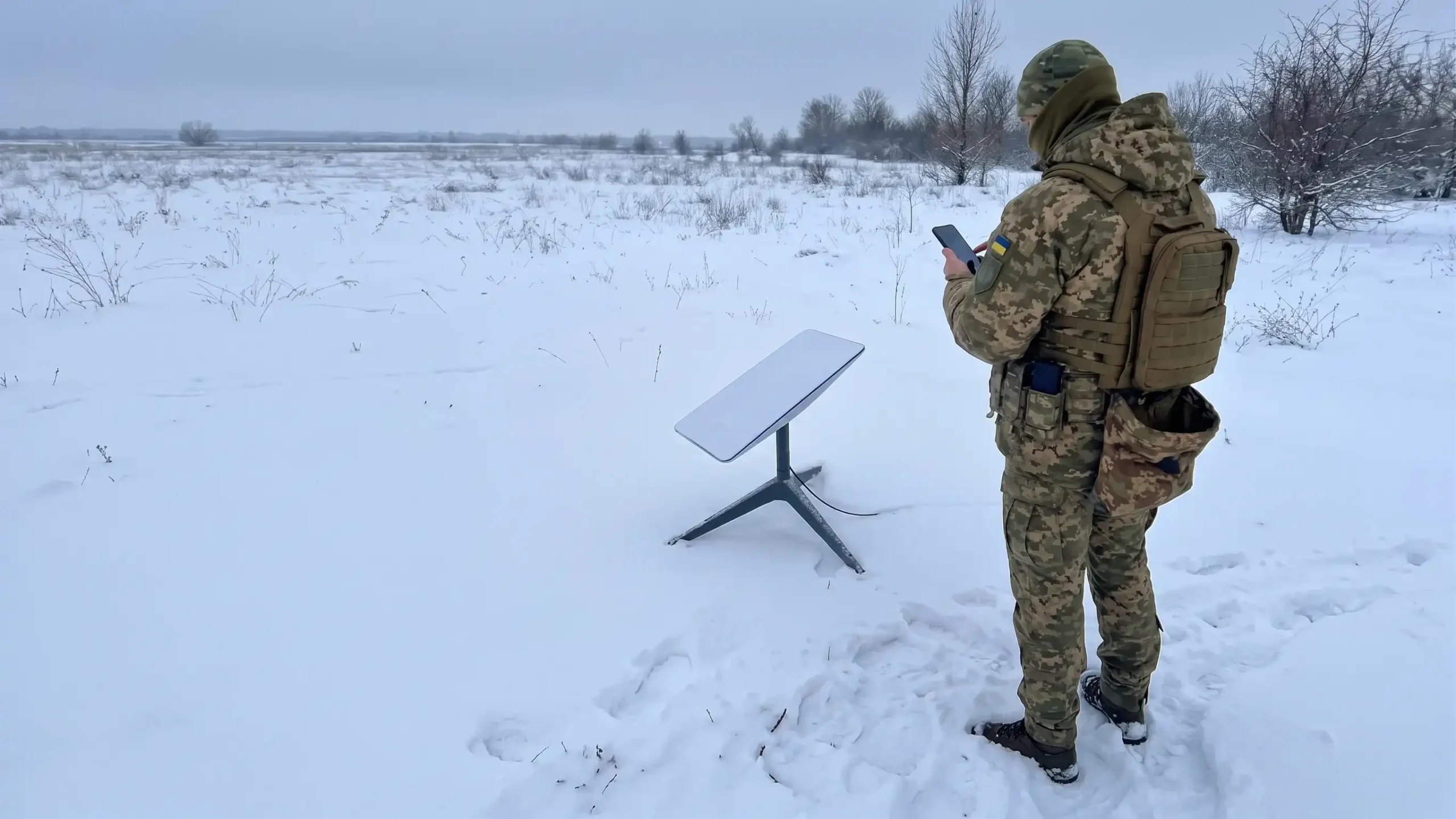
Ukraine says SpaceX’s Starlink and Starshield satellite networks are again operating at pre-restriction speeds, ending roughly two weeks of velocity caps that cut connectivity for terminals on fast-moving drones and vehicles. President Volodymyr Zelensky announced the restoration on October 24, 2026, writing that “the speeds are now where they need to be.” Ukraine’s Ministry of Defense said it was recording stable connectivity on platforms moving faster than 400 kilometers per hour (about 250 mph).
The restoration closes an episode that exposed how dependent Ukraine’s drone war has become on a single US-controlled constellation. Ukrainian units first reported the restrictions on October 13 and 14, when terminals in motion began losing links at roughly 160 km/h (100 mph). The cap arrived amid a rift between Kyiv and Washington over the Trump administration’s deal easing restrictions on Russian diesel exports and its demand that Ukraine stop striking Russian oil refineries, which Zelensky rejected on October 15.
How the Starshield Speed Cap Disrupted Ukraine’s Drone Operations
Starshield is SpaceX’s government-grade service built on the Starlink low Earth orbit constellation. The Pentagon is its largest customer, and the US government pays for Ukraine’s access and controls who can use it. The October restriction did not throttle bandwidth for static users. It was a velocity limit: terminals kept working at fixed positions but dropped their connection once the host platform exceeded a set speed. Zelensky said Starshield equipment stopped functioning at speeds of 130 to 161 km/h depending on the sector of the front, and Ukraine’s 7th Rapid Response Corps reported dropouts of 10 to 20 seconds at 110 to 120 km/h. Ukrainian tests indicated the cap applied inside Ukraine but not to terminals operating in European Union countries.
The operational cost fell hardest on two mission sets. The first was interception of Russia’s jet-powered Shahed variants, designated Geran-3 in Russian service. Publicly available figures put the Geran-3’s top speed at about 370 km/h, more than double the cap, which meant Ukrainian interceptor drones lost their control link during the pursuit phase, when the link matters most. The second was Ukrainian combat helicopters assigned to Shahed interception, which regularly fly above the cap and lost a key satellite data channel used in those intercepts. Zelensky said the cap also slowed frontline logistics. Dimko Zhluktenko, a drone pilot and analyst in Ukraine’s Armed Forces, estimated the losses in the tens of millions of dollars; the Defense Ministry has not published an official figure.
White House, SpaceX, and the Dispute Over Starshield Control
Responsibility for the cap remains contested, and no US official has publicly taken ownership of it. Two US officials and a Western official have said the instruction to slow Ukraine’s Starshield service came from inside the White House and that the Pentagon was notified, while a senior US official denied that President Donald Trump made the request. SpaceX founder Elon Musk said Starshield systems are owned and controlled by the US government. Secretary of State Marco Rubio said no one at the White House had ordered a slowdown and that the president had nothing to do with decisions made by SpaceX and Musk; he also said Ukraine did not have Starshield access and that its request was under discussion, a position at odds with Kyiv’s own account of the service its forces use. The Wall Street Journal, followed by CBS News citing people familiar with the matter, reported that Musk himself ordered the restriction, while The Telegraph, citing four sources, reported that Musk proposed the caps and Trump approved them. Trump told reporters he did not know who ordered the slowdown, but that it was not him.
The resolution took three days. On October 22, Trump said Musk had restored service, reportedly after a phone call between the two. Zelensky countered on October 23 that the limits remained in place. Restoration began overnight into October 24, according to Zelensky, and by morning speeds were sufficient for operational use. Defense Minister Yevhenii Khmara, in office since August 19, briefed Zelensky that morning and credited direct dialogue and the president’s firm stance at the highest level. Zelensky thanked members of Congress, senators, the media, the State Department and the President. Democratic Senator Jeanne Shaheen of New Hampshire had joined three Senate colleagues on October 19 in demanding answers from SpaceX, and with Republican Senator Thom Tillis led a bipartisan call for a Pentagon Inspector General investigation.
Analysis: The episode shows that a velocity parameter set in software, outside Kyiv’s control, can switch off a layer of Ukraine’s counter-drone architecture overnight without touching a terminal. Unlike a munitions cutoff, it takes effect in hours, is reversible at will, and lands on the most time-sensitive engagements, such as intercepting jet-powered drones. For allied militaries wiring proliferated low Earth orbit communications into drone and fires networks, contractual access is not operational assurance. The cap coincided with Zelensky’s reports of a Russian ballistic strike that arrived without US warning and of slowed Patriot deliveries, reinforcing the view in Kyiv that capability access has become a lever of US diplomacy.
Three questions define the next phase. Technically, the ministry recorded stable links above 400 km/h, while Ukrainian specialists say counter-jet-drone missions need links that hold at 450 km/h or more; testing across the full envelope continues. Politically, Zelensky is pressing for delivery of politically approved US and European packages of interceptors against Russian ballistic missiles, while Ukrainian delegations prepare consultations in Europe with US representatives and European allies. Structurally, Ukraine signed a letter of intent on October 23 with Finland’s ICEYE and Nokia to explore a sovereign satellite communications capability, alongside its UASAT constellation, whose first satellite, UASAT-NANO, launched on October 1.