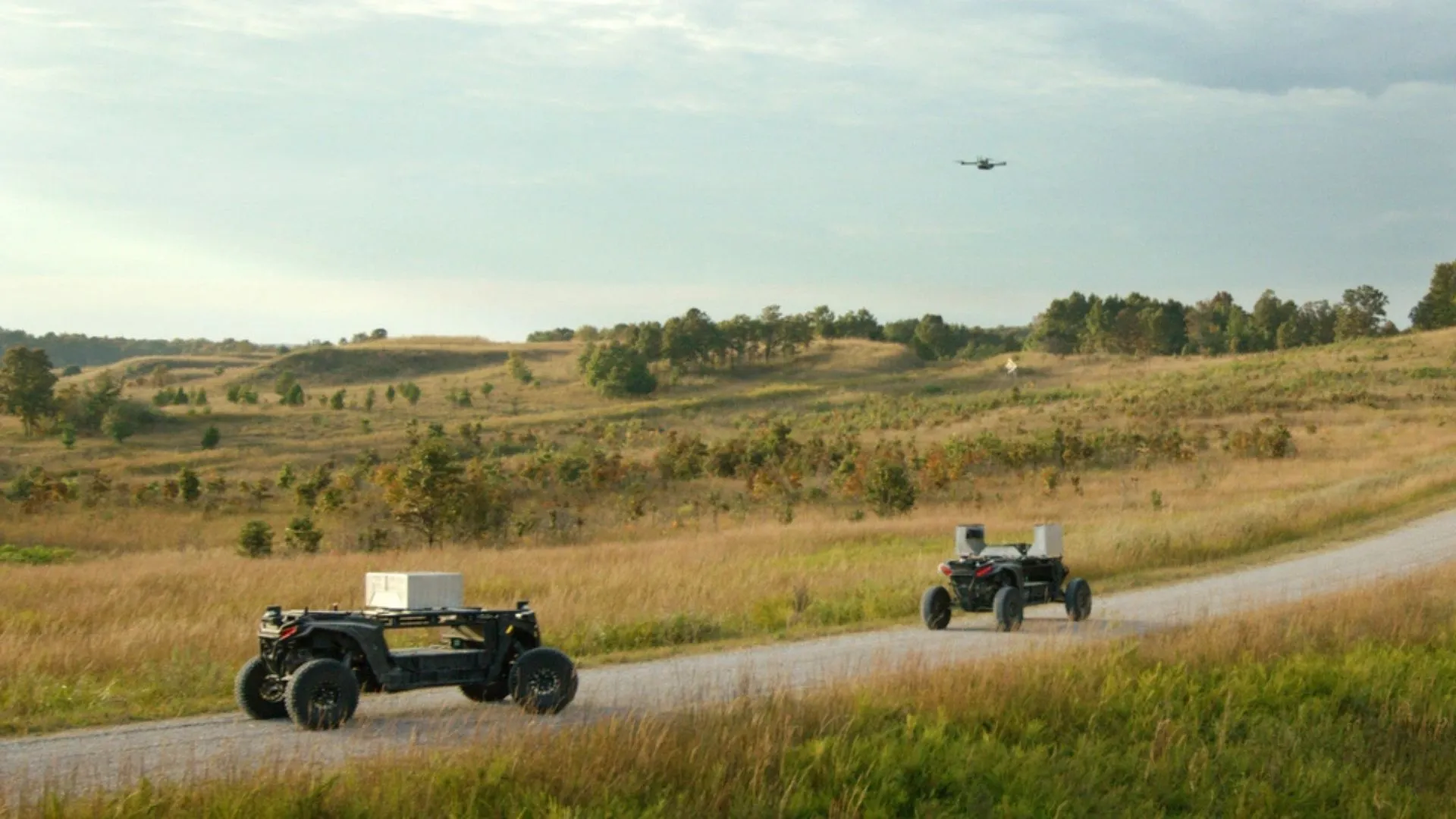
The Defense Advanced Research Projects Agency (DARPA) ran four autonomous unmanned ground vehicles (UGVs) through a hunt-and-strike scenario at Fort Knox, Kentucky, on October 15, 2026, pairing autonomy software from its Robotic Autonomy in Complex Environments with Resiliency (RACER) program with Anduril one-way attack drones mounted on Overland AI vehicles. The robots maneuvered, searched, and detected targets on their own; every engagement required a human operator’s approval.
U.S. European Command (EUCOM) requested the demonstration, held at the post’s St. Vith Range before about two dozen military and government visitors. It was DARPA’s first end-to-end run of the chain, from a satellite imagery cue down to tactical ground maneuver, and follows the close of core development work on RACER, launched in 2021 to build platform-agnostic off-road autonomy.
DARPA RACER Kill Chain: From Satellite Cue to Human-Approved Strike
An operator received a tip on a simulated threat derived from satellite imagery and tasked the robotic team. Dr. Jason Gregory, a DARPA technical advisor, described the interface: “We can drop a ten-digit grid on a traversable mobility corridor that the ground vehicles use with their onboard sensors to understand the terrain and then drive to it comparable to a human.” A ten-digit grid locates a point to within one meter.
The lead vehicle, carrying a closed box housing a drone, moved down a road to search while the other three held at the start point. Halfway up a hill, it detected a potential target and halted to await instructions. Two vehicles then advanced to provide cover and support before a simulated rocket strike hit a mock enemy vehicle on an adjacent hill about 300 yards away. The fourth vehicle moved up as the lead vehicle crested the hill.
Three of the four UGVs carried drone payloads for deeper reconnaissance or strike. Each detection reached the operator as an image chip, and, according to the Army, the Anduril one-way attack platforms engaged simulated targets only after the mission commander’s approval. “It’s controlled engagement,” Gregory said. “All the mobility, all the movement, all the detections, all of that is autonomous. But they don’t pull the trigger until a human says pull the trigger.”
Overland AI Vehicles Running RACER Autonomy Carry Anduril Strike Drones
RACER was structured as an autonomy software effort, not a vehicle program. Performers proved the stack on two very different DARPA-supplied platforms: the RACER Fleet Vehicle (RFV), a 2-ton, 11-foot wheeled all-terrain vehicle based on the Polaris RZR, and the RACER Heavy Platform (RHP), a 12-ton, 20-foot skid-steer tracked vehicle based on the Textron M5 and upfitted by Carnegie Robotics.
During the fourth experiment in Texas in late 2023, teams logged more than 30 autonomous runs and roughly 150 unoccupied miles at up to 30 mph. Gregory framed the payoff as portability: “So, now we can take a vehicle that has a sensor suite and drive-by-wire and equip it with autonomy software so it can be tasked by a Soldier as opposed to manually driven.”
Overland AI, a University of Washington spinout born from one of the RACER performer teams, says it was the last remaining performer when the program ended. The Army did not identify the vehicle model used at Fort Knox. The company’s production tactical UGV, ULTRA, carries a 1,000-pound payload at up to 35 mph over a 100-mile range, according to company specifications. In 2024, Overland won a two-year Army and Defense Innovation Unit contract worth up to $18.6 million to develop its OverDrive software for the Robotic Combat Vehicle program.
The two firms have teamed before, integrating Anduril’s Pulsar-L electronic warfare system and Spyglass radars on ULTRA through Anduril’s Lattice software. Neither DARPA nor the Army has named the Anduril munition used at Fort Knox.
EUCOM Request Ties RACER Autonomy to NATO’s Eastern Flank
EUCOM asked DARPA to show “how we can deploy robotic assets beyond the forward line of troops to do early detection for the Soldier to determine how to respond,” Gregory said. Stakeholders recommended Fort Knox as representative of the European theater.
The request aligns with the Eastern Flank Deterrence Line (EFDL), NATO’s concept for a largely unmanned, sensor-dense defensive layer along the alliance’s borders with Russia and Belarus. Brig. Gen. Thomas Löwin, deputy chief of staff for operations at NATO’s Allied Land Command, outlined the concept publicly in January 2026, and German newspaper Welt am Sonntag reported that the alliance aims to implement it, if possible, by the end of 2027.
Under EFDL, attritable robotic systems make first contact and force an adversary to spend munitions before reaching NATO formations. V Corps has fed 2nd Cavalry Regiment drone and radio frequency detection experiments, signature-managed High Mobility Artillery Rocket Systems (HIMARS), and AH-64 Apache manned-unmanned teaming into the concept.
An on-site technician described the vehicles as modular enough to mount “240 Bravos, drones, rockets,” a reference to the M240B 7.62 mm machine gun, or to serve as casualty evacuation platforms. According to Gregory and others, payloads would define missions ranging from kinetic strike to supply logistics.
Analysis: Fort Knox shows RACER shifting from mobility research to kill-chain integration. DARPA says RACER vehicles already drive off-road comparably to a human. The open question is whether a theater-level cue can flow to a mixed-vendor robotic team, one company’s vehicles carrying another’s strike drones, and return as an approvable target chip.
For EFDL planners, that sequence is the core requirement: attritable robots detecting forward of the line of troops while a human keeps the engagement decision. The Army’s account of the demonstration did not address the hardest variables: link resilience under Russian electronic warfare, approval-loop latency, and unit cost at the volumes an eastern flank screen would demand.
DARPA plans its next test in December 2026, putting the vehicles in front of soldiers to gather input on employment. Still unannounced: a transition partner or program of record for the Fort Knox configuration, the identity of the Anduril munition, and whether EUCOM will test the package in Europe.