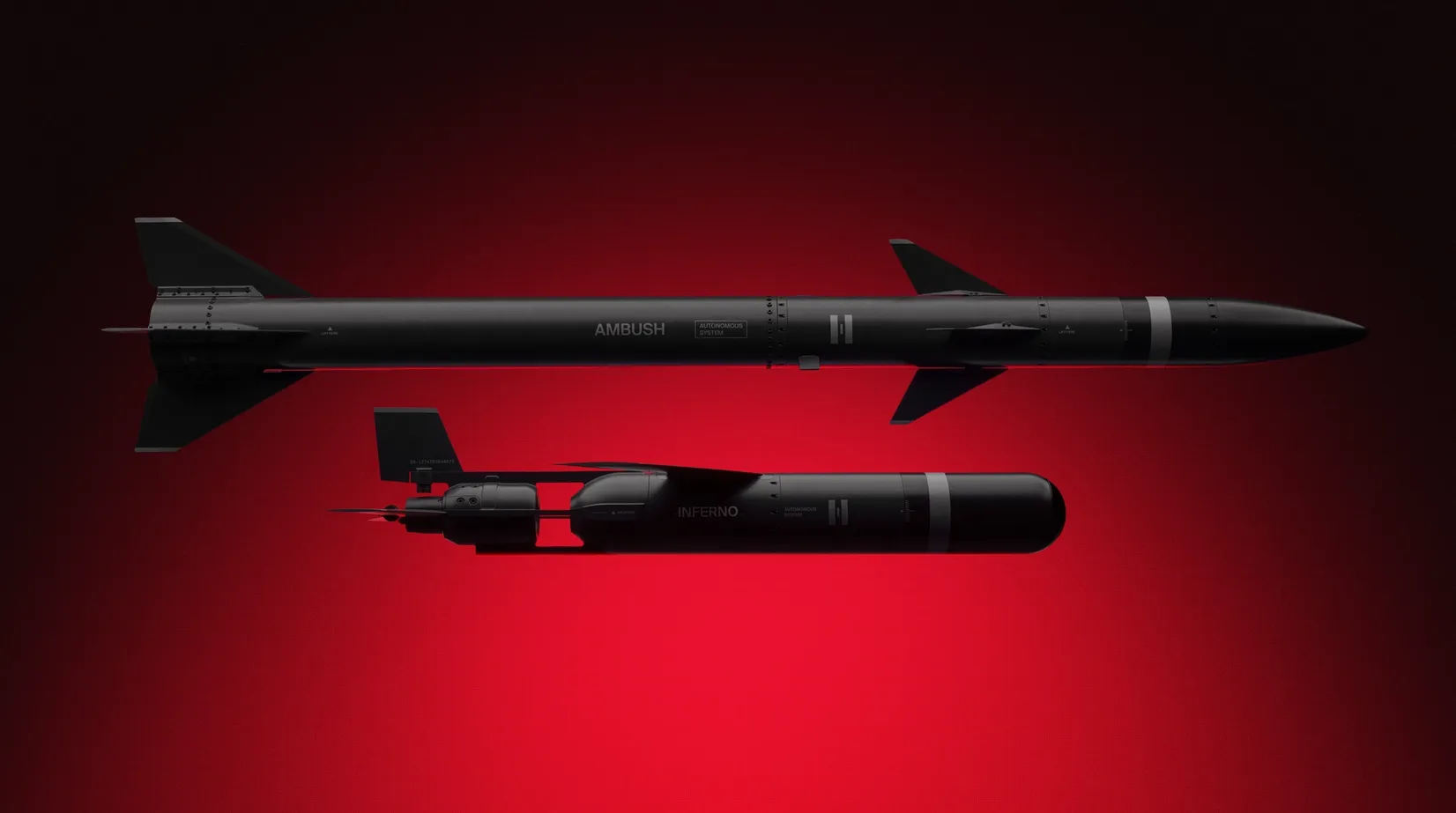
Helsing, the Munich-based defense technology company, unveiled Contra in Berlin on October 26, 2026, an autonomous, artificial intelligence-enabled air defense system built to defeat massed drone and missile attacks. Two container-launched interceptors developed in-house complete the package, the turbojet-powered AD-1 Inferno and the rocket-powered AD-2 Ambush, which Helsing says are sized to catch the fastest jet-powered drones and cruise missiles.
Helsing framed the launch around Russian production, citing intelligence assessments of 4,000 Geran-4 and Geran-5 jet-powered drones built every month, with additional launch sites under construction that bring part of European Union territory within range of potential strikes. Ukraine’s Main Directorate of Intelligence (HUR) reported a figure closer to 3,000 jet-powered Gerans per month earlier in 2026. HUR credits the Geran-5 with an 850 kg takeoff weight, a 90 kg warhead, a range of up to 950 km and a cruise speed of 450 to 600 km/h on a Chinese Telefly TF-TJ2000A turbojet. That speed outruns most electric interceptor drones and leaves defenders firing costly missiles at cheap targets.
Contra Air Defense Architecture: Altra C2, Sensor Fusion, Open Effectors
Contra runs on Altra, Helsing’s command and control (C2) and recce-strike software, which also lets a single operator control HX-2 strike drone swarms. Altra fuses radar, electro-optical, infrared and acoustic data from any manufacturer’s sensors through open, documented interfaces, building one air picture from which Contra can detect and engage hundreds or thousands of threats simultaneously. It also connects to SitaWare and national battle management systems (BMS), a prerequisite for plugging into existing NATO air defense networks.
Operators retain authority over engagement decisions and threat prioritization, while autonomy governs execution. Helsing says the system keeps working under jamming, broken datalinks and the loss of network nodes. At the launch, CEO Gundbert Scherf described Contra as free of International Traffic in Arms Regulations (ITAR) constraints, a selling point for European buyers wary of US re-export controls.
The architecture is effector-agnostic. Helsing says third-party interceptors, counter-unmanned aircraft system (C-UAS) lasers, guns and net systems can be integrated within days, and is already demonstrating this to military customers. Containerized launchers move by rail, ship or truck, supporting two employment concepts shown in Berlin: a wall of containers along a border, or a dome over bases and critical infrastructure. Contra is pitched less as a replacement for existing short-range air defense than as the layer that federates it.
AD-1 Inferno and AD-2 Ambush: Speed, Range, and Seeker Design
AD-1 Inferno targets the gap between electric C-UAS drones, which Helsing calls kinematically outclassed, and surface-to-air missiles too expensive for mass employment. Company specifications list a top speed above 700 km/h, a range of at least 20 km and an engagement altitude above 9,000 m. AD-1 launches on first detection, takes midcourse guidance from Contra’s ground radar stations, and can loiter, swarm and turn back to re-engage after a miss. Scherf said one container holds 20 rounds. Against a Geran-5 cruising near 600 km/h, a margin of little more than 100 km/h makes tail chases marginal, hence the emphasis on early launch and loitering ahead of the threat axis.
AD-2 Ambush covers the upper tier. Its solid rocket motor (SRM) pushes it to Mach 2.5 with a range above 20 km, per the launch announcement, though Helsing’s product page lists a more conservative figure above Mach 2. It is intended for high-altitude one-way attack drones and subsonic cruise missiles beyond AD-1’s reach.
Both rounds carry a Helsing-developed radar seeker built from commercial off-the-shelf (COTS) components for all-weather terminal guidance, with AI shaping the intercept trajectory to maximize kill probability. Helsing argues that electro-optical cameras cannot reliably track targets in darkness and that both electro-optical and infrared seekers degrade in cloud or fog. The seeker is not yet in series production, and warhead, fuzing, dimensions and weight have not been disclosed.
Resilience Factory Production and the Interceptor Cost-Exchange Ratio
Helsing will build both interceptors in its Resilience Factories at unit prices it says are well below current interceptors. Scherf put the price of each round under €100,000 at the Berlin event, although the company has published no official pricing, and defined mass production for AD-1 as 1,000 rounds per month. The first plant, RF-1 in southern Germany, was completed in February 2025 with an initial capacity above 1,000 HX-2 drones per month, and a first US site in West Virginia was announced in July 2026.
AD-1 and AD-2 draw on two independent European supply chains, so a disruption on one line does not halt the other. Niklas Köhler, Helsing co-founder and president, summarized the logic: “Contra ends the air defence dilemma: slow fair-weather drones, or million-euro missiles fired at cheap, mass-produced targets.”
Helsing says a multinational team took AD-1 from concept to demonstrator in two months, with flight tests due in the coming weeks. AD-2 has already flown; the company showed test footage in Berlin.
Analysis: Contra moves Helsing from software and strike drones into ground-based air defense, a market long held by established missile houses. The C2 layer matters more than the interceptors: an ITAR-free, sensor- and effector-agnostic network able to fold existing national inventories into one air picture addresses the fragmentation of European short-range air defense more directly than another standalone missile. If AD-1 and AD-2 reach the quoted price at 1,000 rounds per month, they would add magazine depth between interceptor drones and medium-range systems, a tier where European stocks remain thin. That remains conditional: AD-1 has not yet flown, the seeker is not in series production, and no independent data supports simultaneous engagement of thousands of targets.
Scherf said Helsing has signed a contract with one customer he declined to name, and a company representative gave the second quarter of 2027 as the earliest delivery date. The next milestones are AD-1’s first flight tests and further AD-2 firings. Key unknowns include the unspecified performance of Contra’s ground radar stations and the interceptors’ probability of kill against jet-powered Gerans flying at 450 to 600 km/h.