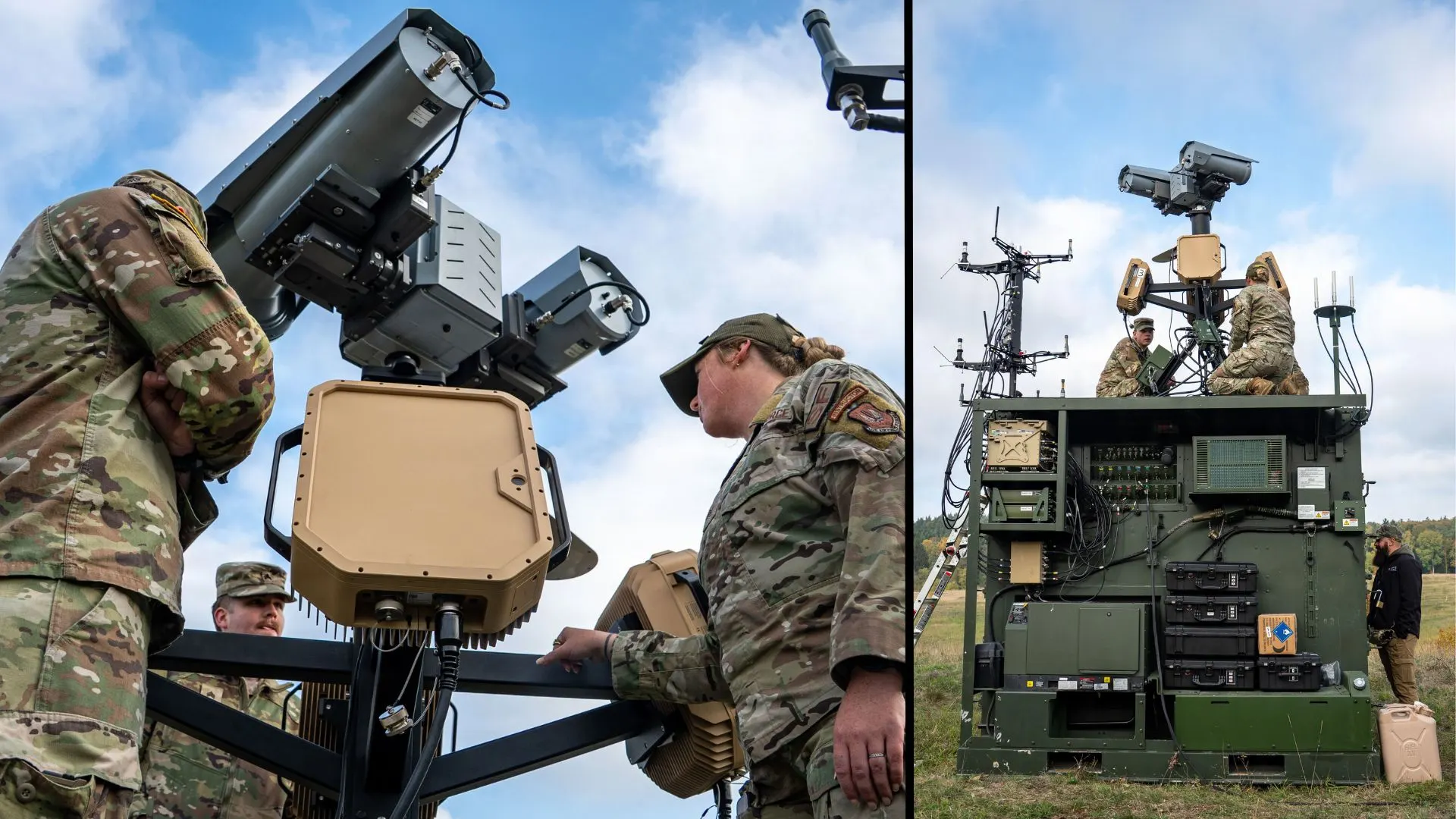
U.S. Army soldiers and U.S. Air Force airmen are training together at Grafenwoehr Training Area in Germany to assess how multi-service training can strengthen the response to evolving drone threats, U.S. Army Europe and Africa (USAREUR-AF) said on October 29, 2026. Photos released with the post show a palletized counter-drone system that the counter-drone news account Counter Unmanned Systems identified as the Rapidly Deployable Small-Unmanned Air Defense System (RD-SUADS), a counter-unmanned aircraft system (C-UAS) built by Trust Automation of San Luis Obispo, California.
The command did not identify the participating units, the duration of the training or whether RD-SUADS will be fielded with units in Europe. The activity follows the Joint Multi-Domain Counter Unmanned Aircraft Systems Operator Course (JMDCC-O), which U.S. Air Forces in Europe and Air Forces Africa (USAFE-AFAFRICA) ran at Grafenwoehr in February 2026 with Air Force, Army and Marine Corps personnel as the Air Force weighs expanding it into a multi-service course. An earlier USAFE-AFAFRICA version of the course, held near Ramstein Air Base, used RD-SUADS as its capstone.
RD-SUADS Counter-Drone System: Palletized Design and Four-Day Endurance
RD-SUADS is the air-transportable member of Trust Automation’s Small-Unmanned Air Defense System (SUADS) family, designed to detect, track, identify and defeat Group 1, Group 2 and Group 2+ unmanned aircraft at bases and deployed sites. The company describes it as a self-contained, self-powered system that fits within a 463L pallet, the standard cargo pallet for C-130 and C-17 aircraft, so it moves through the airlift system like any other cargo.
An integrated diesel generator gives RD-SUADS four days of standalone operation between refuelings, according to Trust Automation, while a shore power interface lets it run on standard DoD generator connections or base power at established sites. An earlier USAFE-AFAFRICA account of the course said the system could reach readiness within an hour.
In April 2026, Echodyne announced that its EchoShield radar had been selected as the primary radar across the SUADS family, with RD-SUADS carrying up to four units. All SUADS variants conform to the Sensor Open Systems Architecture (SOSA) standard, and Echodyne describes EchoShield as the first fully integrated SOSA solution in the platform, a choice that eases future sensor and effector swaps. The Department of War’s Joint Interagency Task Force 401 (JIATF 401) lists the SUADS systems in its 2026 counter-small UAS quick reference guide as able to host several electronic warfare capabilities for non-kinetic defeat.
Three SUADS Variants, a $490 Million Contract and Army Testing
The program sits under a $490 million indefinite-delivery, indefinite-quantity (IDIQ) contract the Air Force awarded Trust Automation for research, prototyping, production and transition of C-UAS capabilities, with work expected to run through August 20, 2030, letting the service order systems in varying numbers and configurations.
Beyond RD-SUADS, the family includes the Fixed Site SUADS (FS-SUADS) for permanent bases, and the Expeditionary SUADS (EX-SUADS), a detection-only kit sized to travel as checked baggage and fit in larger SUVs.
Performance figures remain largely company-reported. Trust Automation said in October 2026 that SUADS completed a U.S. Army operational assessment during a rotation at the National Training Center at Fort Irwin, California, detecting and engaging drones at roughly 2 to 6 km, with coverage reaching about 7 km in favorable conditions. That setup paired radar and electro-optical and infrared sensors with NINJA and DroneBuster electronic attack systems. The earlier USAFE-AFAFRICA course account put detection, classification and tracking at 3 to 4.5 km. No independent test data has been published.
Analysis: The Grafenwoehr activity matters less for the hardware than for who operates it. RD-SUADS was procured as an Air Force base defense tool, yet Army formations in Europe face the same Group 1 and Group 2 drone threat at forward sites, logistics nodes and airfields. Training soldiers and airmen on a common, air-transportable system builds a shared operator pool and common tactics before any joint program of record exists. It also suggests a C-UAS kit bought through one service’s contract can serve as a theater-level force protection asset.
The key unknown is whether the Army intends to acquire RD-SUADS on its own or draw on Air Force orders. USAFE-AFAFRICA has not announced whether JMDCC-O will become a permanent multi-service course. New Air Force task orders and any Army adoption decision after the NTC assessment will show whether RD-SUADS moves from training asset to fielded capability.