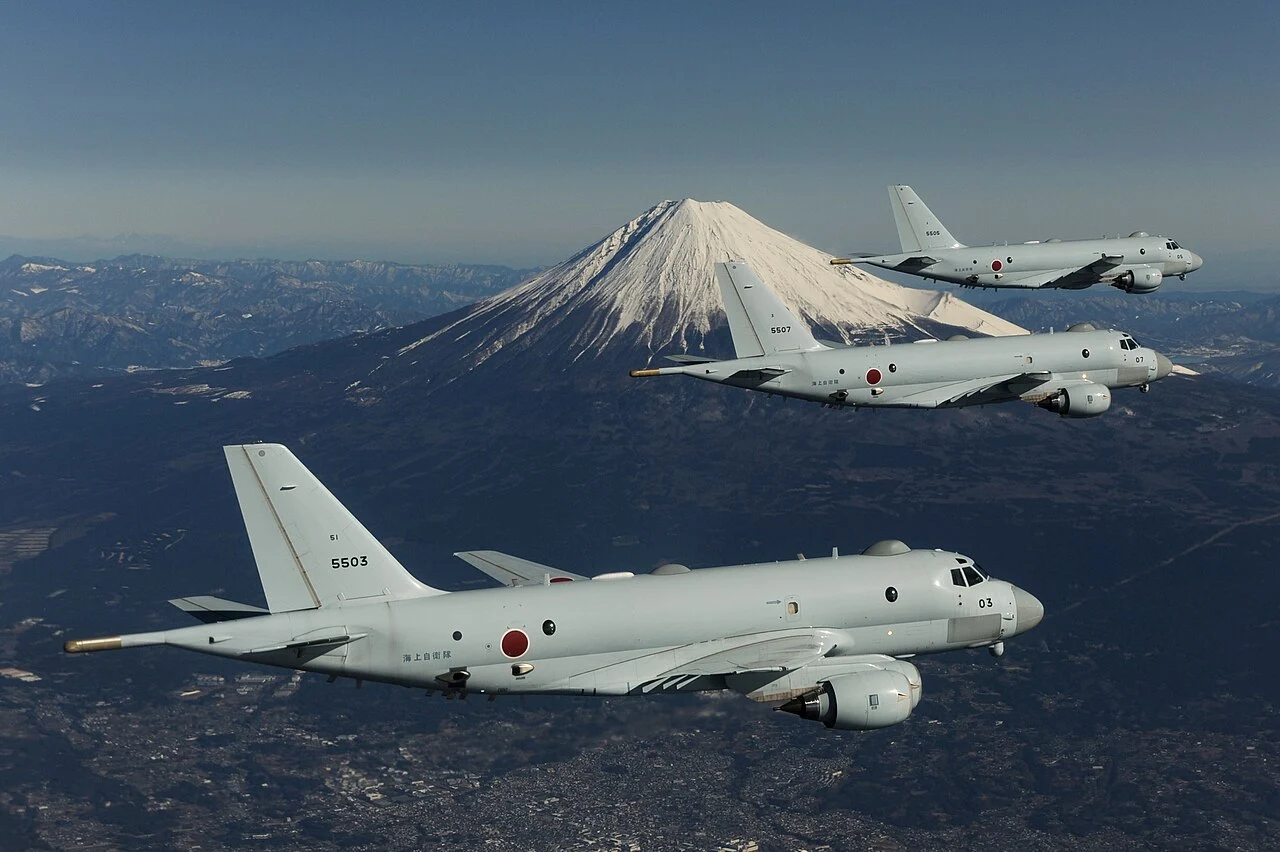
Japan’s Maritime Self-Defense Force (JMSDF) is stripping grounded Kawasaki P-1 maritime patrol aircraft to keep the rest of its fleet flying, and some newly delivered airframes reportedly serve as parts donors on arrival. Only 20% to 30% of the roughly 40 P-1s in service can fly missions, according to people familiar with the fleet cited in a Japanese television report on September 19, 2026.
The issue resurfaced on October 24, 2026, when posts on X lamenting the state of the P-1 fleet drew more than 100,000 views on Japanese social media. Images published with the story show taped-over openings on a P-1 where components had been removed, one marked with a handwritten note that the missing part had been diverted to another airframe. The posts follow a June 27, 2025, Board of Audit report covering fiscal 2019 to 2023, which rated the fleet’s operational status as low and confirmed that crews were cannibalizing aircraft.
How Engine Corrosion and Parts Delays Sidelined the P-1 Patrol Aircraft Fleet
The P-1, built by Kawasaki Heavy Industries and in service since 2013 as the replacement for the Lockheed P-3C Orion, was designed from the outset for anti-submarine warfare (ASW). Publicly available specifications indicate four IHI F7-10 high-bypass turbofans rated at roughly 60 kN (13,500 lbf) each, a Toshiba HPS-106 active electronically scanned array (AESA) radar using multiple antennas for near-360-degree coverage, and the first fly-by-light flight control system on an operational aircraft. The four-engine layout favors stable low-altitude loiter over the ocean.
That mission profile sits at the root of the engine problem. Auditors found that salt from the air during low-level patrols corroded F7-10 engine materials, degraded performance and left a number of engines unusable. The board also reported that corrosion flagged during development testing was handled by adjusting test conditions rather than correcting the design. A key information-gathering mission system, unnamed in the public report, remained out of service in certain numbers, and four onboard weapon types suffered interface faults with the airframe.
Supply was the second failure point. Some parts took more than three years from contract to delivery, and nearly 30% of emergency requisitions took longer than a year to fill as semiconductor shortages, labor constraints and supplier exits stretched lead times. The September report said repair capacity has since reached its limit, while replacement parts have grown costlier since Russia’s full-scale invasion of Ukraine and some components are no longer produced. A reporter observed a P-1 with no engines at one JMSDF base.
Cost Growth, Drones and the 61-Aircraft P-1 Procurement Plan
The program has absorbed ¥1.78 trillion (about $11.3 billion) across 4,656 contracts between fiscal 1991 and fiscal 2023. The unit price, originally projected at about ¥10 billion, rose to ¥42.4 billion (about $270 million) by fiscal 2024, and the Defense Ministry requested ¥47.3 billion (about $301 million) per aircraft for fiscal 2026, nearly five times the original estimate, against a planned fleet of 61 aircraft.
The ministry has said it takes the audit findings seriously and aims to resolve the parts shortage by fiscal 2027 through long-term comprehensive contracts that bundle parts, repairs, maintenance and supply. Cannibalization nonetheless continues, and some insiders argue the ministry should prioritize returning existing P-1s to service over buying new airframes, or redirect funds toward uncrewed systems.
Those uncrewed systems will not close the ASW gap soon. The JMSDF plans to field 23 General Atomics MQ-9B SeaGuardian aircraft by fiscal 2032, with the first arriving in fiscal 2028, but the service has said they will carry neither weapons nor sonobuoys at the outset. Kawasaki has studied a future fixed-wing patrol aircraft since April 2023, aimed at deployment in the 2040s.
The aircrews are not the weak link. A P-1 crew from Air Patrol Squadron 3 won the Dragon Belt at the U.S. Navy-led Sea Dragon 2026 ASW competition near Guam in March 2026, posting the highest score against P-8 crews from the United States, India, Australia and New Zealand in events that culminated in tracking a live submarine.
Analysis: The P-1 shortfall is a sustainment failure, not a capability one. A bespoke four-engine airframe with a unique engine and no civilian counterpart has no commercial spares pool, unlike the Boeing 737-derived P-8A Poseidon, so every supply disruption lands on the flight line. If new airframes are indeed arriving as donors, Tokyo is paying complete-aircraft prices for spares, sustaining the production line at the fleet’s expense. At 20% to 30% availability, the JMSDF fields roughly eight to 12 mission-capable P-1s, shifting more ASW burden onto U.S. Navy P-8A squadrons in Japan.
The next checkpoint is the fiscal 2027 deadline for clearing the parts backlog. The fiscal 2027 budget, typically finalized by the Cabinet in late December, will show whether Tokyo keeps buying airframes or shifts money to sustainment. Neither the ministry nor the Board of Audit has published official mission-capable rates, so the 20% to 30% figure remains unconfirmed.