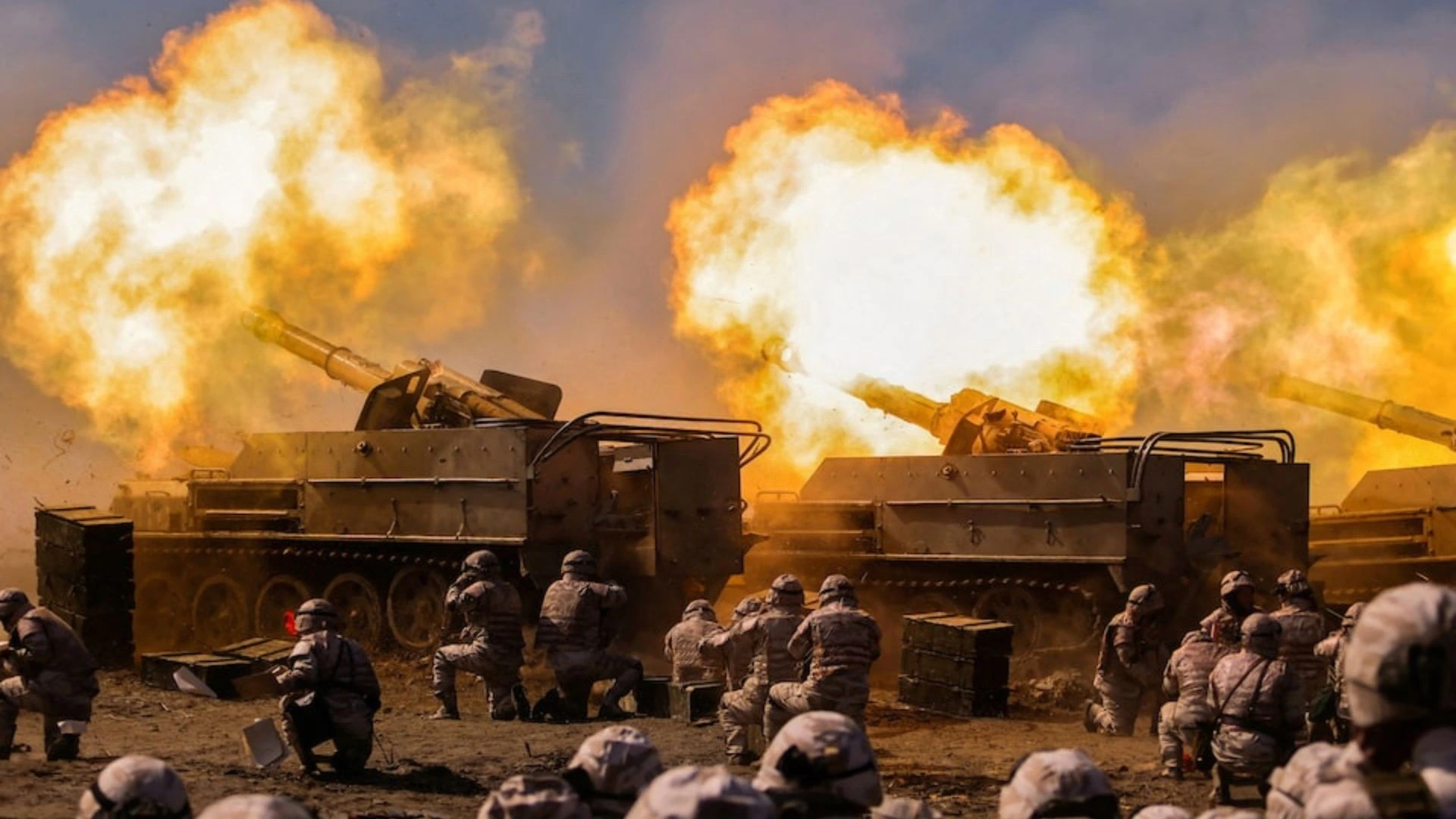
A computer-simulated North Korean conventional offensive during the August 2026 Ulchi Freedom Shield (UFS) exercise broke through South Korean front-line defenses and pushed to within several kilometers of Seoul, according to an exclusive report by South Korea’s Chosun Ilbo published October 14, 2026. The scenario did not assume North Korean use of nuclear weapons. South Korea’s Joint Chiefs of Staff (JCS) has disputed key elements of the account.
The disclosure lands at a tense point in the wartime operational control (OPCON) transition. Wartime OPCON still rests with the Combined Forces Command (CFC), the Republic of Korea (ROK)-U.S. headquarters led by an American four-star general. The allies certified initial operational capability, the first of three verification stages, in 2019. Seoul wants full operational capability (FOC) verification closed this year so a transfer year can be fixed, and President Lee Jae-myung has reaffirmed a 2028 goal. Washington insists conditions come first.
How the Ulchi Freedom Shield Simulation Broke the Western Front
UFS is the allies’ principal summer exercise, built around a computer-assisted command post exercise. The 2026 iteration opened on August 17 and was scheduled to run through August 27, but ended on August 21 after President Donald Trump directed the Pentagon on August 16 to substantially reduce U.S. involvement in the drills. The planned counteroffensive phase was dropped, leaving only the initial defensive phase.
According to the report, the commander of the ROK Army’s Ground Operations Command, a four-star general, acted as commander of the combined ground forces, mirroring the planned post-transition command structure. Simulated Korean People’s Army (KPA) forces advanced along the western axis through Munsan, Paju and Goyang, the corridor used in the June 1950 invasion, even though front-line South Korean corps were reinforced by U.S. Army units. A JCS official reportedly said an advance that close to the capital had few precedents, adding that reinforcements drove the KPA back to the Military Demarcation Line.
A military source attributed the breach to fires management: Ground Operations Command reportedly let each corps employ its own firepower rather than massing fires, a basic doctrinal principle. A retired general noted that the simulation already assumes South Korean units train to the same standard as U.S. forces.
The JCS pushed back on October 15. Spokesperson Navy Capt. Jang Do-young denied that Seoul was endangered because South Korean commanders led the defense, and said this year’s UFS ran under the CFC commander’s leadership. No official data on simulated force ratios, the modeled KPA order of battle or the depth of penetration has been released.
OPCON Transfer Conditions and the Surveillance Gap Behind Them
The report coincided with remarks by Gen. Xavier Brunson, commander of U.S. Forces Korea (USFK), the CFC and United Nations Command, who told a Washington policy forum that the conditions for transfer had changed. Citing a North Korean missile launch earlier that week, he said revised plans brought new standards that must be upheld, and cautioned against transferring OPCON to meet a politically driven deadline. A Defense Ministry spokesperson replied the next day that the principle of transferring OPCON once mutually agreed conditions are met remains unchanged.
Defense Minister Kang Shin-chul, a retired four-star general and former CFC deputy commander, told lawmakers on October 15 that Seoul could assume wartime OPCON now without problems, provided mutual trust is assured. He has framed the gap with Washington as one between “science” and “art,” arguing that the measurable criteria are sufficient while judgments on whether the conditions are met can differ. On October 26, Kang said the three agreed conditions remain the basic framework: South Korean capability to lead combined defense, an allied capacity to counter North Korean nuclear and missile threats, and a security environment suited to a stable transfer.
The second condition exposes the hardest gap. South Korean forces still depend on U.S. satellites and reconnaissance aircraft to track North Korean transporter erector launchers in real time, and the Kill Chain preemptive strike pillar of Seoul’s defense posture cannot be reliably triggered without that detection. Publicly available information indicates the 425 Project reconnaissance constellation reached five satellites in late 2025, with revisit intervals of roughly two hours, short of the persistent intelligence, surveillance and reconnaissance (ISR) coverage needed to cue strikes on mobile launchers.
Analysis: Even disputed, the simulation moves the OPCON argument from the political calendar to warfighting proof. A conventional KPA penetration toward Seoul, if confirmed, points less to a shortage of combat power than to operational-level command and control, precisely what FOC verification is meant to certify. Pyongyang is drilling from the bottom up: at an October 22-23 company leaders’ meeting attended by Kim Jong-un, state media said the army wants “all-mission units capable of fulfilling any combat duty independently,” and North Korea has gained combat experience by sending troops to the war in Ukraine. Seoul now has to demonstrate massed, synchronized fires under South Korean command, not assert them.
Kang is expected at the ASEAN Defence Ministers’ Meeting-Plus in Cebu, Philippines, from around October 27 to 30, where a first meeting with U.S. Defense Secretary Pete Hegseth is being arranged. The Security Consultative Meeting, expected in December, is the decision point for FOC sign-off and a target year. On October 25, a North Korean 122 mm self-propelled howitzer was photographed in the open on the Kaepung County coast, barrel facing south, from Gimpo’s Aegibong observatory, which sits about 1.5 km from North Korean territory. Whether the allies release any UFS findings before December remains unknown.