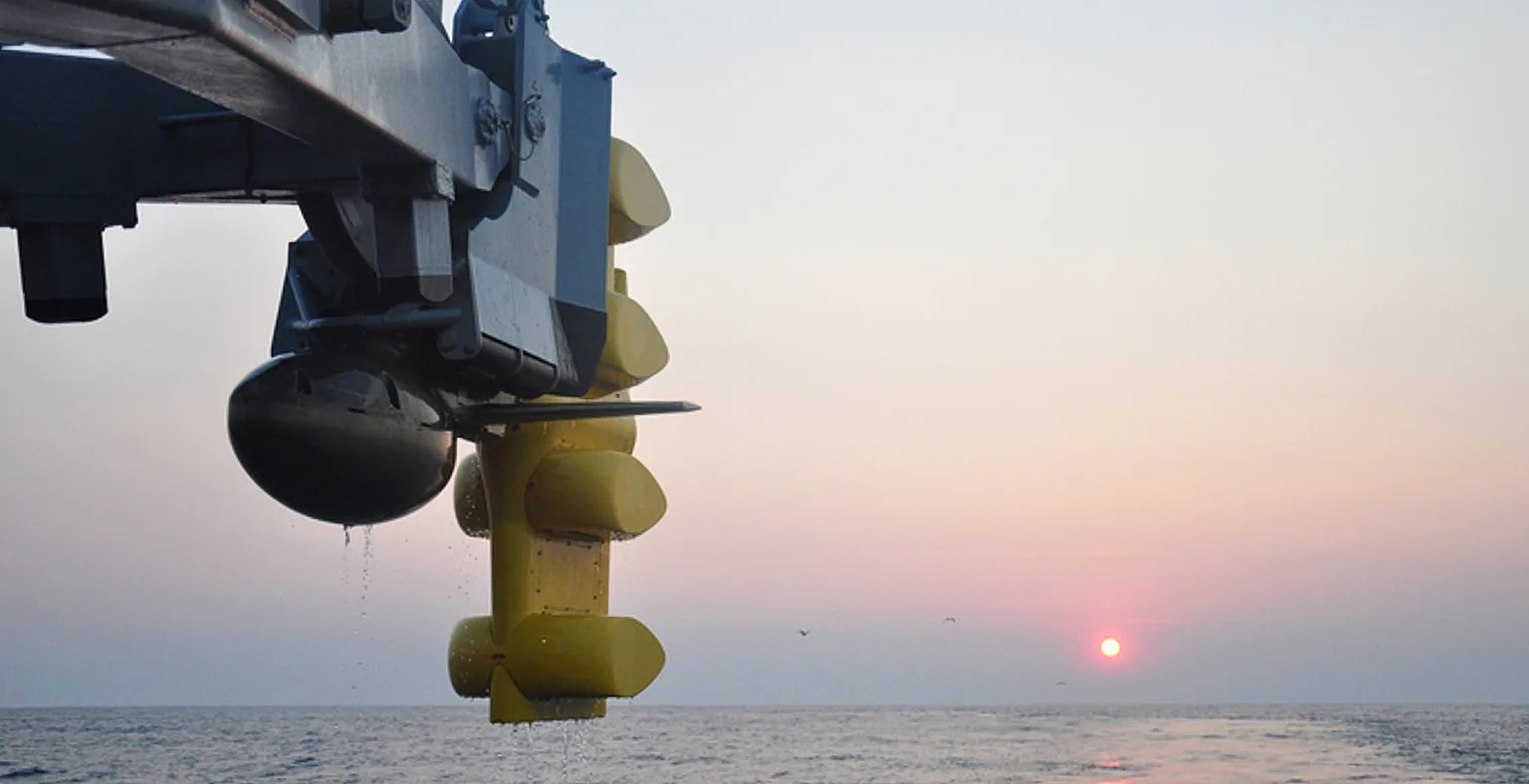
Australia’s Minister for Defence Industry, Pat Conroy, has opened a new towed array sonar manufacturing and sustainment facility at Thales Australia’s Rydalmere site in Western Sydney, the company announced on October 26, 2026. The 100-metre hall, co-funded by Thales Australia and the Commonwealth, will handle end-to-end production and support of towed arrays for the Royal Australian Navy’s (RAN) Hunter class frigates, its Collins class submarines and the BlueSentry uncrewed surveillance system.
The hall sits within the Thales Australia Acoustics Centre of Excellence, which has supplied RAN sonar programs for more than three decades. It opens two months after BAE Systems Australia laid the keel of the first Hunter class frigate, NUSHIP Hunter, at Osborne Naval Shipyard in South Australia on August 24, 2026, and five months after Canberra launched the Collins class life-of-type extension (LOTE) with HMAS Farncomb. Both programs rely on towed arrays, the trailing hydrophone lines that give anti-submarine warfare (ASW) platforms their long-range passive hearing. The investment amount has not been disclosed.
Hunter and Collins: What the Rydalmere Towed Array Sonar Hall Builds
Thales identifies three product lines for the new hall. The first is the towed array for the Hunter class, a six-ship program run under Project SEA 5000 Phase 1 and derived from BAE Systems’ Type 26 Global Combat Ship. The frigates, 151.4 metres long with a lightship weight of about 8,200 tonnes, pair an Ultra S2150 hull-mounted sonar with Thales Sonar 2087, the British-developed variant of the CAPTAS-4 (Combined Active and Passive Towed Array Sonar) low-frequency system. According to Australia’s Department of Defence, Sonar 2087 can detect, locate and classify submarines at ranges up to 60 kilometres, with 360-degree coverage and real-time torpedo alerts. Defence announced in November 2025 that its towed body and towed array handling systems had passed factory acceptance testing at Thales’s facility in Brest, France. Thales has not specified which Hunter sonar subsystems will be produced at Rydalmere and which will remain in France and the United Kingdom, a work-share question that will define how sovereign the frigate’s acoustic supply chain becomes in practice.
The second line is the Collins class submarine sonar system, which Thales says draws on more than 35 years of collaboration with the RAN and Australian defence science organisations. Rydalmere previously carried out manufacturing and integration under an A$230 million Thales contract that replaced the boats’ legacy cylindrical array with a Modular Cylindrical Array based on Sonar 2076 technology. Local array production and repair gain weight as the six submarines, commissioned between 1996 and 2003, are kept in service through a LOTE effort backed by an A$11 billion, ten-year funding commitment, pending the arrival of nuclear-powered submarines under the AUKUS partnership with the United States and United Kingdom.
BlueSentry and the Push for Sovereign Undersea Sensor Sustainment
The third line is BlueSentry, which combines Thales’s thin-line fibre-optic towed array with uncrewed surface vessels (USVs), principally the Ocius Bluebottle under a teaming agreement signed in 2022. Thales describes the thin-line array as a miniaturised version of its submarine fibre-optic towed array, built to detect, classify and localise surface and subsurface contacts that radiate or reflect sound. Publicly available specifications indicate the Bluebottle is propelled by solar, wind and wave energy and can operate for up to six months at sea without refuelling. That endurance turns a sensor once reserved for crewed submarines and frigates into a persistent, shore-launched acoustic picket for Australia’s maritime approaches.
Sustainment is the operational case for the facility. Towed arrays endure repeated mechanical stress during deployment and recovery, and Thales says local repair will cut the need for long offshore maintenance periods, keeping sensors available for Australian intelligence, surveillance and reconnaissance (ISR) missions. For a navy fielding a small number of high-value ASW platforms, every week an array spends in an overseas depot is a week a frigate or submarine sails with degraded passive coverage, or stays alongside.
Conroy described the co-investment as the basis for “a sovereign centre of excellence for advanced acoustic systems” serving Australian Defence and export markets. Jeff Connolly, chief executive of Thales Australia and New Zealand, linked the Rydalmere work to today’s Collins fleet and to the Hunter frigates and BlueSentry systems that will follow it. The company expects the facility to create dozens of direct engineering and advanced manufacturing jobs over the coming years, plus roles across its supply chain. Thales Australia already employs around 4,500 people at 35 sites and supports more than 2,000 positions among domestic suppliers.
Analysis: The facility tackles a dependency that rarely draws attention: Australia’s ASW force relies on acoustic sensors whose most complex elements have often been built or overhauled abroad. Moving towed array production and repair onshore narrows that exposure just as the RAN stretches its Collins boats, brings six Hunter frigates into service and watches uncrewed ASW concepts such as BlueSentry mature. Scale remains the constraint. Dozens of jobs and an undisclosed multimillion-dollar outlay amount to a capacity anchor rather than a surge capability, and the real test will be throughput once Hunter deliveries begin.
The next markers are production milestones. The Hunter class is due to begin entering service in the early 2030s, and no date has been given for the first Rydalmere-built frigate array. Thales has not released BlueSentry order figures or named export customers. Collins LOTE sonar work packages and any RAN contract for operational BlueSentry systems will be the first indicators of how heavily the new hall is loaded.