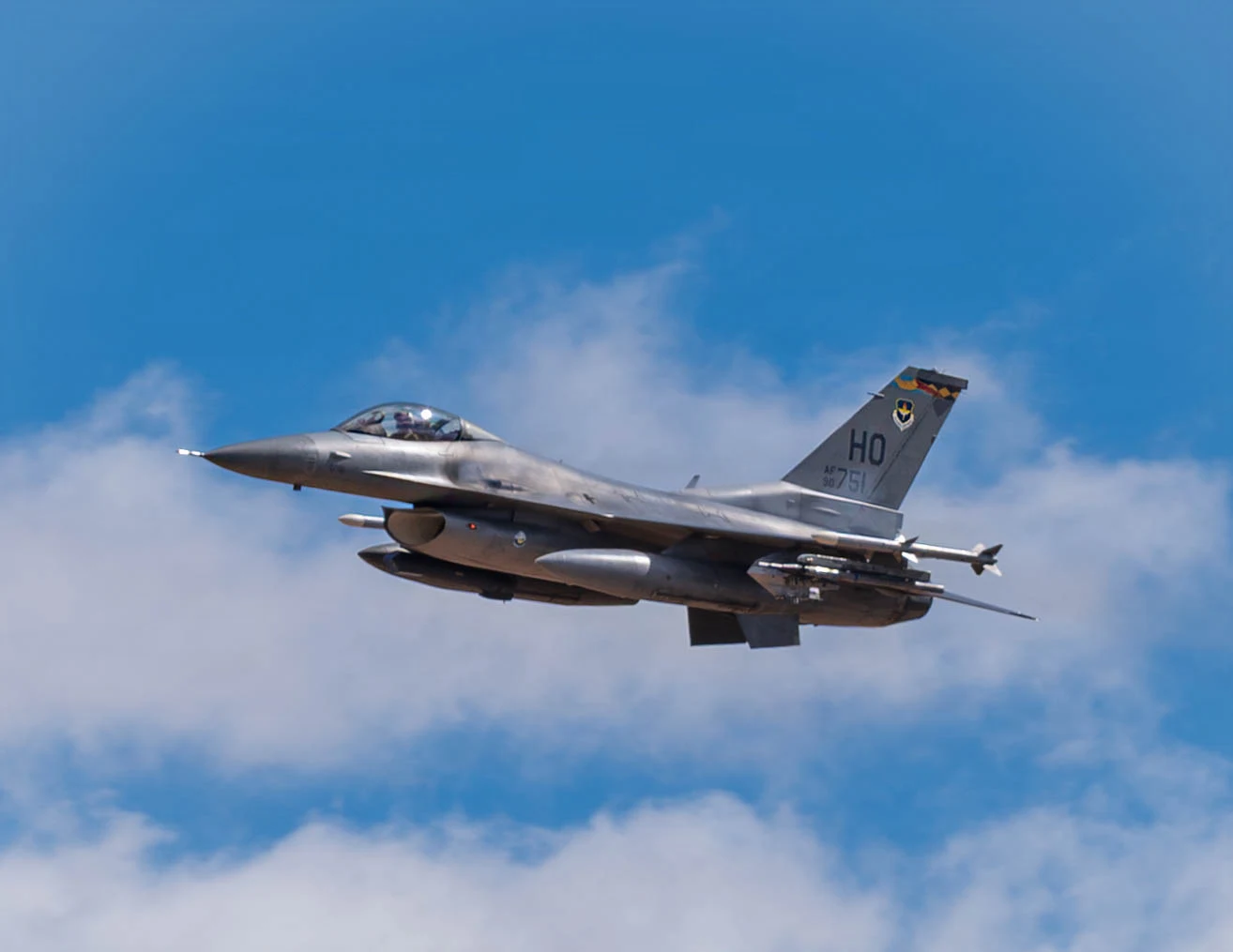
Castelion has received a contract modification from the Air Force Research Laboratory (AFRL) to begin integrating its Blackbeard hypersonic missile onto the F-16 Fighting Falcon, the company announced on October 26, 2026. The award brings the weapon closer to the U.S. Air Force (USAF), following integration work for the Navy and Army. Castelion did not disclose the value of the modification, the integration schedule or a date for a first F-16 launch, and the Air Force has not commented.
Castelion said the modification extends its existing work with the laboratory and allows it “to begin Blackbeard integration activities with the F-16.” AFRL added $16.4 million to a Castelion contract in September for a low-cost, mass-producible long-range strike weapon, lifting its value from $20.9 million to $37.2 million, with work running through June 30, 2028. The company has not said whether the F-16 work falls under that same contract. AFRL has funded Castelion since a September 2023 Small Business Innovation Research (SBIR) award.
Blackbeard Hypersonic Missile Design, Range, and Cost Targets
Blackbeard is a solid rocket-propelled strike weapon designed to exceed Mach 5 while maneuvering inside the atmosphere, a flight profile that denies defenders the predictable arc of a ballistic missile. Castelion, founded in 2022 by former SpaceX engineers and headquartered in Torrance, California, builds its solid rocket motors and flight computers in-house and has flown more than 20 developmental tests. Dimensions, warhead and seeker details remain undisclosed. Castelion cites a range of up to 500 nautical miles, a figure the Navy has not officially confirmed.
Cost, not peak performance, drives the design. Army budget documents state that the ground-launched variant will not match the velocity or range of the Long Range Hypersonic Weapon (LRHW), and instead targets about 80% of Precision Strike Missile (PrSM) Increment 4 capability at far lower cost. No official unit cost has been published, but the Navy’s September production order, worth up to $200 million for 444 all-up rounds, implies a ceiling near $450,000 per round if the full value covers missiles alone. By comparison, Navy budget plans released in 2023 averaged more than $50 million per Conventional Prompt Strike round.
Castelion is building Project Ranger, a privately funded 1,000-acre campus in Rio Rancho, New Mexico, valued at more than $250 million and sized for 500 weapons a year. A Pentagon framework agreement announced in May calls for at least 500 missiles a year once testing and validation conclude.
Navy and Army Contracts Set the Pace for F-16 Integration
The Navy remains the lead customer. It selected Blackbeard in February as the first weapon candidate for its Multi-mission Affordable Capacity Effector (MACE) program, then awarded $105 million in April to integrate the missile onto the F/A-18E/F Super Hornet, covering carrier certification, flight testing and live-fire trials in the Indo-Pacific. A $23.4 million order in June bought 50 Early Operational Capability (EOC) pre-production prototypes. An $89,997,162 award on August 25 funded the transition to a Navy program of record and Defense Exportability Features to speed sales to allies. The September delivery order for 444 rounds moved the weapon into production.
The Army placed its integration award in October 2025 for Blackbeard GL, a ground-launched variant designed to fire from modified Multiple Launch Rocket System Family of Munitions pods on the M142 High Mobility Artillery Rocket System (HIMARS) and the future Common Autonomous Multi-Domain Launcher.
The F-16 extends that reach to the most numerous fighter in the USAF inventory, a jet that also flies with more than two dozen other nations. The Air Force’s hypersonic portfolio centers on the Lockheed Martin AGM-183A Air-Launched Rapid Response Weapon (ARRW), revived with a $387.1 million fiscal 2026 procurement request and tested from the B-52, and the Raytheon Hypersonic Attack Cruise Missile (HACM), whose integration effort prioritizes the F-15E. Neither program has been publicly tied to the F-16.
Analysis: The F-16 award matters as much for the export market as for the Air Force’s own inventory. If the work extends to export configurations, which Castelion has not confirmed, the Navy-funded exportability features would put a hypersonic weapon priced in the hundreds of thousands of dollars within reach of F-16 operators across NATO and the Indo-Pacific. For the USAF, Blackbeard offers a high-volume hedge alongside the costlier ARRW and a HACM program the Government Accountability Office (GAO) has reported as behind schedule. The Air Force has not said whether it intends to buy the weapon.
Key details remain undisclosed: the value and duration of the F-16 work, first captive-carry and live-fire dates, and the export question. Nearer markers sit with the Navy, which targets EOC on the Super Hornet in 2027, and at Project Ranger, where production is expected to begin next year. The fiscal 2028 budget request will show whether the Air Force moves Blackbeard from integration toward procurement.