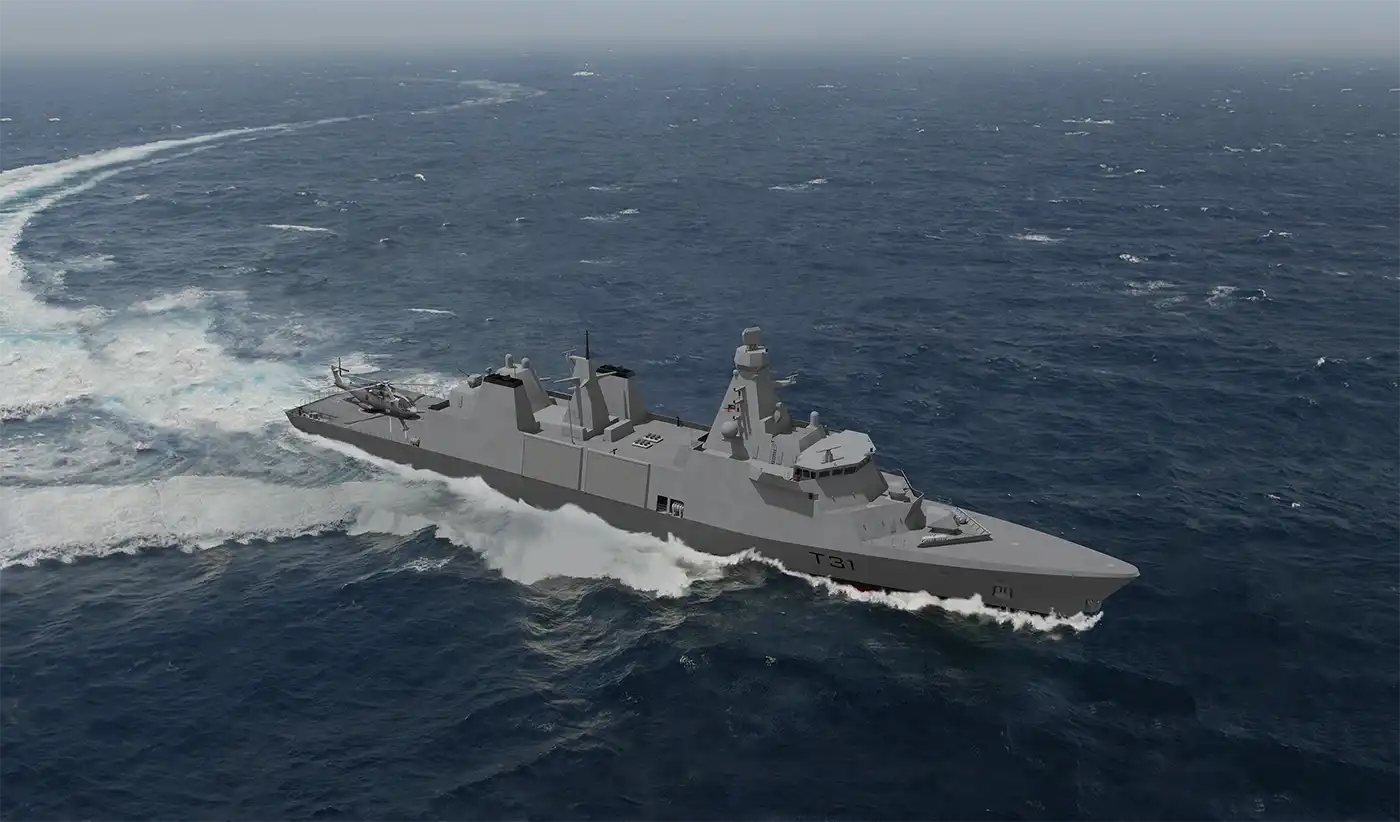
Babcock International has confirmed it will put forward its Arrowhead 140 general-purpose frigate, the design behind the Royal Navy’s Type 31 class, for the U.S. Navy’s international frigate effort. The British company has held preliminary talks with Pentagon officials and is expected to file an expression of interest before the end of October 2026. It is understood to be working with Huntington Ingalls Industries (HII), the largest U.S. military shipbuilder, on a proposal for license production in the United States.
The bid enters a competition reshaped by the Navy’s November 25, 2025, cancellation of the Constellation-class (FFG-62) program, a FREMM-derived frigate so heavily modified for U.S. service that it collapsed under cost and schedule overruns. The Navy has since turned to FF(X), a patrol frigate based on the Coast Guard’s Legend-class National Security Cutter that HII is building, whose initial configuration is not expected to include a vertical launch system (VLS). An August 13, 2026, presidential memorandum opened a parallel path for mature allied designs, and the Navy’s assessment is due November 12, 2026. Japan’s upgraded Mogami class, South Korea’s Chungnam class and Türkiye’s Istanbul class were already under study.
Arrowhead 140 Frigate Design: Hull, Propulsion, and Mission Systems
The Arrowhead 140 derives from Denmark’s Iver Huitfeldt-class frigates. Publicly available specifications indicate a length of 138.7 meters (455 feet), a beam of 19.8 meters (65 feet) and a baseline displacement of about 5,700 tonnes. Four MTU 20V 8000 M71 diesels of roughly 8 megawatts each, in a combined diesel and diesel (CODAD) arrangement, drive two shafts for speeds above 28 knots. The plant favors endurance, a fit for escort and presence missions.
The Royal Navy’s five Type 31s, under construction at Rosyth in Scotland, pair a Thales NS110 active electronically scanned array radar and Tacticos combat management system with Sea Ceptor air-defense missiles, a Bofors 57 mm Mk 3 main gun and two Bofors 40 mm Mk 4 mounts. The U.S. Navy and Coast Guard already field the 57 mm gun as the Mk 110, which would ease logistics and training. The Royal Navy also plans to add a 32-cell Mk 41 VLS, with no confirmed timeline.
Poland’s Project 106 Miecznik variant shows the hull’s growth margin, with a reported 76 mm Leonardo gun, a 32-cell Mk 41 VLS, eight Naval Strike Missiles and lightweight torpedo launchers at a maximum displacement near 7,700 tonnes. That margin is the core of the pitch to Washington. No U.S. configuration has been published, however, and the baseline Type 31 is not optimized for sustained anti-submarine warfare (ASW). Adding the sonar suite a convoy escort needs would be a substantial integration effort.
How Babcock and HII Could Transfer Arrowhead 140 Production Stateside
Babcock owns no American shipyard, which makes HII the linchpin of the offer. HII operates Newport News Shipbuilding in Virginia and Ingalls Shipbuilding in Mississippi, and the two firms already cooperate on submarines. Under a 2025 agreement, Babcock builds Virginia-class sections at Rosyth, while its Rosyth and Bristol sites produce missile-tube assemblies for General Dynamics Electric Boat’s Common Missile Compartment, fitted to Columbia-class and Dreadnought-class submarines.
The likely model is a transfer of design rights and intellectual property, with Babcock providing engineering support while a U.S. yard builds the ships. Babcock has done this before: Poland is building its three Miecznik frigates at Gdynia, where lead ship Wicher is already afloat, and Indonesia selected the design for local construction. The company is also marketing the Arrowhead 140 to Denmark, New Zealand and Chile.
Sir Nick Hine, head of Babcock’s marine business and a former Second Sea Lord, cited Babcock’s design and U.S. industrial ties, telling The Telegraph it “would be insane for us not to respond.”
HII’s role is unusual. Backing a second frigate design while it holds the FF(X) work raises capacity and priority questions across its yards, and neither company has disclosed the terms of a proposal.
Competing Against Mogami, Chungnam, and Istanbul Under Tight Design Rules
The August memorandum bars the Navy from imposing iterative design changes without the Secretary of War’s approval, aiming to avoid the delays and cost overruns that redesign brought to the Constellation. It also allows overseas construction through a national security waiver, but every ship after the first two must be built in the United States, and a foreign builder must build or acquire a U.S. shipyard and license its technology there.
Those rules favor designs already at sea. Mogami-class and Chungnam-class ships are in operational service, while HMS Venturer, the lead Type 31, has not yet entered service. Babcock’s Rosyth line is committed to the five Royal Navy hulls, and HMS Bulldog, the fourth, entered construction on February 24, 2026. That leaves little room to build an initial pair in Scotland and puts the weight on a rapid transfer to U.S. yards.
The field is widening. Fincantieri, designer of the Constellation, has signaled renewed interest, and Rheinmetall has unveiled its GMF 140 frigate with North America as its first target market.
Analysis: The Navy’s international frigate effort is shaping up as a contest of transferable production lines rather than hulls. The Arrowhead 140 offers what the memorandum rewards: a large modular hull with margin for U.S. weapons, a main gun already in the American inventory, and a technology transfer already under way at a Polish yard. Its weaknesses are equally concrete. It lacks the operational record two rivals already have, and closing its ASW gap could trigger the requirement creep the memorandum is designed to prevent. Teaming with HII adds the largest U.S. military shipbuilder but concentrates two frigate programs in one company when shipyard workforce and throughput, not design, are the binding constraints.
Babcock’s expression of interest is due by the end of October, and the Navy’s assessment by November 12, 2026. No contract has been awarded, the number of ships has not been disclosed, and no U.S. weapons or sensor fit has been defined. The next markers are whether HII confirms its role, whether the assessment narrows the field, and whether Congress funds a foreign-design frigate line alongside FF(X).